The 15-Month Wait-Out Is Gone — But the Six-Month Clock Is the Rule That Now Matters

HDB lifted the 15-month wait-out period for private property owners on 28 July 2026; the conditions left behind, and today's mortgage rates, tell you far more about who benefits.
On 28 July 2026, the Ministry of National Development and HDB removed the 15-month wait-out period for private residential property owners buying a non-subsidised HDB resale flat, with immediate effect. The headline is straightforward. The fine print is where the money is.
A brake lifted after the car had already slowed
The wait-out rule was introduced on 30 September 2022, in a year when HDB resale prices rose 10.4% — on top of 12.7% in 2021. It came bundled with a cut in the HDB loan-to-value limit to 80% and a 3% interest rate floor on HDB loans. The LTV limit was tightened again to 75% in August 2024.
By the time it was scrapped, the market it was designed to cool no longer existed. Resale price growth had decelerated to 2.9% in 2025, then turned negative: -0.1% in 1Q2026 and -0.3% in 2Q2026, following five straight quarters of flat or slowing growth from 4Q2024 to 4Q2025.
Volumes told the same story. Just 6,396 resale flats changed hands in 2Q2026, down 9.9% year on year and the weakest second quarter since 2Q2020, when circuit-breaker restrictions held transactions to 3,426.
Minister for National Development Chee Hong Tat had flagged the exit as early as May 2025, conditional on continued moderation. The government kept its word. That is worth noting in a policy environment where cooling measures often outlive their purpose.
What actually changed — and what didn't
Read the conditions carefully, because they define the entire population of beneficiaries. The exemption applies to private property owners and ex-owners, of any age, buying a non-subsidised resale flat of any size, and crucially, without taking an HDB housing loan. An HDB Flat Eligibility letter is still required.
Three things did not change:
- The 30-month wait-out period still applies to anyone buying a subsidised flat, buying an Executive Condominium directly from a developer, or taking an HDB housing loan.
- Private properties — in Singapore or overseas — must be disposed of within six months of completing the resale purchase.
- Minimum occupation period rules on the flat itself are untouched, so there is no new flipping route into public housing.
Previously, only Singapore Citizens aged 55 and above were exempt, and only if they moved into a four-room or smaller non-subsidised flat. The age ceiling and the size ceiling are both gone. That single change reshapes the buyer pool more than the removal of the waiting period itself.
The "no HDB loan" condition has quietly lost its teeth
On paper, requiring buyers to forgo an HDB loan looks like a meaningful filter — a way of reserving concessionary public financing for households who need it. In mid-2026, it is close to costless.
HDB loans carry an interest rate floor of 3%. Meanwhile, the three-month compounded SORA has fallen from above 3.0% to roughly 1.00%–1.17%, and fixed-rate home loans have dropped from about 3.1% in early 2025 to 1.4%–1.8% this year. A bank loan is now the cheaper option outright.
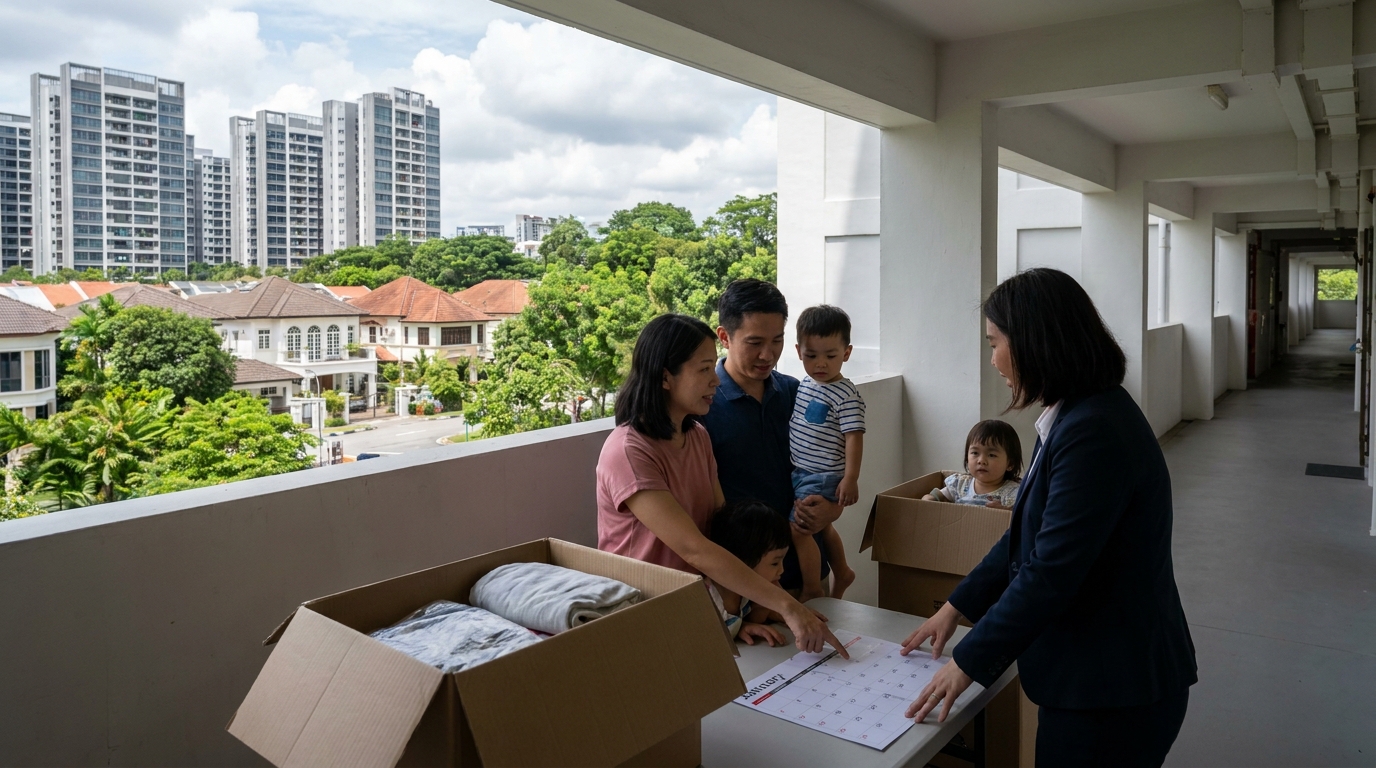
A condition designed as a filter has become a formality. Right now, giving up the HDB loan is not a sacrifice — it is an upgrade.
So the policy's remaining guardrail is doing less work than its drafting implies. It screens out households who genuinely need HDB financing — the very people least likely to be sitting on private property — while waving through the cash-rich buyers the 2022 measure was aimed at. If rates normalise upward, the condition regains its bite. Until then, treat it as administrative.
The supply wave and the demand wave are not the same flats
The official reassurance is supply. HDB expects 13,500 flats to reach MOP in 2026, 15,000 in 2027 and 19,500 in 2028 — roughly 48,000 units over three years, up sharply from 8,000 in 2025. The June 2026 exercise added about 6,900 BTO units across Ang Mo Kio, Bishan, Bukit Merah, Sembawang and Woodlands, absorbing first-timer demand.
That is a real buffer for the market as a whole. It is a weaker buffer for the specific stock downgraders want.
Look at what the wait-out rule suppressed. Five-room resale transactions fell from 6,951 units in 2022 to 5,966 in 2025. Executive and multi-generational flats slid from 1,946 to 1,539 over the same period. Those are the segments private downgraders buy — larger layouts, mature estates, central locations.
MOP supply is newer BTO stock. It replenishes three- and four-room inventory and adds five-room units in the estates where those projects were built. It does not create executive maisonettes, and it does not manufacture more of the older, larger flats in established central estates that command a premium. Aggregate supply and segment-level supply are different arguments, and officials have leaned on the first to answer questions about the second.
The removal is unlikely to move the overall Resale Price Index much. The pressure point is narrower: 5-room, Executive Apartment and Executive Maisonette units in mature and central estates, where the supply pipeline offers the least relief.
The million-dollar segment was already running — with the brake on
Here is the number that should temper the "market has cooled" framing. In 2Q2026, HDB resale flats transacting at S$1 million or more hit a record 491 units, up 19.5% quarter on quarter and accounting for 7.7% of all resale volume.
That record was set in the same quarter the index fell 0.3% and volumes hit a six-year low for a second quarter — and while the wait-out period was still in force. The top end of the resale market has been decoupling from the average for some time.
Now add buyers who have just liquidated a private property, who must redeploy capital within six months, and who can borrow at under 2%. Analysts across the market expect precisely this: broadly stable prices, with concentrated upside in larger and prime-location flats, and firmer cash-over-valuation where private sale equity meets thin listings.
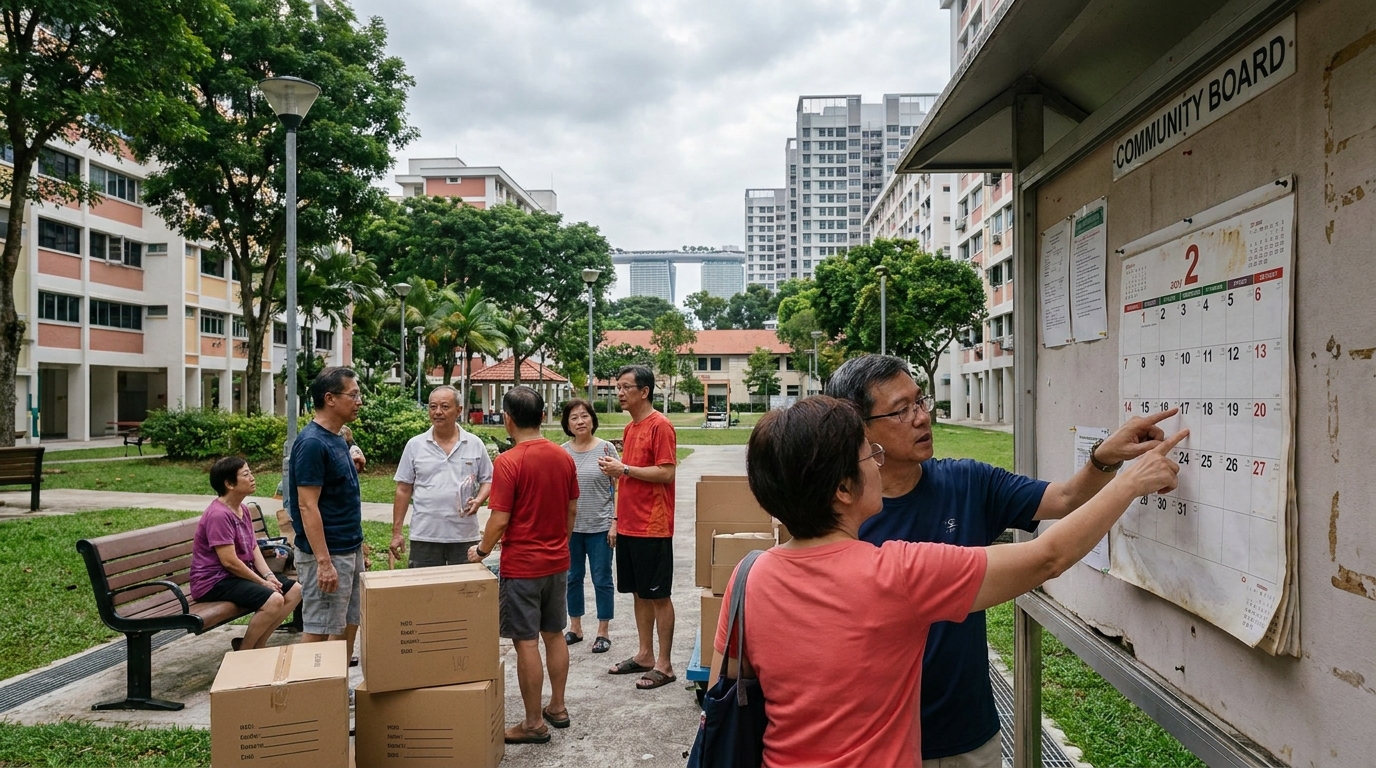
The distributional question follows. A first-time family stretching for a five-room flat in a mature estate now bids against a household with realised private property gains. Supply may keep the index flat while making the most contested slice of the market harder to enter.
The 75% who were told no
Set the market mechanics aside for a moment, because the fairness case for removal is the strongest one. As at 31 March 2025, HDB had processed about 5,500 appeals for waivers of the 15-month rule. Roughly 25% were approved.
That means around 4,100 households were told to wait — divorce, illness, business reversals, ageing parents, a job loss, whatever sat behind the application. Waiting meant 15 months of rent, or 15 months in a relative's spare room, while their sale proceeds sat idle.
A blunt instrument is defensible when the market is rising more than 10% a year. It is much harder to defend when prices are falling and the discretionary appeals process rejects three in four applicants. Removing the rule restores something plain: households can sell one home and buy the next without an engineered gap in between.
Six months is the new wait-out period
The binding constraint has simply moved. It now sits on the other side of the transaction: dispose of the private property within six months of completing the flat purchase, and that includes overseas holdings.
Sequencing matters. Buy the flat first and you are on a clock — negotiating the sale of a condominium, or an overseas asset with its own conveyancing timeline, under a deadline that a buyer can smell. Sell first and you avoid the clock, but you carry the deposit and financing for the flat without knowing what the resale market looks like when you find one.
Anyone contemplating a move from private property to an HDB resale flat should therefore be clear on four things before signing anything: that they are buying non-subsidised stock, that they are not using an HDB loan, that the HFE letter is in hand, and that the six-month disposal timeline is realistic for every property they hold — here and abroad.
What to watch in the next two quarters
The test is narrow and measurable. Watch the 3Q2026 and 4Q2026 Resale Price Index, but do not stop at the headline number — the interesting data is in the segment splits.
- Five-room and executive flat volumes: do they recover toward the 2022 levels of 6,951 and 1,946 units respectively?
- Million-dollar transactions: does the 491-unit record in 2Q2026 hold as a peak, or become a floor?
- The MOP inflow: whether 13,500 units in 2026 actually lands where returning downgraders are bidding.
- Rates: if bank loans drift back toward the 3% HDB floor, the "no HDB loan" condition starts filtering again.
The government has framed this as a measure that served its purpose and outlived its need. On the aggregate numbers, that reading holds. But cooling measures do not just cool — they reroute demand, and removing one reroutes it back. This one is coming back into the segment with the least new supply, at the cheapest borrowing cost in three years, and into a market that was already setting million-dollar records while the restriction was still in place.