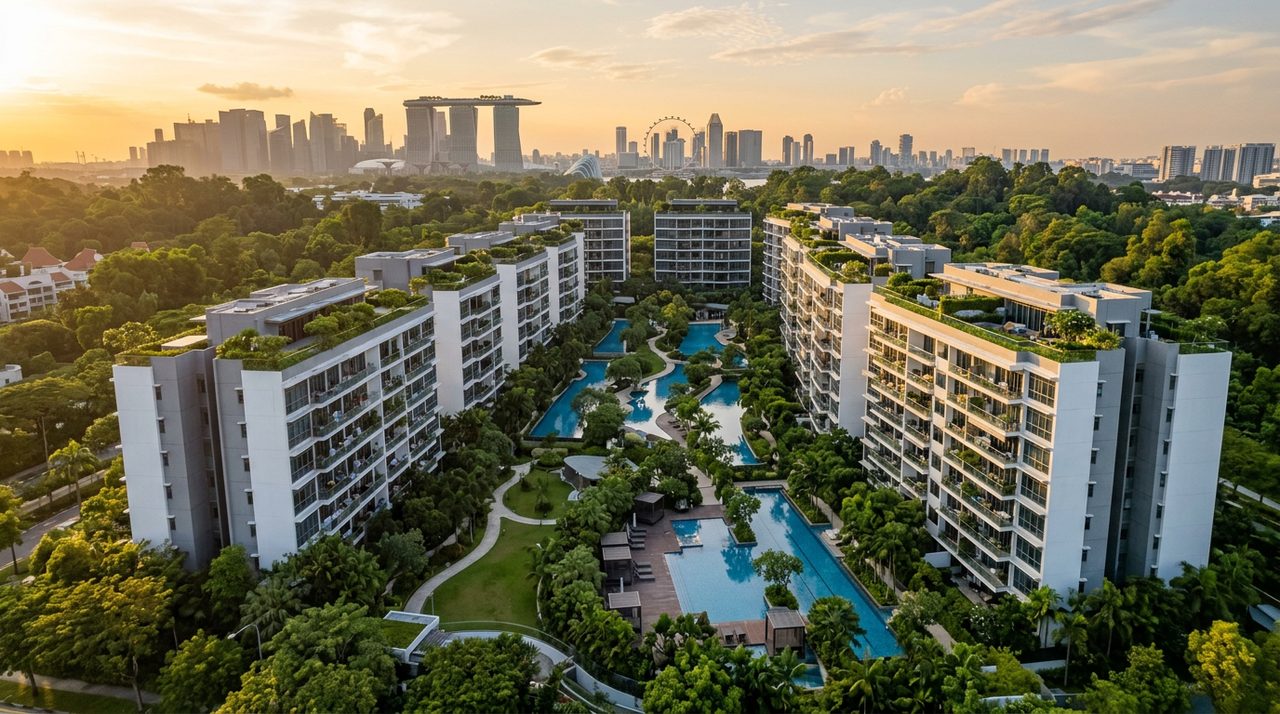
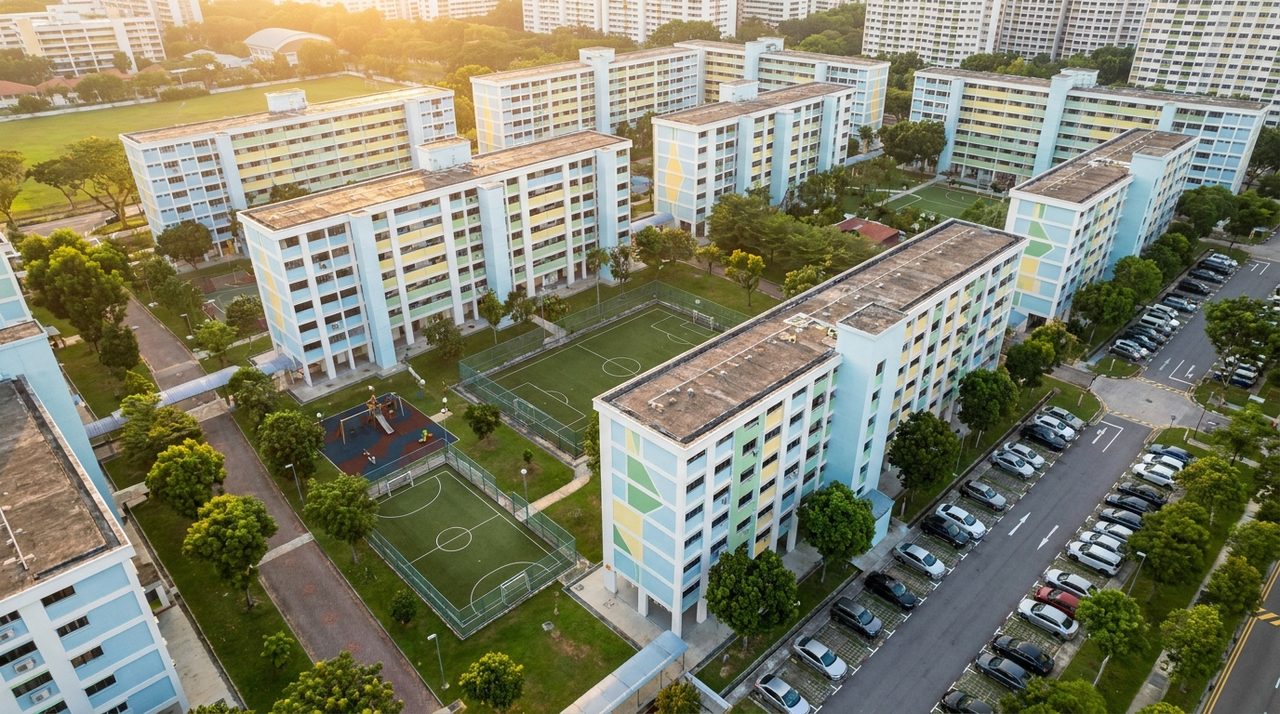
A flat that has gone up in value for four years straight isn't just a home — it's money you can use. The real question for most owners in 2026 is simple: how much of that gain is actually yours to move, and how far does it get you into a condo?
1 in 7
suburban condo buyers in early 2026 came from an HDB flat
~$1.6M
the going price for a resale condo in 2026
~50%
extra you pay for a brand-new condo over a resale one
Where you stand
Moving from an HDB flat to a condo used to be a big jump only high earners made. Not any more. Flat prices have quietly climbed, and a large share of condo buyers today start exactly where you are — with a flat, some CPF, and a decision to make. This guide walks through that decision using public URA and HDB data, in plain numbers.
You’ve seen the starting point — now build the decision
So how far does your money actually go?
You’ve seen that the price gap is real. The full guide shows what your cash, loan and timing can realistically buy — and what could derail the move.
The full cash-to-budget maths.
Resale vs new, plus the loan and ABSD rules.
A live budget calculator for your own numbers.
Open the full guide
Enter your details for instant access — about 30 seconds.
You’re in.
The rest of the guide and the calculator are open below.
Instant accessNo account requiredRelevant follow-up only
Your flat is probably worth more than you think
The starting point — your HDB flat
HDB resale prices have risen four years in a row, and million-dollar flats are no longer rare. In 2025, 1,588 flats sold for more than $1 million — up from 1,027 the year before. The first three months of 2026 alone added more than 400.
HDB flats sold above $1 million
Once rare, now normal. 2025 was well ahead of 2024, and early 2026 is already past 400.
HDB resale transactions above $1M, 2024–Q1 2026.
It all starts with one number: what your flat would sell for today, minus what you still owe on it. That's your usable cash.
New condo or resale? Mind the gap
The gap between a brand-new condo and a similar resale one has grown fast. In 2019 the difference was small. By 2026, a new launch costs about half as much again for much the same thing.
New launch vs resale condo — median quantum
The price difference has widened from about 16% in 2019 to roughly 50% in 2026.
New launchResale
URA · median non-landed private (excl. EC) · as of Q1 2026
For most people upgrading today, resale gives you more for your money: more space per dollar, a home you can move into (or rent out) straight away, and years of sale records so the price — and your eventual sale — are easier to judge. A brand-new condo still makes sense in some cases: a fresh 99-year lease, or paying in stages while you sell your flat.
More people are making this move than you’d think
This isn’t a rare move. About 1 in 7 condo buyers in the suburbs came straight from an HDB flat in early 2026. And unlike a flat, a condo on a long or freehold lease doesn’t slowly lose value to a ticking lease clock.
OCR condo vs 4-room HDB — median quantum
Both have risen since 2010. The condo line has climbed faster, and carries no lease countdown.
OCR 3-bedroom condo4-room HDB
URA & HDB · median · as of Q1 2026
What your flat’s equity actually buys
Start with the sale. Here’s how it looks on a typical 5-room flat:
What the sale frees up — 5-room example
Item
Amount
Sale price
$780K
Loan still owed
–$200K
Selling & legal costs (~1% + $3K)
–$11K
Cash left in hand
$569K
mastplan
On top of that, the CPF you used to buy the flat — plus the interest you’d have earned — goes back into your CPF account when you sell. It isn’t gone. It joins your cash to become the pool you buy your next home with.
Around $569K in cash and CPF, with a normal income, can support a budget of roughly $1.8M — well within reach of a resale condo.
Why a bank loan usually lets you borrow more
The single biggest change when you move to private is how you’re allowed to borrow. An HDB loan is capped by the MSR — your home loan can’t exceed 30% of income. A bank loan uses the TDSR instead: up to 55% of income for all your debt. For most households that lifts the ceiling noticeably.
HDB loan vs bank loan — the rules that set your ceiling
HDB loan
Bank loan
Income cap
MSR 30%
TDSR 55%
Max borrowing
Up to 75% of price
Up to 75% of price
Loan tenure
Up to 25 years
Up to 30 years
Rate you’re assessed at
~2.6% (pegged)
stress-tested at 4%
Assessed to age
65
65 for full amount
mastplan
Indicative rules as at 2026. A longer tenure and the 55% cap usually raise the ceiling — but the bank still stress-tests you at 4%, so leave headroom for higher rates.
The trade-off: a bank rate moves with the market, and you’re tested at 4% even if the live rate is lower. Borrow to the very top of the 55% cap and a rate rise can squeeze you — size the loan with room to spare, not to the maximum.
The same budget buys less space each year
There’s a catch worth seeing. At a $1.5M budget, a brand-new condo gives you far less floor space than it used to. This is exactly why resale — where you’re paying for real, proven space — stretches further.
What $1.5M buys — median condo floor space (sq ft)
A fixed $1.5M budget bought about 1,446 sq ft of median condo space in 2010, and roughly 680 sq ft today.
URA · median psf basis · as of Q1 2026
Resale isn’t automatically right — a new launch buys you a fresh 99-year lease, the latest layouts, and staged payments while you sell. But for the same money, resale usually wins on space, location and a track record you can actually price against.
The full cost of the move — beyond the deposit
The deposit isn’t the whole bill. Before you commit, map every upfront cost against the cash and CPF you’re freeing up. On a $1.6M resale condo, roughly:
Upfront costs on a $1.6M resale condo
Cost
Rough amount
Deposit (25% — cash + CPF)
$400K
Buyer’s Stamp Duty
~$50K
Legal (buy + sell)
~$6K
Agent on the flat sale (~1% + GST)
~$8K
Renovation
$30–80K
Upfront, before the loan
~$470K + reno
mastplan
Illustrative, on a $1.6M purchase funded partly by a $780K flat sale. Much of the deposit can come from CPF; Buyer’s Stamp Duty and fees usually need cash.
This is why the sale proceeds and returned CPF matter so much: together they have to cover the deposit, the stamp duty and the fees, with enough left for renovation and a cash buffer. The calculator further down sizes this for your own numbers.
Sell first or buy first? The $320K question
The order you sell and buy in is the most expensive decision in the whole move, because of one tax: ABSD. Buy your condo before you’ve sold your flat and, for that moment, you own two homes.
Sell first, then buyYou buy the condo as your only home — no ABSD. The cost is logistics: you may need interim housing (HDB allows up to ~3 months to stay on after completion) and could move twice.
Buy first, then sellNo interim housing and no double move — but you pay ABSD upfront (20% for a citizen’s second home). A married couple with a citizen can reclaim it only by selling the flat within a tight window; miss it and the money is gone.
ABSD on a $1.6M condo is about $320K. Getting the sequence wrong is the single costliest mistake in an upgrade — plan the order before you fall in love with a unit.
If you buy: two things that actually move value
Not every condo holds or grows its value the same way. Two factors do most of the work:
Project size and liquidityLarger developments transact often, so pricing is clearer and your eventual exit is easier than in a tiny, rarely-traded block where one odd sale sets the ‘market’.
Transformation catalystsAreas with confirmed government land sales, new MRT lines or URA Master Plan upgrades tend to re-rate as those plans complete — you’re buying the ‘before’, not the ‘after’.
Four things to check before you commit
Before you fall for a unit, four things decide how easily it loans and resells:
How much lease is leftBanks generally want the lease to cover the youngest buyer to age 95, and CPF use tightens on shorter leases. A short lease means fewer future buyers and harder financing.
Your real borrowing limitThe 55% TDSR cap usually lets you borrow more than the HDB rules did — but get the actual figure for your income and existing debts before you shortlist.
The order you sell and buySell first and you avoid ABSD entirely. If you must buy first, budget the ABSD and know the remission window cold.
Loan length vs your ageA longer tenure lowers the monthly repayment but raises total interest, and tenure is capped by your age — the right balance depends on your plan.
What quietly costs upgraders
None of these mean “don’t upgrade.” They mean go in with eyes open and price them in:
Lease decay on an older condoA 99-year unit past its middle age loses buyers and loan access as the lease shortens. Freehold or a long remaining lease protects your exit.
Borrowing to the very topSizing the loan to the 55% cap leaves nothing for a rate rise. The 4% stress test exists for a reason — keep a buffer.
Paying the new-launch premium blindA new launch runs about 50% dearer than comparable resale. Sometimes worth it — but only if you’ve weighed what the same money buys second-hand.
Under-counting holding costsA bigger private home means maintenance fees, higher property tax and utilities — recurring costs a flat never had.
From flat to condo, step by step
1
Value your flatFind out what it would sell for today — that anchors everything else.
2
Sell and clear the loanNet proceeds plus returned CPF become your cash in hand.
3
Confirm your budgetYour cash and CPF, plus how much a bank will lend under TDSR.
4
Sequence the moveSell first to avoid ABSD; line up interim housing and the CPF timing.
5
Buy the resale condoMore space, ready to move in, a long lease and a clearer exit.
In our example, about $569K in hand supports a home around the $1.6M resale mark — a long-lease place with no lease clock ticking against it. It’s not a promise; it’s a path you can check against your own numbers.
The bottom line
Your usable cash — sale price minus loan and costs — sets your budget, not the headline price.
In 2026 the value is in resale: a new condo costs about 50% more for much the same thing.
A condo loan uses the 55% income cap, not the HDB 30% one — you can often borrow more than you’d expect.
Sell first, buy second to skip the extra ABSD tax. The order is worth more than most people realise.
mastplan
Where it can lead — a resale condo
Try your own numbers
You’ve seen how the pieces fit. Put in your figures and see the budget your cash and income actually support.
Condo budget calculator
Where does your budget land?
Four numbers in, a rough budget out. It uses the same loan, income and stamp-duty rules a bank would, so you can sanity-check the move before you talk to anyone.
Your rough condo budget
—
A starting range — before the specific unit, floor and condition.
Cash + CPF to use—
Roughly how much a bank may lend—
Rough estimate only. Assumes selling costs of about 1% + $3,000, a loan of up to 75% of the price, and your deposit and stamp duty paid from your own funds. The loan is capped at 55% of your income over 30 years (tested at a 4% rate, no other debts). Assumes you sell before you buy, so no extra ABSD. This is not financial advice or a loan offer.
The plan, not the theory
Get a personal HDB-to-condo plan.
A read on your cash, a realistic budget, and a shortlist of resale condos that fit — plus the right order to sell and buy so you skip the extra ABSD tax. No obligation; you’ll leave with a clear next step either way.
Your cashWhat you can affordResale shortlistResale vs newSell-then-buy orderTimeline
Got it.
We’ll be in touch shortly with your next step.
About the figuresThe numbers come from public URA and HDB data (2025–Q1 2026) and are rough as at publication and may change. Prices are medians, and the worked examples are just examples. Estimates aren’t valuations, offers, or financial advice. Please check with a professional before making any property decision. See our full Disclaimer.
Create your account or sign in
One account unlocks every gated resource. New members create an account here; returning members use the same form to sign in.