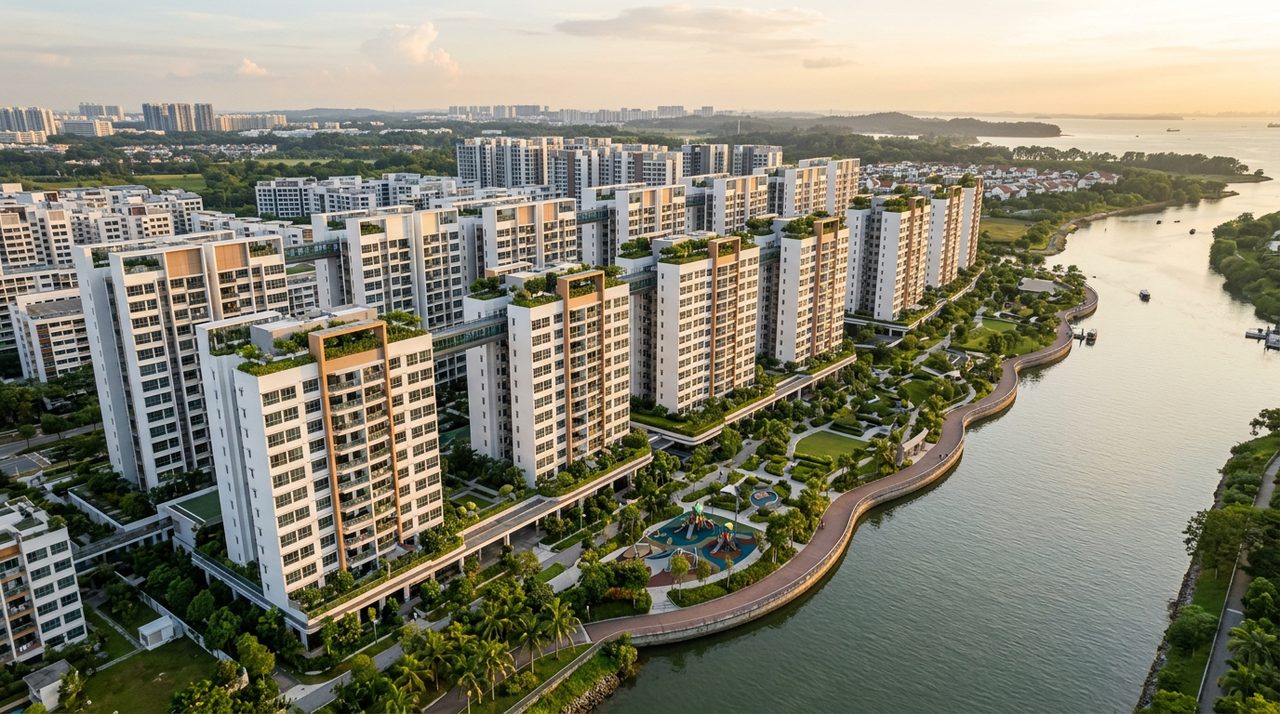
In 2026 one of the biggest waves of HDB flats in years crosses the five-year mark and becomes free to sell. If you own in Punggol, Northshore, Queenstown or Tampines, the real question isn’t whether you can sell — it’s whether you should sell, hold, or use the moment to move up.
13,480
HDB flats reach MOP in 2026 — about double 2025
~19,600
new BTO flats planned for 2026, adding to supply
No SSD
your flat is long past the 4-year seller’s-stamp-duty window
What reaching MOP actually means
MOP is the Minimum Occupation Period — the five years you must live in a flat before you can sell it on the open market or rent out the whole unit. Flats from the 2016–2017 BTO launches cross that line in 2026, and a lot of them sit in Punggol, Northshore, Queenstown (Dawson) and Tampines.
Two clocks matter, and you’ve cleared both. You’re past the five-year MOP, so you can sell. And because you’ve owned for more than four years, you’re past the Seller’s Stamp Duty window too — so selling now attracts no SSD.
You’ve seen the starting point — now build the decision
So which move — sell, hold, or upgrade — fits you?
You’ve seen the timing and the market gap. The full guide shows which option fits your finances, housing timeline and next move.
Sell, hold or upgrade — the trade-offs, side by side.
The transition rules — cash, CPF, ABSD and the timeline.
A live budget calculator for your own numbers.
Open the full guide
Enter your details for instant access — about 30 seconds.
You’re in.
The rest of the guide and the calculator are open below.
Instant accessNo account requiredRelevant follow-up only
Why 2026 is a crowded year to sell
The same wave that frees you to sell also puts more flats on the market at once — and new launches are competing for the same buyers. More supply usually means you have to price sharply and market well, rather than name your number.
HDB flats reaching MOP
2026’s cohort is about twice the size of 2025’s — the most eligible-to-sell flats in years, on top of roughly 19,600 new BTO flats planned for the year.
Over the last 15 years, private property has pulled well ahead of HDB. That’s the whole reason the sell-and-upgrade question is even on the table — the longer you sit purely in HDB, the wider that gap tends to grow.
Median price per square foot — HDB vs private
Since 2010, HDB is up about 68%; private resale about 116% and new launches about 100%. Private has simply climbed faster.
New launchPrivate resaleHDB median
Indicative median psf, 2010–2026.
Three ways to play it
There’s no single right answer — it depends on your income, your plans and your appetite for a mortgage. The three real options:
Sell and right-sizeCash out the gain, move to a smaller or cheaper flat, and lower your monthly commitment. Simplest, lowest risk — but you step off the private-property ladder.
Hold and rent it outKeep the flat and rent the whole unit now that you’re past MOP. You earn yield and keep the asset — but your one subsidised flat stays tied up, and you still live somewhere.
Sell and upgradeUse your flat’s equity as the deposit on a private home, financed with a bank loan. The biggest upside if prices keep diverging — and the biggest commitment and risk.
The rest of this guide works through the third option in detail — because it’s the one with the most moving parts, and the one worth getting right.
Why property behaves differently from savings
Staying put is simple: your flat is your main asset, worth roughly what you could sell or right-size it for. Upgrading is different because of one thing — leverage. You control a large asset while funding only a fraction of it yourself.
Where your money works hardest
Asset
You fund
Gains apply to
Property
~25%
the full value
Shares
100%
your capital only
Fixed income
100%
your capital only
mastplan
With ~25% down and a 75% loan, appreciation on the whole property accrues to you — not just on the cash you put in.
Leverage cuts both ways. It magnifies gains when prices rise — and losses, holding costs and interest when they don’t. The upgrade only works if the numbers hold with room to spare.
How that can compound over 30 years
Here’s the mechanism behind the HDB-versus-private gap, worked forward. As a leveraged property appreciates, two things happen at once: your equity grows on the full value, and the loan shrinks as you pay it down. Over a full loan tenure, the equity ends up close to the asset value.
How equity can build over 30 years — an illustration
A model, not a forecast: it assumes steady progression and ~2% growth from 2025. As the asset appreciates, your equity grows and the mortgage shrinks.
Asset valueEquityMortgage
Illustrative model — assumes ~2% growth and continued progression.
The jumps aren’t magic — they assume you keep progressing (a second property along the way, covered next). It won’t look exactly like this for anyone. The point is the shape: leverage plus time turns a modest deposit into most of the asset value.
Two worked examples
If you upgrade — a resale condo
Your flat’s usable cash — sale price minus the outstanding loan and selling costs, plus the CPF that returns to your account — becomes the deposit. How far it reaches depends mostly on income, because a bank caps your loan at 55% of income (TDSR). Two illustrative households:
Household A — mid-30s, ~$11K/monthBought a 4-room flat for ~$250K in 2017. After MOP, their numbers support up to about $1.72M — roughly a $4,000/month mortgage, of which around $2,000 is covered by CPF.
Household B — late-30s, ~$22K/monthA 5-room flat bought around $400K, two children. Their income supports up to about $3M — comfortably into resale-condo territory.
Indicative next-home budget by household income
The same idea as a picture. Your own figure depends on your cash, CPF and existing loan.
Illustrative only — worked on 75% LTV and 55% TDSR.
The two-property approach — and its real cost
The bigger plays keep two homes: one to live in, one an income property a tenant helps pay for. A worked shape of it:
One to live in (~$1.4M)Your own home, financed normally.
One to rent out (~$1.57M)An income property — combined, the two start around $2.97M.
The tenant carries most of itRent of about $4,000/month covers the bulk of the investment loan; you top up roughly $650, for a ~$4,650 total monthly instalment.
Held four yearsOn the same illustrative growth, the pair could be worth about $3.4M+ — the compounding you saw above.
The honest catch: a second property attracts ABSD (20% for a citizen’s second home at the time of writing), plus vacancy and interest-rate risk. It only works if that cost is built in from day one.
If you buy: two things that actually move value
Not every private home appreciates the same way. Two factors do most of the work:
Project size and liquidityLarger developments transact often, so pricing is clearer and your eventual exit is easier than in a tiny boutique block where one odd sale sets the ‘market’.
Transformation catalystsAreas with confirmed government land sales, new MRT lines or URA Master Plan upgrades tend to re-rate as those plans complete — you’re buying the ‘before’.
The move, step by step
1
Value the flat and check your numbersWhat it would sell for today, minus the loan and costs — that’s your cash in hand.
2
Line up your financingConfirm your loan ceiling (up to 75% of price) and that your income clears TDSR at a stressed rate.
3
Sequence sell vs buySell first and you buy as a first home — no extra ABSD. Buy first and you trigger ABSD plus bridging. The order changes the cost a lot.
4
Handle the gapsYou’ll need about 10% upfront in cash, CPF takes 3–4 weeks to return after the sale, HDB allows up to 3 months to stay on, and reno runs ~2 months.
Most of the stress in an upgrade is timing, not affordability. Get the sequence right and the ABSD, the cash gap and the double-move mostly take care of themselves.
Try your own numbers
You’ve seen the paths. Put in your figures and see the budget your flat and income actually support.
Next-home budget calculator
Where does your budget land?
Four numbers in, a rough budget out. It uses the same loan, income and stamp-duty rules a bank would, so you can sanity-check the move before you talk to anyone.
Your rough next-home budget
—
A starting range — before the specific unit, floor and condition.
Cash + CPF to use—
Roughly how much a bank may lend—
Rough estimate only. Assumes selling costs of about 1% + $3,000, a loan of up to 75% of the price, and your deposit and stamp duty paid from your own funds. The loan is capped at 55% of your income over 30 years (tested at a 4% rate, no other debts). Assumes you sell before you buy, so no extra ABSD. This is not financial advice or a loan offer.
The plan, not the theory
Get a personal MOP plan.
A read on your flat’s value, a realistic next-home budget, and a straight answer on whether sell, hold or upgrade fits your situation — plus the right order to sell and buy so you skip the ABSD. No obligation; you’ll leave with a clear next step either way.
Flat valuationSell / hold / upgradeWhat you can affordSequencingABSDTimeline
Got it.
We’ll be in touch shortly with your next step.
About the figuresThe 13,480 MOP figure and the 4-year Seller’s Stamp Duty holding period are drawn from public reporting and MAS/IRAS rules (2025–2026). Price and supply figures are indicative public data as at publication and may change; prices are medians and the worked examples are illustrative. Estimates aren’t valuations, offers, or financial advice. Please check with a professional before making any property decision. See our full Disclaimer.
Create your account or sign in
One account unlocks every gated resource. New members create an account here; returning members use the same form to sign in.