VERS at 65%: Singapore Just Set a Consent Threshold for Private En Bloc. The Hard Part for Old HDB Flats Is the Price.
The Land Titles (Strata) (Amendment) Bill's 65% threshold for 60-year-old developments is being read as a template for VERS — but a vote is only as valuable as the offer it accepts.
The gist
- The tabled Bill cuts collective sale consent to 65% for private developments aged 60 years and above.
- Thresholds tier by age: 70% for 40-59 years, 80% for 10-39 years, 90% under a decade.
- VERS is a state buyback priced on Bala's curve, with no tender, bidder or competitive offer.
- Safeguards were tightened too: requisition bar rises to 35% and the signature window shrinks to six months.
On 4 August 2026, the Ministry of Law tabled the Land Titles (Strata) (Amendment) Bill, cutting the collective sale consent threshold to 65% for private developments aged 60 years and above. Within a fortnight, the number had jumped species — analysts and commentators began asking whether the same 65% should govern the Voluntary Early Redevelopment Scheme for ageing HDB flats.
A number borrowed from a market that works differently
The Bill's tiering is straightforward. 65% for developments 60 years and older, 70% for those aged 40 to 59, 80% for 10 to 39 years, and 90% for anything under a decade. The logic is that older buildings should be easier to retire.
Writing in The Business Times on 17 August 2026, columnist Leslie Yee asked the obvious follow-up question: could 65% work for VERS too? His argument is sound on its own terms — insufficient redevelopment hurts the economy and society, and old public housing precincts are where the ageing stock actually sits.
But borrowing the number without borrowing the machinery around it is where the reasoning gets thin. In a private en bloc, consent is the last gate before a competitive tender. Owners vote to sell into a market that then tells them what the site is worth. Under VERS, there is no tender and no bidder. There is one counterparty — the state — and it sets the terms before the vote, not after.
VERS is a buyback, not a sale
This distinction does most of the work in the debate, and it is routinely glossed over. An HDB flat owner holds a lease, not the land. A VERS vote is not an invitation for developers to compete; it is a decision on whether to accept a government offer to end that lease early.
The compensation basis has already been signalled. VERS payouts are to reflect the depreciated value of the remaining lease, in line with the Singapore Land Authority's Bala's curve. That is a formula, not a bid.
Compare that with the scheme it replaces. Under the Selective En bloc Redevelopment Scheme, owners received market value plus a 20% premium and a guaranteed subsidised replacement flat nearby, with no vote required at all — SERS was compulsory acquisition. The Ministry of National Development has confirmed there are no further SERS exercises planned. Future public estate renewal runs through VERS alone.
Lowering the consent threshold changes who can block a VERS exercise. It does not change what the exercise pays. The second question decides whether the first one ever matters.
What 65% genuinely fixes
Give the proposal its due. Holdout paralysis in large precincts is a real and predictable failure mode, and it has nothing to do with bad faith.

HDB precincts are not 200-unit condominiums. They are multi-block estates running into the hundreds or thousands of households, with uncontactable owners, estates caught in probate, and elderly residents who will not engage with paperwork at all. In the private market, an 80% bar has repeatedly stalled older developments for exactly these administrative reasons rather than any genuine opposition.
An 80% bar in a thousand-unit precinct does not measure opposition. It measures how many letters came back unopened.
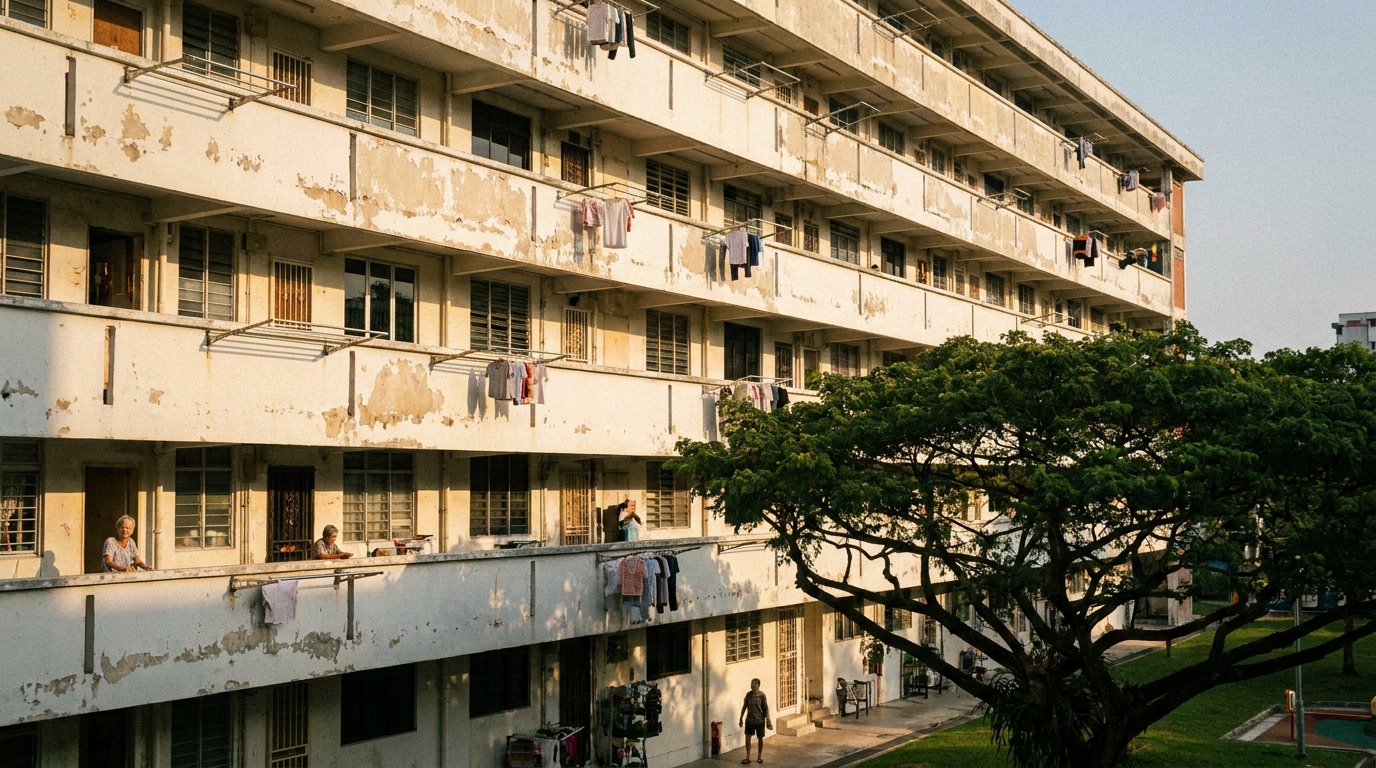
A 65% threshold means a minority of roughly a third cannot freeze an entire estate's future. Set against a lease cliff — flats built through the 1970s and 1980s in Queenstown, Toa Payoh, Marine Parade, Ang Mo Kio and Bedok are now between 45 and 58 years old — a workable threshold is the difference between staggered renewal over decades and a mass expiry problem in the 2060s and 2070s.
The scale asymmetry between the two housing markets makes the point. Government data puts around 20,000 private non-landed units at more than 40 years old, against over 360,000 units under 40. The private ageing problem is a rounding error next to the public one. Whatever Parliament decides for strata titles is a rehearsal; VERS is the main event.
The safeguards did not travel with the number
The Bill is not a one-way loosening. To offset lower finishing thresholds, MinLaw tightened the start line: the requisition bar to convene a collective sale general meeting rises from 20% to 35%, the signature-gathering window shrinks from 12 months to six, and repeat attempts after a failure face a tighter restriction period. Objecting owners' additional payouts are capped at 0.5% of sale proceeds or S$2,000, whichever is higher.
Read that package properly and it is a trade: easier to finish, harder to start, and less room to litigate on the way out. Every one of those safeguards assumes a private market with a sale committee, a marketing agent, a tender and a Strata Titles Board.
None of it maps cleanly onto VERS. There is no requisition to convene, because HDB selects the precinct. There is no signature window, because polling is run by the state. There is no objector payout, because there are no sale proceeds to apportion — only a compensation formula. Importing the 65% and leaving the counterweights behind would be the worst version of this reform.
The affordability gap nobody has closed
Here is the scenario that should concern policymakers more than any voting arithmetic. A precinct votes yes at 65%. Owners with roughly 30 years of lease left receive compensation pegged to that depreciated value. They then go shopping for replacement housing in the same mature town, at 2030s resale prices.
The financing rails are not generous. HDB loan LTV is capped at 75%, aligned with commercial bank limits. The 30% Mortgage Servicing Ratio applies. MAS stress-testing rules apply. Moderating SORA through 2025 and 2026 has taken some pressure off borrowing costs, but rate relief does not close a valuation gap — and a household in its sixties has limited runway to service anything new regardless.
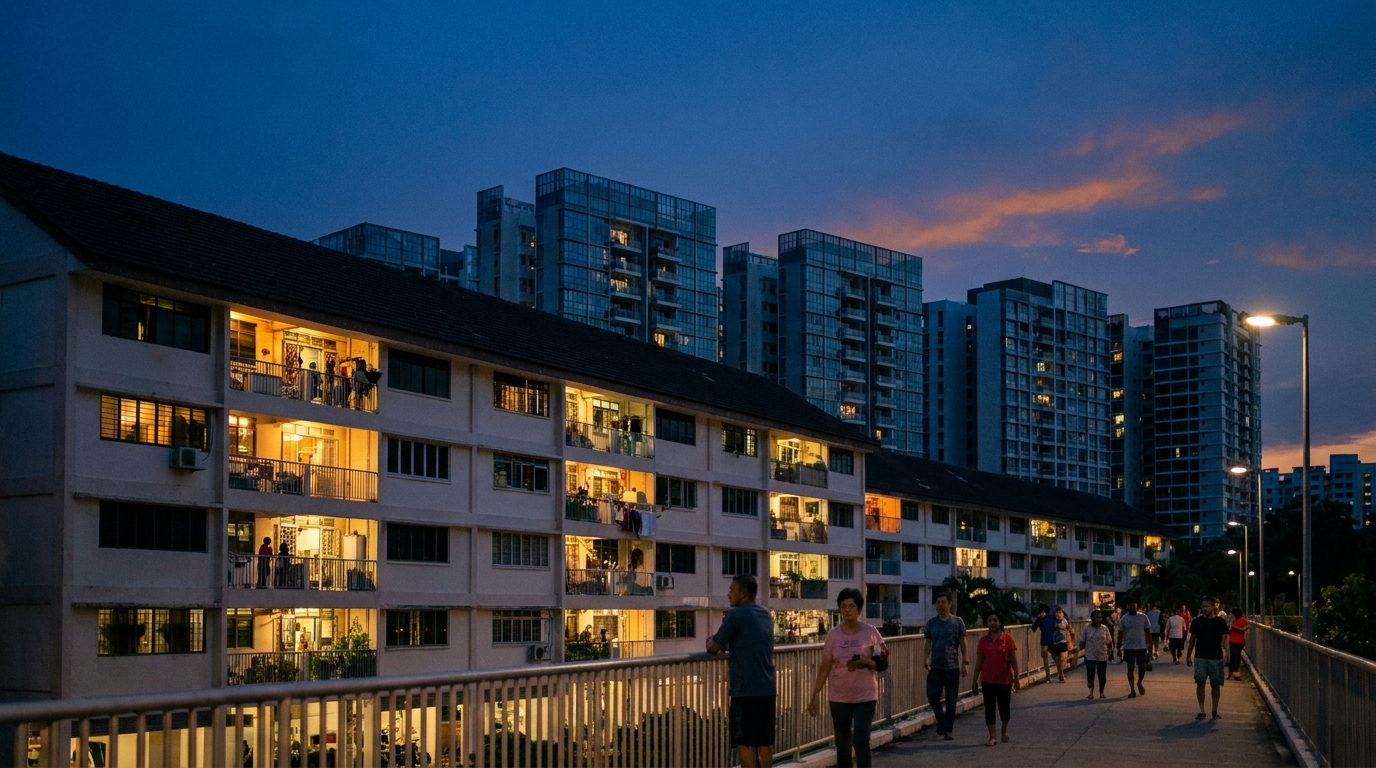
So the up-to-35% who voted no are not an abstraction. They are, disproportionately, people who finished paying for a flat decades ago, who are embedded in a neighbourhood's social infrastructure, and who now face relocation with a lease-decayed cheque. The lower the threshold, the larger that displaced cohort can legally be. That is precisely the caution Yee raised alongside his support for the reform, and it deserves more weight than it is getting.
Ageing in place is a policy, not a consolation
Singapore already runs the alternative to redevelopment. HIP II targets flats at around 60 years, and the Silver Upgrading Programme retrofits ageing blocks for older residents. These exist because not every old precinct should come down, and not every old resident should move.
The honest framing is that VERS and upgrading are two ends of one policy, and the consent threshold determines the handover point between them. Set it too high and estates decay under escalating maintenance, spalling concrete and lift replacement bills. Set it too low without a credible compensation package and you convert a housing policy into a displacement policy.
What actually decides this
The Bill has cleared its First Reading and awaits parliamentary debate. VERS itself remains in formulation, with MND committed to establishing the framework within the current term of government, first pilots slated for the first half of the 2030s, and a phased rollout across 20 to 30 years.
Three things matter more than whether the eventual number reads 65% or 70%:
- The compensation formula. How closely does the lease-decay valuation track the cost of a comparable replacement home in the same town?
- The rehousing package. Priority BTO allocation, flexi-lease senior housing options, and whether staying within the precinct is realistic.
- The voting unit. Whether approval is counted by household headcount, by flat type, or by precinct boundary — and who draws the boundary.
For owners of older flats, one conclusion follows immediately. VERS is voluntary, selective, decades out, and paid on lease decay rather than developer premium. It is not an en bloc windfall, and buying an ageing flat on the hope of being selected is a bet on a formula designed to prevent exactly that.
The end of new SERS announcements has already stripped much of that hope premium out of very old flat pricing. Watch transaction volumes in the 50-plus-year segment across Toa Payoh, Queenstown and Bedok for the real verdict — that is where the market will tell you whether it believes the eventual VERS terms are worth waiting for.
A 65% threshold is a reasonable answer to a question about deadlock. It is not an answer to the question owners are actually asking, which is what the cheque looks like.