The BTO Income Ceiling Hits S$16,000. OCR Condo Sellers Won't Feel It for Three Years.
Raising the HDB income ceiling to S$16,000 does divert demand away from mass-market condos — but the diversion runs on construction timelines, not headlines.
The gist
- BTO income ceiling rose from S$14,000 to S$16,000 on 24 August 2026, singles from S$7,000 to S$8,000.
- Only households earning S$14,000 to S$16,000 shift demand away from mass-market condos.
- BTO waits of three to five years and 10-year MOPs keep immediate-need buyers private.
- Forecasts point to 1 to 3 per cent annual mass-market private price growth, not a correction.
On 24 August 2026, a household earning S$15,500 a month went from locked out of new HDB flats to eligible for them. That single band — S$14,000 to S$16,000 — is the entire mechanism by which the National Day Rally announcement touches the private condo market. It is narrower than the headlines suggest, and it moves on a three-to-five-year clock.
What actually changed, and when
Prime Minister Lawrence Wong announced the revision at the National Day Rally on 23 August 2026. It took effect the next day for HDB Flat Eligibility applications. The monthly household income ceiling for Build-to-Order flats rose from S$14,000 to S$16,000, and for singles aged 35 and above from S$7,000 to S$8,000. Extended and multi-generational families were set a ceiling of S$24,000.
The Executive Condominium ceiling moved from S$16,000 to S$18,000, but only for EC developments whose land tenders close on or after 24 August 2026. That is a materially slower fuse than the BTO change.
The revised S$16,000 figure also carries across to CPF Housing Grants on the resale market and to HDB concessionary loans. That second point matters more than it reads: it changes financing, not just eligibility, for households already shopping the open HDB market.
This is the first income ceiling revision since September 2019. The prior sequence — S$10,000 in 2011, S$12,000 in 2015, S$14,000 in 2019 — shows a roughly four-year cadence. On that pattern, 2026 is late, not early.
This is catch-up, not expansion
Average monthly household employment income grew 22 per cent between 2019 and 2025, reaching S$13,752 on SingStat's numbers. Hold a ceiling still for seven years while incomes climb by a fifth, and you are quietly shrinking the eligible population every year. The 2026 revision restores a ratio; it does not create new demand out of nothing.
Research estimates put the S$16,000 ceiling at just under the 70th percentile of resident employed households. That is roughly where the ceiling has historically sat. The households now brought back in are not a new buyer class — they are the same sandwich-class couples who were pushed out by wage growth and had to shop somewhere else.
Somewhere else, for most of them, meant an entry-level condo in the Outside Central Region or a million-dollar resale flat. That is the demand the ceiling is reclaiming.
The quantum gap is enormous. The timing gap is bigger.
Run the numbers and the BTO-vs-condo question looks lopsided. New four- and five-room Standard and Plus flats generally launch in the S$350,000 to S$750,000 range. Entry-level OCR resale condominiums trade at roughly S$1,650 to S$1,880 psf, with two- and three-bedroom quantums typically landing between S$1.4 million and S$1.85 million. New mass-market launches frequently clear S$2,000 to S$2,200 psf.
On borrowing power, a first-time household earning S$16,000 can support around S$909,372 in bank financing under the 30 per cent Mortgage Servicing Ratio, enough for a new flat priced up to about S$1.2 million. Against a S$500,000 BTO, that is comfortable. Against a S$1.7 million OCR resale unit under the 55 per cent TDSR, it is a stretch — and a much larger cash and CPF outlay upfront.
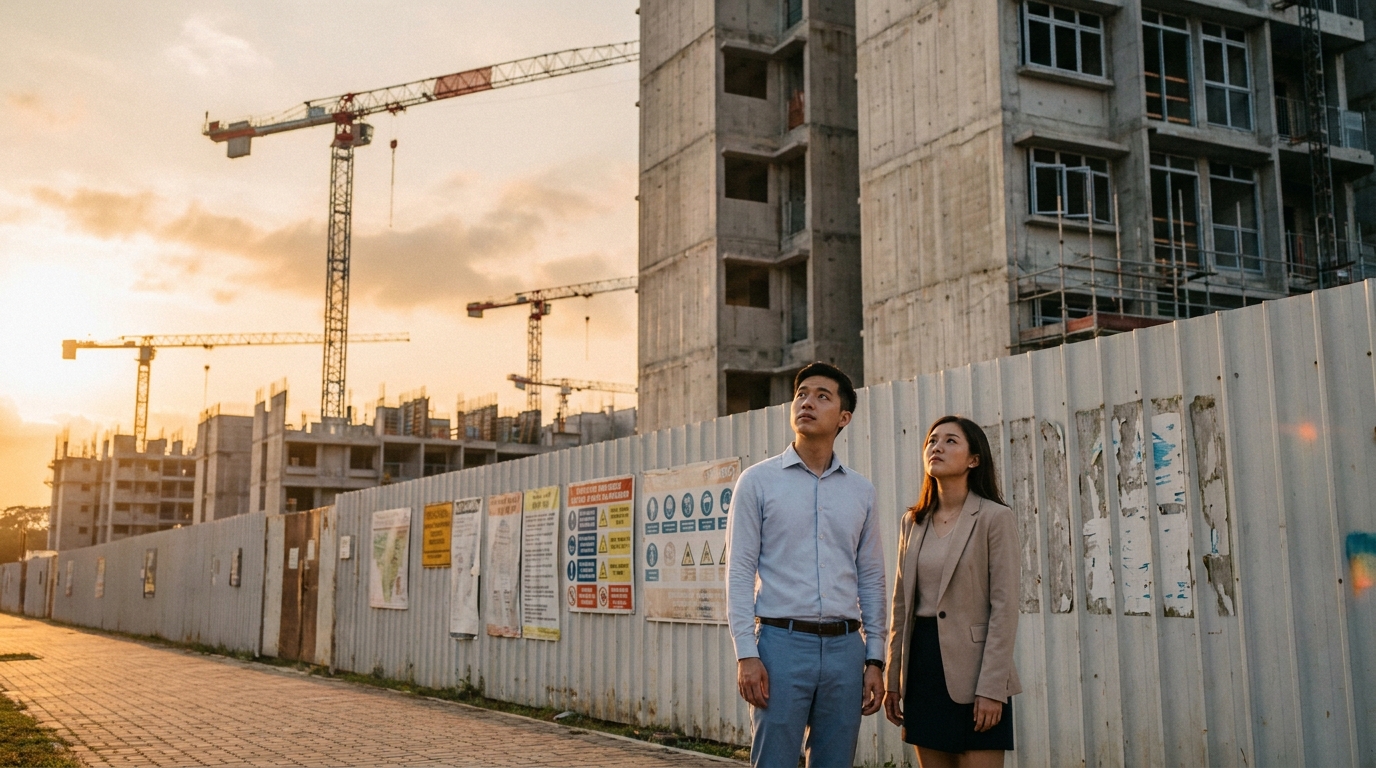
So why won't the private market crack? Because a BTO takes three to five years to build, and Plus and Prime flats carry 10-year minimum occupation periods plus subsidy clawbacks on resale. A couple who needs keys this year cannot use any of it.
The income ceiling change removes the reason some buyers went private. It does not remove the deadline that sent others there. Wait-tolerant first-timers divert; move-in-now buyers do not.
Who is left holding up the entry-level private market
Strip out the divertible buyers and a solid floor remains under OCR resale. Several groups are structurally untouched by any HDB income ceiling:
- Immediate-need buyers — marriages, births, expiring leases, relocations. A four-year wait is not a substitute for a home in three months.
- Single permanent residents and foreign buyers, who are ineligible for BTO flats at any income level.
- HDB upgraders selling MOP flats, whose demand is driven by equity release and space, not eligibility.
- Buyers who reject the lock-in — a 10-year MOP on a Plus or Prime flat is a decade of frozen capital.
That is why the sober forecasts land on 1 to 3 per cent annual price growth for mass-market private homes rather than a correction. The ceiling is a calibrated accessibility tool, not a cooling measure. It was announced in a family-formation frame, and the market effect is a second-order consequence.
The number that should worry OCR sellers isn't the ceiling
Supply is the real story. HDB is launching about 19,600 BTO flats in 2026, including roughly 4,000 with waiting times under three years, and is on track to exceed its commitment of 55,000 flats between 2025 and 2027. Newly eligible households are not walking into a starved pipeline.
Then the resale wave. Flats reaching MOP climb from 13,500 in 2026 to 15,000 in 2027 and 19,500 in 2028. That is a compounding stream of move-in-ready public housing entering the open market — with no income cap on buyers — precisely as the diverted BTO cohort would otherwise have been shopping.
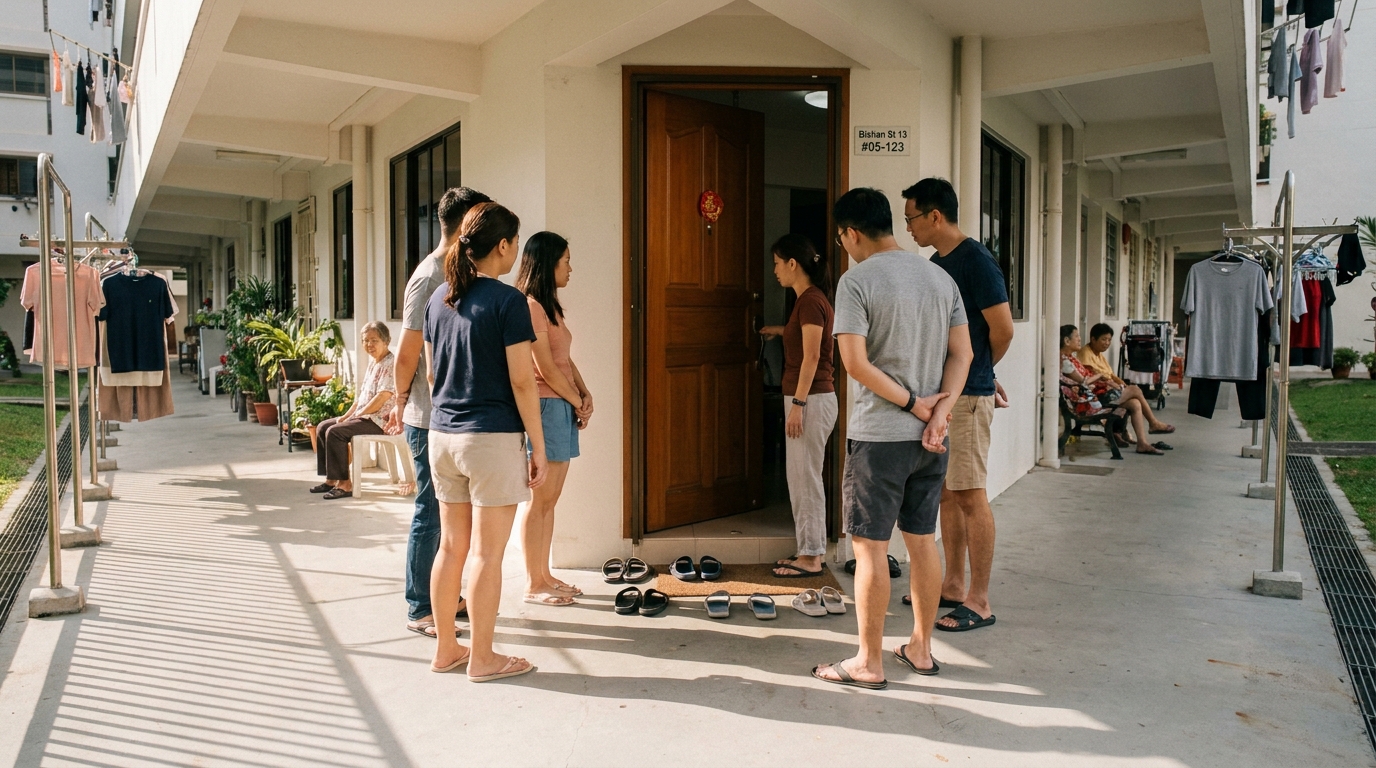
Put the two together and the pressure on older, poorly located OCR two- and three-bedders is not a demand shock in 2026. It is a slow squeeze on liquidity across Districts 17, 18, 19, 22, 23 and 27 as the marginal buyer gains more alternatives each year. Sellers lose pricing power before they lose price.
What each side of the table should do
For sandwich-class first-timers now eligible: the honest answer to "BTO or mass-market condo" is a timing question, not a value question. If you can wait, the subsidy is unbeatable — a 50 to 75 per cent quantum discount against an entry-level private unit. If you cannot, the ceiling change is irrelevant to you except for one thing: the higher CPF Housing Grant and HDB loan thresholds now apply to resale flats too.
For EC-minded buyers: new ECs at roughly S$1,300 to S$1,750 psf and three-bedroom quantums of S$1.3 million to S$1.6 million sit 20 to 30 per cent below comparable private OCR projects. But EC purchases are bound by the 30 per cent MSR, not the 55 per cent TDSR — so a higher income ceiling does not translate one-for-one into higher borrowing capacity. And the S$18,000 cap only attaches to sites tendered from 24 August 2026, which means the actual launches are years out.
For sellers of older OCR resale units: expect longer marketing periods and more price-sensitive viewers rather than a valuation cliff. Pricing above prevailing benchmarks becomes markedly harder when a chunk of your buyer pool has a subsidised exit.
For investors: the cap is on the exit, not the entry. If future local buyers retain a subsidised pathway, mass-market OCR capital appreciation stays in the low single digits. Easing SORA and mortgage rates lower servicing costs, but the 75 per cent LTV, the TDSR and ABSD keep leverage anchored to fundamentals.
Four things to watch before drawing conclusions
The diversion thesis is testable. Four data points will settle it over the next 18 months:
- BTO and Sale of Balance Flats application rates. If oversubscription in Plus and Prime projects spikes, the S$14,000–S$16,000 cohort is genuinely pivoting — and repeated ballot failures will eventually spill frustrated demand straight back into resale.
- The OCR new launch versus resale price gap. Watch the URA price index for whether developers narrow the spread against resale to defend market share.
- EC land tender results from 24 August 2026 onward. Sites at Canberra Drive, Admiralty Walk and Jurong East are the first to price in the S$18,000 ceiling. Land bids will reveal whether developers believe the expanded buyer pool is real.
- Transaction mix in URA Realis and HDB data. If first-timer share of OCR private purchases falls while upgrader share holds, the mechanism is working exactly as designed.
The ceiling change is the right policy at a defensible time. It is also a slow-acting one. Anyone reading it as an imminent hit to mass-market condo prices is reading a construction schedule as a market signal — and those two things run on very different clocks.