Sin Ming and Lorong 4 Toa Payoh: HDB Is Pouring Concrete on Flats You Can't Apply For Until 2027
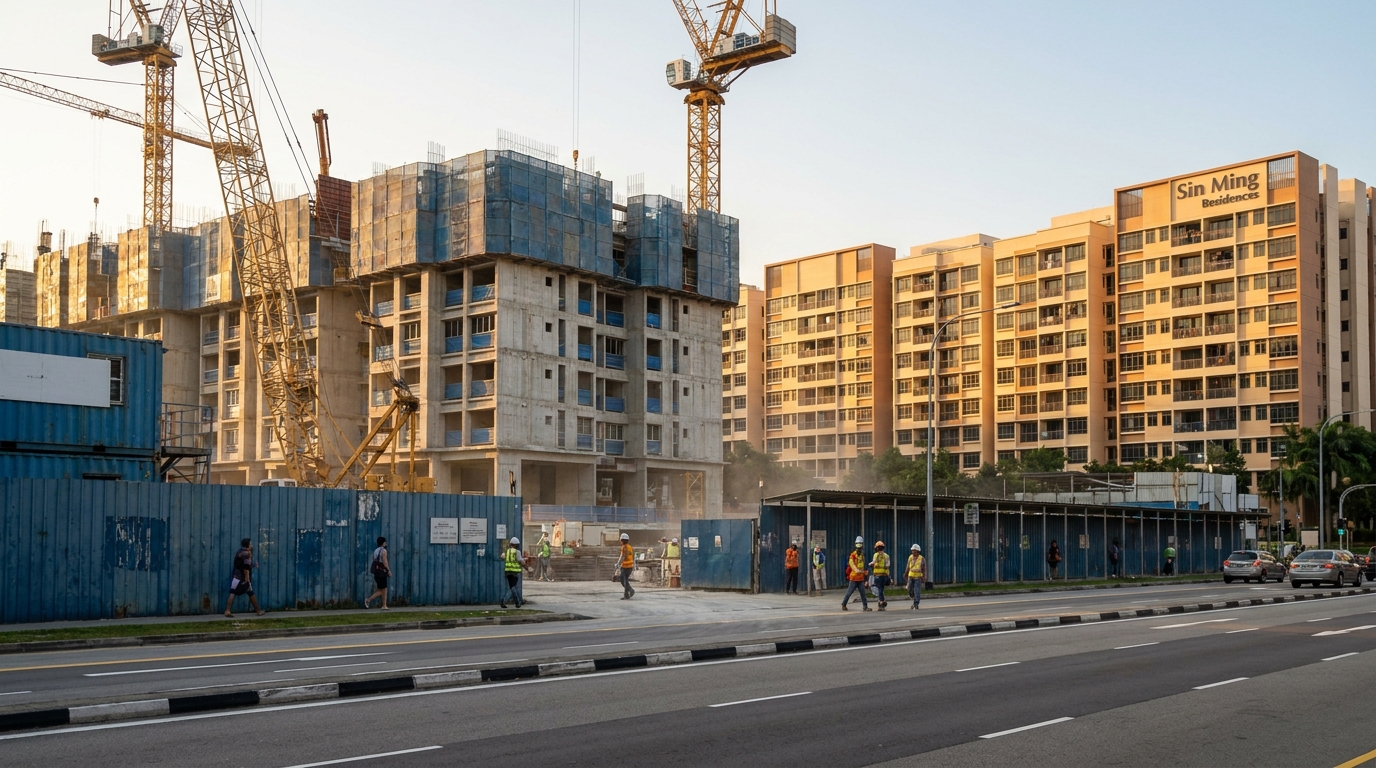
Two brownfield sites — 1,076 units in Bishan, 193 in Toa Payoh — are already under construction, and the variable that will decide what they're worth hasn't been announced yet.
The gist
- HDB has begun construction at Sin Ming Street (1,076 units) and Lorong 4 Toa Payoh (193 units).
- Applications open mid-2027 at the earliest, with keys expected around mid-2030 under shorter waiting time launches.
- Whether the projects are Standard, Plus or Prime is unannounced, deciding a five- or ten-year MOP.
- Bishan's public housing stock grew about 11% from 1996 to 2025 versus 67% nationally.
Two plots of land in Bishan and Toa Payoh are already being built on. Nobody can apply for the flats until mid-2027 at the earliest, and nobody will collect keys until mid-2030. That inversion — build first, sell later — is the whole point.
The method matters more than the sites
The Housing Board confirmed to The Straits Times that Built-To-Order flats with shorter waiting times are being built at Sin Ming Street in Bishan town and Lorong 4 Toa Payoh. Launch dates and estimated waiting times will be announced later. The projected completion date does the arithmetic for us.
Shorter Waiting Time flats are defined by HDB as those with a wait of under three years from launch to keys. The mechanism is blunt: start construction before the sales exercise, so the buyer inherits a project already part-built.
This is not a one-off. The national target is roughly 12,000 SWT flats launched between 2025 and 2027, about 24% of the 50,000-plus BTO pipeline over that stretch. In the February 2026 exercise alone, 1,316 SWT units were offered across three projects, with waits ranging from 1 year 11 months to 2 years 9 months. Compare that to Kim Keat Crest in Toa Payoh in the same exercise, at 3 years 1 month. The gap between an SWT flat and a conventional one is now more than a year of somebody's life.
Sin Ming: 1,076 units into a town that stopped growing
The Sin Ming Street project will yield 1,076 units, with a childcare centre and a supermarket built into the precinct. It sits across the road from Sin Ming Residences, the 984-unit project nearing completion. The site previously held an HDB rental block and several industrial buildings, all demolished.
Here is the number that frames everything else. Public housing stock in Bishan grew by roughly 11% between 1996 and 2025, against a national average of 67%. Bishan has been, in supply terms, frozen for three decades while the rest of the island expanded.
The demand side reflects that. Every one of the five BTO projects launched in Bishan since August 2020 drew at least three applicants per flat. At Sin Ming Residences in December 2023 — the first BTO in Sin Ming in over 30 years — the four-room flats pulled 2,293 applications for 627 units, while three-room flats drew 177 applications for 105 units. The appetite is concentrated, and it is family-shaped.
The single most consequential fact about these two projects has not been published yet: whether HDB classifies them as Standard, Plus or Prime. That decision — not the price, not the ballot — determines whether a buyer is locked in for five years or ten.
Lorong 4 Toa Payoh: 193 flats on 0.78ha, and what that signals
The Toa Payoh project is a single 40-storey block of 193 units, with a multi-storey carpark topped by a roof garden, a precinct pavilion and community facilities. The site is about 0.78ha — an open-air carpark wedged between Blocks 62B and 66 Lorong 4 and Block 63 Lorong 5.
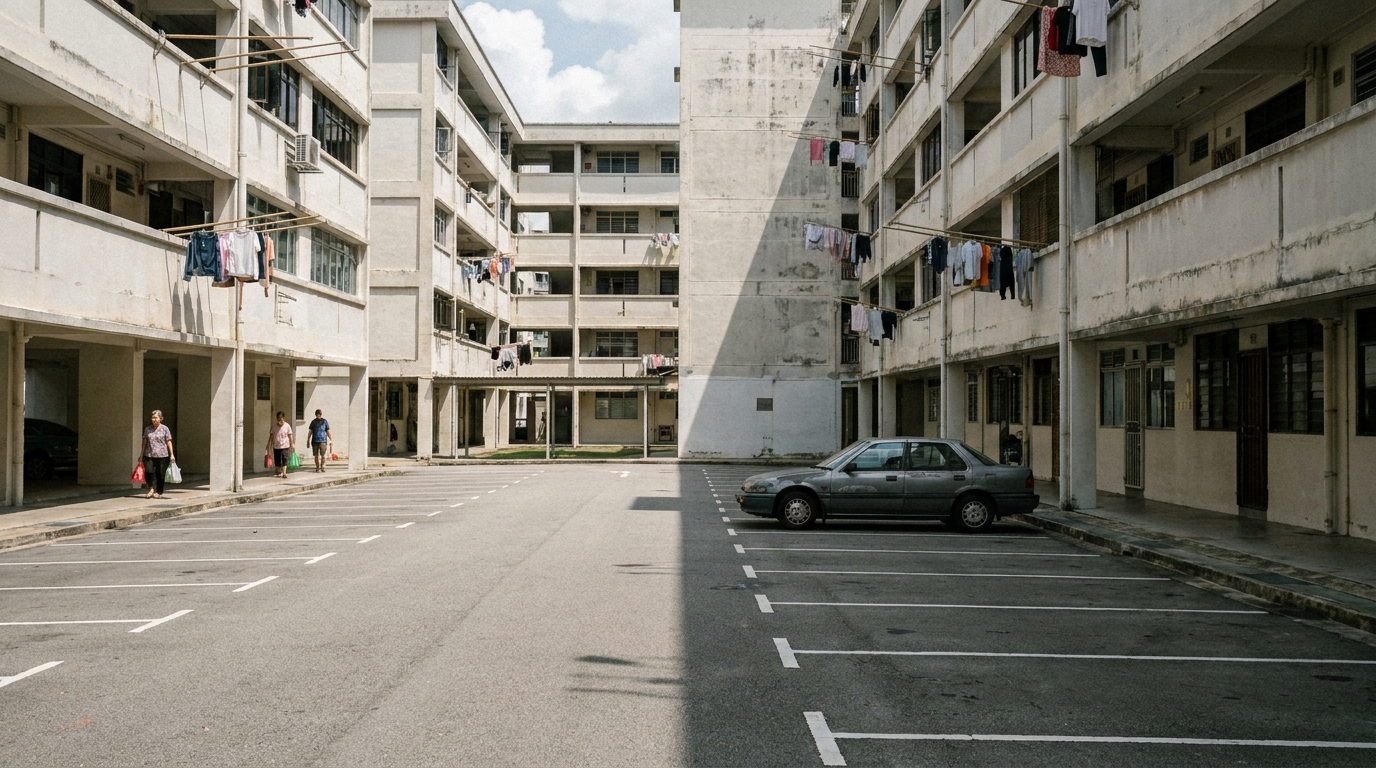
By unit count, analysts note this would be the smallest BTO project in Toa Payoh since the 188-unit Golden Clover launch in March 2012. On a per-project basis it is almost rounding error against the national pipeline.
Asked why it would develop such a tight infill parcel hemmed in by existing blocks, HDB was direct: "Given our limited land, we must redevelop where we can to optimise our land use." The board added that Toa Payoh has been built up progressively over the years and has limited room left.
A 193-unit tower on a former carpark is not a housing programme. It is an admission that the easy land in central Singapore is gone.
Both sites are brownfield — previously developed. HDB stated that it has been "progressively redeveloping vacant or suitable brownfield sites for housing in the first instance, before considering other sites that are zoned for housing." Read that as sequencing policy, not a throwaway line. Carparks, demolished rental blocks and old industrial parcels are now the front of the queue in mature estates.
The classification is the trade, and it is still unannounced
Under the Standard, Plus and Prime framework, central and well-connected launches attract heavier subsidies and heavier restrictions. Plus and Prime flats carry a 10-year Minimum Occupation Period, subsidy clawback on first resale, a ban on renting out the whole flat, and income ceilings for future resale buyers.
Analysts reading the two sites see them landing differently. Sin Ming sits deeper in a quieter enclave, further from an MRT station, which points toward Standard. Lorong 4 Toa Payoh sits close to the town centre and MRT, which points toward Plus or Prime. Neither has been confirmed by HDB.
For a buyer, the difference is a decade. If the Toa Payoh block is classified Plus or Prime, the MOP clock starts only at key collection in 2030 — meaning no private property purchase and no whole-unit letting until at least 2040. That is a very long horizon to hand a couple in their late twenties.
The flip side is honest too: those restrictions exist precisely because the location is good, and the upfront subsidy is larger. The buyer who intends to live there is being paid to stay. The buyer quietly planning an upgrade in year six is buying the wrong flat.
A shorter wait pulls your money forward
The comfortable part of a four-or-five-year BTO is the runway. CPF accumulates, salaries rise, the renovation fund fills. An SWT flat compresses that runway to under three years.
Financing conditions are unforgiving of improvisation. The HDB loan-to-value cap sits at 80%, tightened from 85% in August 2024. The Mortgage Servicing Ratio remains capped at 30% and the Total Debt Servicing Ratio at 55%. The HDB concessionary rate is anchored at 2.60% per annum, pegged 0.1 percentage point above the CPF Ordinary Account rate of 2.50%.
Two practical consequences follow. Applicants need a valid HDB Flat Eligibility letter in hand well before the exercise opens, not scrambled together in the final week. And couples counting on three more years of savings to bridge a cash-over-CPF gap should model the shorter timeline now, because the flat will be ready whether or not they are.
There is a countervailing provision. Under Deferred Income Assessment, eligible young couples — students and full-time national servicemen among them — can apply early and defer income assessment until closer to key collection. On an accelerated build, that sequencing is worth more than it sounds.
What these launches are actually meant to do
Look at the Bishan resale record. In 2025, about 25% of the 376 resale flats sold in Bishan transacted at or above $1 million. In the first seven months of 2026, 46 of 230 transactions crossed the same mark. Buyers who cannot wait four years for a BTO end up bidding in that market.
That is the policy logic of SWT flats in mature estates: intercept the time-pressed buyer before they overpay in resale. Whether 1,076 units in Bishan and 193 in Toa Payoh are enough to bend that price curve is a separate question. Directionally the pressure eases; arithmetically, 193 flats will not reset Toa Payoh.
Some historical anchors, offered as context rather than forecast. Sin Ming Residences launched in December 2023 at $374,000 to $473,000 for three-room flats and $519,000 to $665,000 for four-room, with a wait of 2 years 8 months. More recent Toa Payoh launches under Plus or Prime terms have carried four-room indicative prices in the $583,000 to $614,000-plus range before grants. Nobody has published prices for either upcoming project, and anyone quoting you one is guessing.
What to watch between now and mid-2027
The useful signals are few and specific:
- Classification. Standard versus Plus or Prime for each project. This is the single largest swing factor in a buyer's decision.
- Flat mix. Whether the Sin Ming project includes five-room units. Analysts have argued for them, given proximity to primary schools within 1km — Catholic High and Ai Tong among them — and the historical skew toward four-room demand.
- Official waiting times. HDB has not confirmed how far under three years either project will land. A 2-year-and-change wait is a different proposition from one just shy of 36 months.
- Interim SWT exercises. Application rates and pricing in the 2026 and 2027 launches will set the benchmark buyers are actually competing against.
One last caution. Median first-timer application rates for three-room and larger flats have stabilised at roughly 1.3 to 3.0 times, well off the post-pandemic peaks — but that national average will not describe Sin Ming. Betting an entire housing plan on one oversubscribed mature-estate ballot is how couples lose two years and end up in the resale market anyway, paying the price these launches were designed to suppress.