 plan
planTwo severe-hoarding HDB fires expose the limits of early intervention
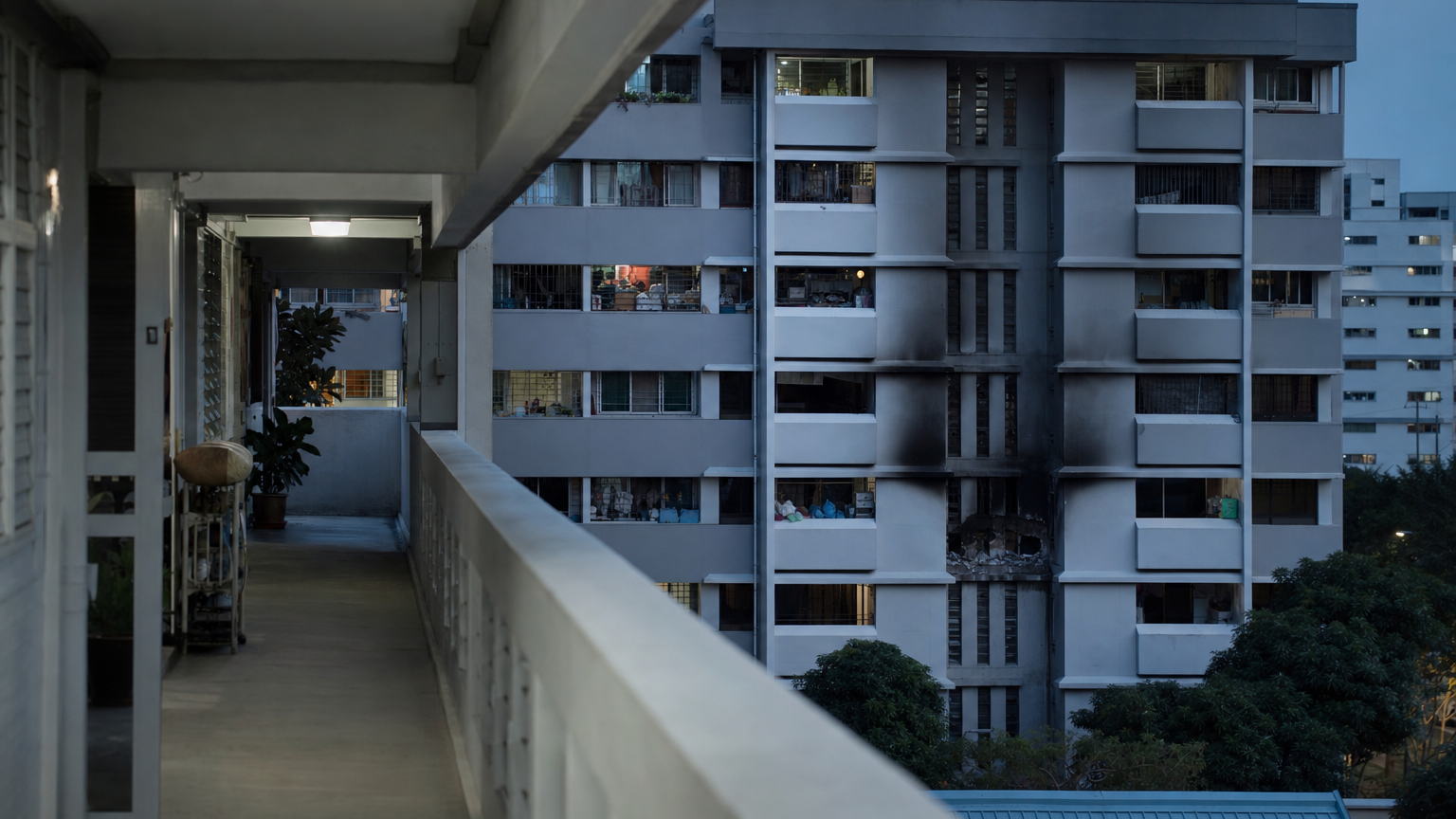
The fatal outcome is a warning about escape routes and recurring household risk—not evidence that whole blocks or estates should be repriced.
The gist
- The fatal outcome is a warning about escape routes and recurring household risk—not evidence that whole blocks or estates should be repriced.
- Two fires between 2020 and 2025 occurred in HDB flats already known to agencies as severe-hoarding cases.
- The finding exposes a difficult intervention gap.
Two fires between 2020 and 2025 occurred in HDB flats already known to agencies as severe-hoarding cases. One caused smoke-inhalation and burn injuries; the other resulted in a death. Both households had received help before the fires, but neither had been directed by the Singapore Civil Defence Force to maintain a clear escape path inside the flat.
The finding exposes a difficult intervention gap. Severe accumulation can threaten escape and emergency access, yet the conditions for compulsory action inside a home may not be met—or may be hard to establish—before an incident.
For the property market, this is not evidence of a broad HDB pricing problem. It is a highly local warning: a persistent hazard at one flat or corridor can materially affect safety, daily life and the pool of willing buyers without changing the prospects of an entire block or estate.
The gist
- Two HDB fires from 2020 to 2025 involved flats previously identified as severe-hoarding cases; one fire was fatal.
- Agencies and community partners had engaged both households. Decluttering initially succeeded in one case before the behaviour returned, while the resident in the other case resisted intervention.
- SCDF can direct an occupant to clear an internal escape path when severe hoarding impedes evacuation, but no such direction was issued in either case.
- The immediate property implication sits at the unit and corridor level, not in an assumed discount across a town or block.
The risk is rare in aggregate but potentially decisive at the corridor level.
The fires reveal an intervention problem, not their cause
The official finding needs careful reading. It establishes that the flats had previously been identified as severe-hoarding cases; it does not say hoarding ignited either fire.
The clearer mechanism is the danger created after a fire starts. Dense accumulations can impede an occupant’s escape, hinder responders and make it harder to move through a home. The same practical concern applies when possessions extend into common passageways used by neighbours.
That distinction matters because a dramatic headline can encourage two unsupported conclusions: that clutter necessarily causes fires, or that a known case makes the surrounding estate broadly unsafe. Neither follows from the evidence released.
Earlier official figures recorded 23 HDB fires involving excessive hoarding from 2020 to 2024. Over the same period, HDB estates experienced roughly 800 to 900 fires a year, putting the hoarding-related cases within a much larger set of incidents.
These datasets also measure different things. The earlier count covered fires involving excessive hoarding, while the newer answer isolated two flats already known as severe cases. No estate names, flat types, resale records or comparisons with unaffected blocks were provided.
It is therefore not possible to calculate a price effect from the released information. Any suggestion of an estate-wide discount would be speculation rather than a finding supported by transaction evidence.
Why prior engagement did not remove the danger
Both households had been approached by government agencies and community organisations before the fires. In one case, decluttering efforts worked initially, but the accumulation returned. In the other, the resident resisted the attempt to clear the home.
This is the central policy difficulty. Removing objects at one moment does not necessarily address the behaviour or circumstances behind their accumulation. Cooperation may also disappear before a home reaches the legal threshold for stronger fire-safety action.
SCDF can require an occupant to maintain a clear escape path where severe hoarding impedes evacuation during a fire. Failure to comply with such a direction can result in a fine of up to $10,000, imprisonment for up to six months, or both.
No direction was issued in either of the two cases. The official reply said the threshold had not been met based on agencies’ assessments at the time, even though subsequent events had grave consequences.
This creates an uncomfortable middle ground. A home may be visibly overloaded, distressing for neighbours and difficult to address, but still fall short of the test for a compulsory internal escape route.
The strongest counterargument to earlier intervention is also serious. Lowering the threshold too far could allow subjective complaints or neighbour disputes to trigger intrusive action inside a person’s home. Clutter, poor housekeeping and a clinically complex hoarding condition are not interchangeable.
The challenge is consequently not just to intervene more often. It is to define objective evidence that a private condition has become a shared safety threat, while preserving procedural safeguards for the resident.
Inside a flat and outside it are different property risks
The distinction between internal hoarding and corridor obstruction is important for owners and buyers. What happens inside a flat is less visible and involves stronger privacy considerations. Common corridors, staircases and lift lobbies are shared escape routes subject to clearer fire-safety expectations.
Town councils are responsible for ensuring that common areas in HDB estates comply with fire-safety requirements. A minimum 1.2-metre-wide escape passage should be maintained along common corridors, while staircases, landings and access to firefighting equipment should remain unobstructed.
Visible corridor clutter is therefore more than an aesthetic complaint when it narrows the required route or blocks emergency facilities. It is also easier for a prospective buyer to observe and for an owner to document than conditions hidden behind a neighbour’s door.
Not every shoe rack, bicycle or potted plant establishes a severe hazard. The meaningful questions are whether people can pass safely, whether a wheelchair or stretcher could get through, whether the stairs remain accessible and whether firefighting equipment can be reached.
Recurring obstructions can also affect saleability at a very small scale. Reporting on one HDB corridor dispute described prospective buyers leaving quickly after seeing possessions from an opposite unit extend towards the lift lobby. That account illustrates buyer behaviour, but it is anecdotal and does not establish a measurable resale discount.
This is the appropriate level of interpretation. A persistent neighbouring condition may reduce the number of buyers comfortable with a particular unit or stack. It does not follow that otherwise unaffected flats in the block should be repriced.
What owners, sellers and buyers can establish
An owner living beside a worrying accumulation should focus on observable safety conditions rather than labels. Photographs and dated reports can show blocked common access, combustible materials in shared space, obstructed firefighting equipment or a passage too narrow for ordinary movement.
Those facts are more useful than asserting that a neighbour is a “hoarder”, which an owner may not be qualified to determine. They also separate a fire-safety issue from the noise, smell and interpersonal disputes that may require different forms of intervention.
A seller faces a narrower commercial question. If a corridor condition is plainly visible during viewings, buyers will form their own judgement. Denying it or making an unsupported promise that it has been permanently resolved is unlikely to help.
The defensible approach is to describe what can be verified: whether the obstruction remains, whether the town council has attended and whether any notice known to the seller is still active. An official severe-hoarding designation should not be claimed without evidence.
For buyers, the renovated interior is only part of the inspection. The route between the front door, lift and stairs reveals how the shared environment functions. Access to hose reels and other emergency equipment should also be visible and unobstructed.
A second visit can help distinguish temporary moving boxes or scheduled works from a recurring condition. It cannot diagnose what is happening inside another flat or guarantee future behaviour, but it can show whether common access is already compromised.
Buyers should also resist converting uncertainty into certainty. A crowded interior glimpsed through an open door does not prove that an enforcement threshold has been crossed. Conversely, a freshly cleared corridor does not establish that a long-running problem has ended.
Basic HDB fire insurance leaves important gaps
The consequences of a neighbouring fire can extend beyond the unit where it began. Smoke, heat, water and emergency access may affect adjoining homes, but the official reply does not assign liability for either of the two incidents.
Owners should also understand the limited purpose of the compulsory HDB fire-insurance scheme. It applies to owners with outstanding HDB loans that commenced on or after 1 September 1994 and primarily covers the reinstatement of damaged internal structures, fixtures and items supplied by HDB.
It does not cover household contents, personal belongings or renovations. This limitation matters after any flat fire, whether or not hoarding is involved.
The implication is about protection, not blame. The two cases provide no basis for assuming that a neighbouring resident would automatically compensate every affected household, or that the basic HDB policy would restore a renovated home and replace its contents.
The next question is whether the threshold changes
The latest reply did not announce a lower intervention threshold or a new notice regime. Agencies will continue working through the existing multi-agency and community framework for hoarding cases.
That continuity may be justified by the complexity and small number of known severe cases reaching this outcome. Coercive powers cannot guarantee lasting behavioural change, and broader authority could carry significant privacy and due-process costs.
Yet the two fires show the weakness of relying on engagement alone when cooperation fails or accumulation returns. The policy question is whether agencies can identify a more durable intermediate response before an internal route becomes clearly impassable.
For owners and buyers, the immediate conclusion remains deliberately local. There is no evidence here for marking down an HDB town, or even an entire block. But a repeatedly obstructed shared route beside a particular unit can be a consequential safety and resale factor.
The development to watch is whether future rules define earlier, evidence-based action around escape and responder access. That—not a speculative estate-wide price effect—is what could change how persistent severe-hoarding cases are managed.