 plan
planPunggol East’s riverfront is turning residential—but 8,000 homes are not yet approved
Tenancy expiries make the 25ha redevelopment credible. For owners and buyers, the unanswered questions about tenure, timing and site design matter more than its theoretical capacity.
The gist
- Tenancy expiries make the 25ha redevelopment credible.
- A 25-hectare strip beside Sungei Serangoon is being prepared for residential redevelopment, with tenancies at several state properties in Punggol East due to expire on 31 December 2026.
- But the figure attracting attention, more than 8,000 homes, is not an approved building programme.
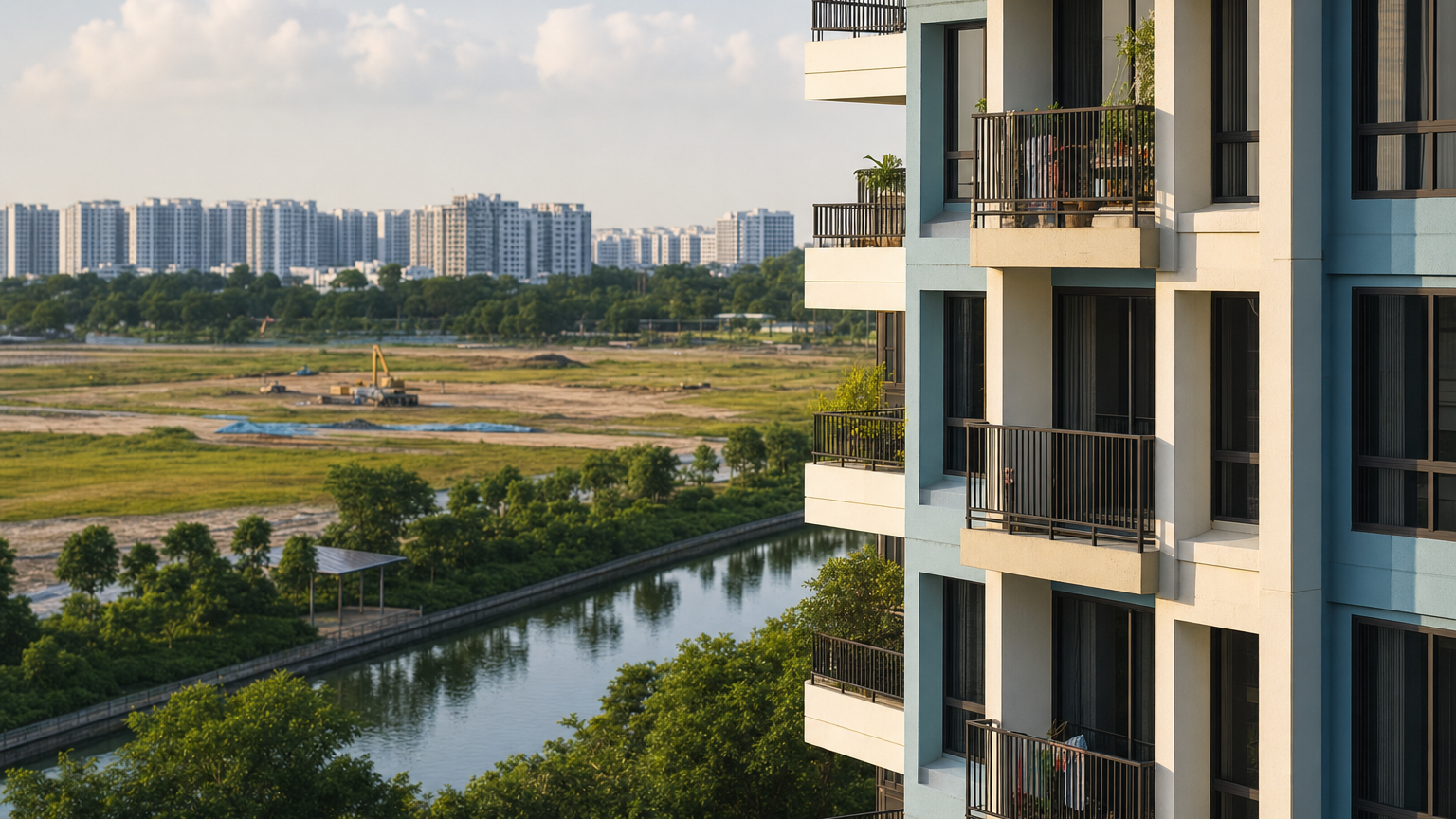
A 25-hectare strip beside Sungei Serangoon is being prepared for residential redevelopment, with tenancies at several state properties in Punggol East due to expire on 31 December 2026. This is a concrete step towards a substantial new neighbourhood—not merely another long-range planning concept.
But the figure attracting attention, more than 8,000 homes, is not an approved building programme. It is an estimate of what the five residential-zoned plots might accommodate under current planning parameters. No final unit count, housing mix, land-release route or completion schedule has been announced.
That distinction shapes what this development means for owners and buyers. Punggol East’s river edge is moving towards denser residential use, but its immediate effect is likely to be site clearance and uncertainty rather than thousands of completed homes.
The gist
- Five plots around Punggol East Road and Tebing Lane cover about 25ha and are zoned for residential development.
- Tenancies at 32 Punggol East and 6 and 10 Tebing Lane expire on 31 December 2026, after which the sites are to be redeveloped.
- The estimate of more than 8,000 homes is a planning-capacity calculation, not a confirmed government unit count.
- The Cross Island Line’s Punggol Extension, including Riviera station, is expected to improve the area’s longer-term rail access.
Site recovery makes redevelopment credible
The clearest evidence of movement is the impending end of existing land uses. Besides the properties with tenancies expiring at the end of 2026, the master tenancy for the container-park site at 50 Punggol East Road cannot be extended because the land is needed for future residential redevelopment.
This affects an occupied riverside belt containing food-and-beverage, recreation and other interim uses. Recovering control of the land allows the state to clear, plan and eventually parcel the area without having to work around long leases.
It still leaves several steps between tenancy expiry and housing delivery. The sites could be allocated for public housing, offered through the Government Land Sales programme, divided between public and private development, or retained while infrastructure and detailed plans are prepared. None of these delivery routes has been confirmed.
URA describes the Master Plan as the statutory land-use plan guiding Singapore’s development over the medium term. It establishes permissible uses and development intensity, but it is not itself a construction programme.
The land-use change is becoming tangible, but the housing outcome remains open.
That is the central point obscured by the headline number. Site recovery materially raises the likelihood of redevelopment, while leaving its timing and eventual form unresolved.
Why 8,000 homes is an estimate, not a pipeline
The five plots reportedly have gross plot ratios ranging from 3.0 to 3.4 and a combined area of roughly 2.6 million sq ft. Applying assumed unit sizes to the resulting floor area produced estimates of up to about 8,400 private homes, or just under 7,000 public flats.
These scenarios are calculations, not parallel government proposals. Public and private projects use land differently and commonly have different unit sizes, parking arrangements, facilities and site-planning requirements. A mixed precinct could produce a total that differs from either estimate.
Gross floor area is also not the same as saleable residential space. Buildings require circulation and services, while a neighbourhood needs roads, landscaping, communal facilities and possibly shops or other supporting uses. One of the reported plots permits residential development with commercial space on the first storey.
The 8,000-plus figure is therefore useful for understanding scale. It indicates that this would not be an isolated project or a handful of infill blocks. It should not, however, be treated as an approved supply figure, much less as homes arriving in one launch window.
The eventual sequencing may matter as much as the final total. Several parcels released over many years would affect the resale market differently from a large public-housing precinct delivered in a concentrated phase. Until a site plan or land-release programme appears, that supply profile cannot be established.
Existing owners face both renewal and competition
For nearby owners, the positive interpretation is straightforward. Replacing low-rise interim uses with a planned residential precinct could bring a larger resident base, more active public spaces and stronger demand for everyday services. The river and park-connector setting would remain an important part of the area’s identity.
The counterargument is that new homes also create competition. Future projects may offer newer layouts, facilities and landscaping than established condominiums around Punggol and Sengkang. Buyers comparing a new project with a resale unit will decide whether the older home’s space, price and established surroundings compensate for its age.
The effect will not be uniform. A home enjoying an open outlook today could later face construction or another residential block. Another property may benefit from improved routes, shops or public spaces without losing its view. Those outcomes depend on block placement and access design that have not been published.
Tenure is another decisive unknown. A mainly private precinct would create more direct competition for existing condominiums. A predominantly public-housing estate would affect the market differently, potentially enlarging the pool of local households able to move through the housing ladder over time. A mixed district could do both.
It is consequently too early to infer a general price uplift or decline. The defensible conclusion is narrower: the eventual projects will alter the Riviera–Tebing Lane micro-market, but their impact will vary by property type, facing, age and price position. That is an editorial interpretation of the reported scale, not a forecast.
Buyers must separate disruption from the finished district
The near-term issue for someone buying beside these plots is not an overnight supply shock. It is the possibility of a prolonged transition after existing operators leave.
No official construction start, phasing plan or housing completion date has been disclosed. Site preparation, infrastructure works and separate building phases could change local traffic, noise and views well before residents gain access to any new amenities.
This creates a timing mismatch. A buyer may bear years of adjacent change while the eventual benefits remain distant. Someone expecting to move again within a short period will experience that trade-off differently from a household intending to remain through the next decade.
Buyers should also avoid valuing unannounced amenities as though they already exist. A larger population can support shops and services, and one plot reportedly permits first-storey commercial use, but the amount, placement and opening dates of any retail have not been confirmed.
The strongest bullish case rests on the combination of riverfront character, large-scale renewal and better rail connectivity. It is plausible, but it does not eliminate execution or pricing risk. When projects eventually reach the market, households will still compare their layouts, walking distances, surroundings and prices with established alternatives elsewhere in Punggol, Sengkang and the east.
Riviera’s rail improvement matters—but only at street level
The Cross Island Line’s Punggol Extension provides the firmer long-term transport element. Riviera is one of the stations on the extension, which will connect the Punggol area towards Pasir Ris.
This should improve the strategic accessibility of the wider precinct. Yet a station shown near a development is not proof that every future block will be equally convenient.
Actual usefulness depends on the walking route from each building, including crossings, shelter, shade and barriers created by roads or other parcels. It also depends on whether units face transport infrastructure or busy approaches. These details cannot be assessed without a detailed site plan.
Rail delivery and housing delivery should not be assumed to proceed in lockstep, either. The extension has its own construction programme, while the housing sites have no disclosed completion schedule. One may become available well before the other.
For today’s owners, improved rail access can strengthen the district’s long-range proposition without instantly changing the attributes of an individual home. For future buyers, the meaningful measurement will eventually be the route from a specific lobby to Riviera station—not a broad claim that the precinct is “near MRT”.
The state retains valuable choices
The most important planning feature may be the state’s ability to control the sequence. The Master Plan reserves land and establishes development parameters over a medium-term horizon, while the expiry of state tenancies restores operational control of the sites.
That creates flexibility. Parcels can potentially be timed according to housing needs, market conditions and infrastructure readiness closer to delivery. The public-private mix can also be determined later rather than fixed by today’s capacity estimate.
This flexibility is useful for housing policy, but it limits what owners can infer now. A planning capacity is not equivalent to near-term market supply because the land can be released in stages, redesigned or assigned to different housing forms within the applicable planning framework.
The prudent reading is therefore neither that owners should fear an imminent wave of competing units nor that buyers must rush to secure a home before the riverfront is transformed. Both conclusions run ahead of the evidence.
What has changed is more specific: the existing low-rise strip is losing its interim status, and preparations for eventual residential redevelopment now have an operational milestone at the end of 2026. What remains unknown includes tenure, unit mix, parcel boundaries, launch sequence, construction phasing and completion.
What to watch next
The next market-relevant development will be an official sign of delivery rather than another estimate of theoretical capacity. That could take the form of an HDB announcement, a Government Land Sales listing, a tender, a formal site plan or confirmation of the public-private housing mix.
Each would answer a different question. A land listing would clarify timing and development conditions; a site plan would reveal access and block relationships; confirmation of tenure would show which parts of the existing market face the most direct comparison.
Until then, the evidence supports a measured conclusion. Punggol East’s riverside is being prepared for a substantial residential future after 31 December 2026, but more than 8,000 homes remains an indication of possible capacity—not a launch pipeline that owners or buyers can confidently price today.