 plan
planPinnacle@Duxton’s $1.701m Sale Breaks Its Record From 15 Storeys Lower
The five-room deal raises the estate’s ceiling without taking Singapore’s national HDB crown. Its real message is that, in a rare central project, buyers price the whole home—not height alone.
The gist
- The five-room deal raises the estate’s ceiling without taking Singapore’s national HDB crown.
- A five-room flat at 1B Cantonment Road in The Pinnacle@Duxton was reported sold for $1.701 million on 9 September 2026.
- The striking detail is its height.
A five-room flat at 1B Cantonment Road in The Pinnacle@Duxton was reported sold for $1.701 million on 9 September 2026. The 1,151 sq ft home, in the 28th-to-30th-storey band, achieved about $1,477 per sq ft (psf)—a new high for the development and the Central Area’s HDB resale market.
The striking detail is its height. The flat surpassed a smaller unit much nearer the top of the same block, suggesting that buyers in this rarefied segment are not applying a simple “higher floor, higher price” formula.
But the headline needs one important qualification. This is a project and Central Area record, not Singapore’s national HDB resale record. That remains the $1.728 million paid for a five-room City Vue @ Henderson flat in April 2026.
The gist
- The reported transaction involved a 1,151 sq ft five-room flat on the 28th to 30th storeys, sold for $1.701 million, or approximately $1,477 psf.
- It exceeded The Pinnacle@Duxton’s previous reported five-room high of $1.63 million, achieved by a smaller flat on the 43rd to 45th storeys in May 2026.
- The sale shows that size, layout, outlook and project scarcity can collectively outweigh a large difference in floor level.
- It is most relevant to closely comparable Pinnacle flats—not a basis for automatically repricing ordinary HDB homes elsewhere.
A record—but not the national one
Two reports carry the same central particulars: a five-room configuration, an address at 1B Cantonment Road, a 1,151 sq ft floor area, the 28th-to-30th-storey band and a consideration of $1.701 million.
The transaction reportedly establishes a new price benchmark for The Pinnacle@Duxton and for an HDB resale flat in the Central Area. That is significant in its own right, given the development’s prominence and history of million-dollar transactions.
It should not, however, be described as Singapore’s most expensive resale HDB flat. Official-data-based market research recorded a $1.728 million five-room transaction at City Vue @ Henderson in April 2026. The cleaner conclusion is that The Pinnacle@Duxton has reset its own benchmark while remaining $27,000 below the national high.
That distinction improves the analysis rather than diminishing the sale. National records invite broad claims about the whole resale market; a project record tells us more precisely how buyers are valuing one highly differentiated development.
“At the top end, the benchmark is the specific home, not merely the postcode.”
Why the lower elevation did not prevent a higher price
The previous reported Pinnacle record was $1.63 million for a 1,130 sq ft five-room flat in the same block. That home was on the 43rd to 45th storeys and achieved approximately $1,442 psf in May 2026.
The newer flat was therefore around 13 to 15 storeys lower, yet sold for $71,000 more. It was also 21 sq ft larger and achieved a psf rate about $35 higher.
A simple calculation helps separate the two effects. Valuing the additional 21 sq ft at the earlier flat’s reported $1,442 psf produces roughly $30,300 of extra value. The remaining approximate $40,700 arises from the higher rate paid across the newer flat’s area, subject to rounding and the accuracy of the reported measurements.
This does not identify what caused the premium. The available reports do not provide enough evidence about the two homes’ renovations, layouts, orientations, interior condition or precise views to isolate any one feature.
Nor does it prove that storey height has stopped mattering. Higher floors can still offer more open views, less road noise and greater separation from surrounding buildings. The narrower inference is that a buyer did not require a near-top-floor unit to pay a record price at this development.
A flat on the 28th to 30th storeys is also not “low floor” in any ordinary sense. It may deliver much of the outlook and privacy associated with high-rise living, even if it does not carry the scarcity premium attached to the highest storey bands.
The strongest counterargument is therefore straightforward: this transaction does not overturn the conventional floor premium; it may simply show that the particular home had other advantages large enough to compensate for its lower elevation. Without complete unit-level details, that remains a credible explanation.
The Pinnacle is a market of its own
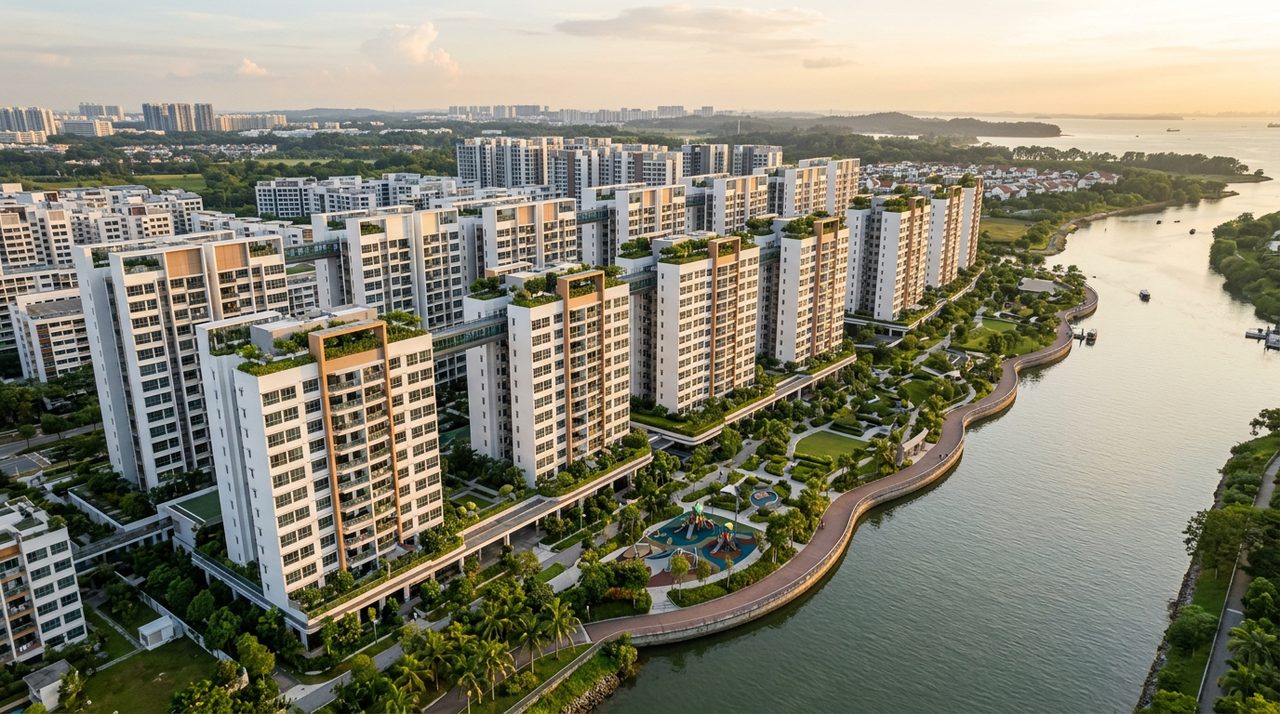
The Pinnacle@Duxton is structurally unlike the typical HDB resale project. HDB describes the development as seven 50-storey blocks in the Central Area. Its scale, linked form and city location give it an architectural identity that few public-housing developments can replicate.
Its location also combines access to the central business district with the larger floor plate of a five-room flat. Buyers seeking that combination face a limited pool of substitutes, particularly if they specifically want public housing rather than a smaller private apartment.
This scarcity helps explain why a project record is more informative locally than nationally. A five-room Pinnacle seller can point to the transaction as fresh evidence of what at least one buyer accepted for the same flat type and block. A seller in a conventional nearby block cannot assume the same psf rate transfers intact.
Even within The Pinnacle@Duxton, comparability has limits. Flat type, floor area, storey band, orientation, internal condition and view corridor can materially change how buyers assess two nominally similar homes. A four-room unit or a five-room flat with a less preferred outlook does not automatically inherit the $1,477 psf benchmark.
For owners, the sale strengthens the upper edge of the evidence. It may support higher expectations where a home closely matches the transacted unit, but an asking price is not a completed transaction. Subsequent registered sales will reveal whether this was an isolated agreement or the beginning of a durable new range.
For buyers, the same scarcity can work both ways. A recognisable central project may retain a deep pool of interested households when conditions are firm, but buying near a record leaves less room for imperfect comparisons. The next buyer need not value a renovation, orientation or view in the same way.
The cash commitment extends beyond $1.701 million
The record price is only the first layer of the financing decision. Under HDB’s current housing-loan framework, the maximum loan-to-value limit can be 75%, subject to eligibility and applicable loan conditions.
If a qualifying buyer obtained the full 75% against a valuation equal to the transaction price, the loan would be approximately $1,275,750. The remaining $425,250 would have to be funded through the permitted combination of cash and CPF savings, before stamp duty and other transaction expenses.
The valuation assumption matters. HDB’s resale financing process distinguishes the agreed resale price from the value used for financing; where the price exceeds the valuation, the difference is the cash-over-valuation amount and must be paid in cash. At a project-record price, that uncertainty deserves more attention than the nominal loan percentage alone.
Buyer’s Stamp Duty on a $1.701 million residential purchase is approximately $54,650, based on the prevailing marginal residential rates: 1% on the first $180,000, 2% on the next $180,000, 3% on the next $640,000 and 4% on the remaining $701,000.
That calculation does not include Additional Buyer’s Stamp Duty. A Singapore citizen buying a first residential property currently pays no ABSD, while liability varies by residency status and the number of residential properties already owned.
These figures do not establish whether the home is affordable for a particular household. Income, age, CPF balances, loan tenure, existing commitments and proceeds from a previous home all affect the answer. They do show why comparing a record-priced HDB flat with a private apartment solely by headline price can be misleading: valuation exposure, eligibility and funding structure matter too.
What this transaction changes—and what it does not
For The Pinnacle@Duxton, $1.701 million is now the strongest reported reference point for a closely matching five-room home in Block 1B. It demonstrates that the project’s upper market is not confined to its highest floors.
For the broader HDB market, its signal is weaker. The transaction bundles centrality, a comparatively large home, substantial elevation and the identity of a landmark development. Most resale flats reproduce only some—or none—of those attributes.
It would therefore be a mistake to treat this deal as proof that all Central Area flats have appreciated by the same amount, or that floor premiums have disappeared. One transaction reveals a clearing price between one buyer and one seller. A market shift requires a pattern.
The useful lesson is more specific. At the expensive edge of public housing, buyers appear willing to price the complete unit rather than rank homes mechanically by storey. A sufficiently elevated flat with more space, an acceptable outlook and scarce project attributes can outperform a higher-floor predecessor.
The next evidence to watch is the run of completed transactions around it. If similar five-room Pinnacle units begin clearing near $1,477 psf, this sale will look like a new pricing band. If later deals fall materially below it, the $1.701 million result will remain an exceptional home-specific benchmark rather than a general reset.