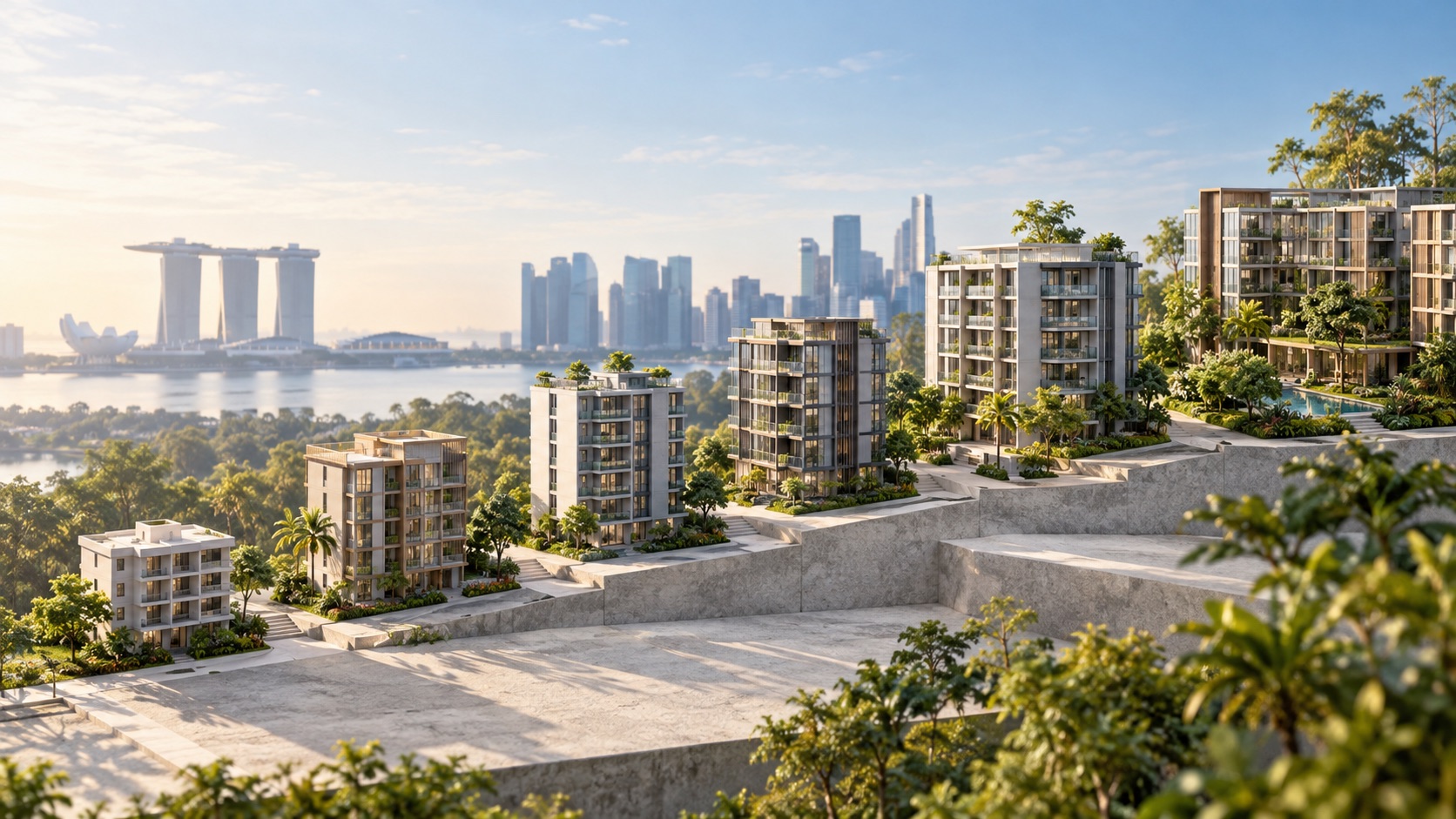
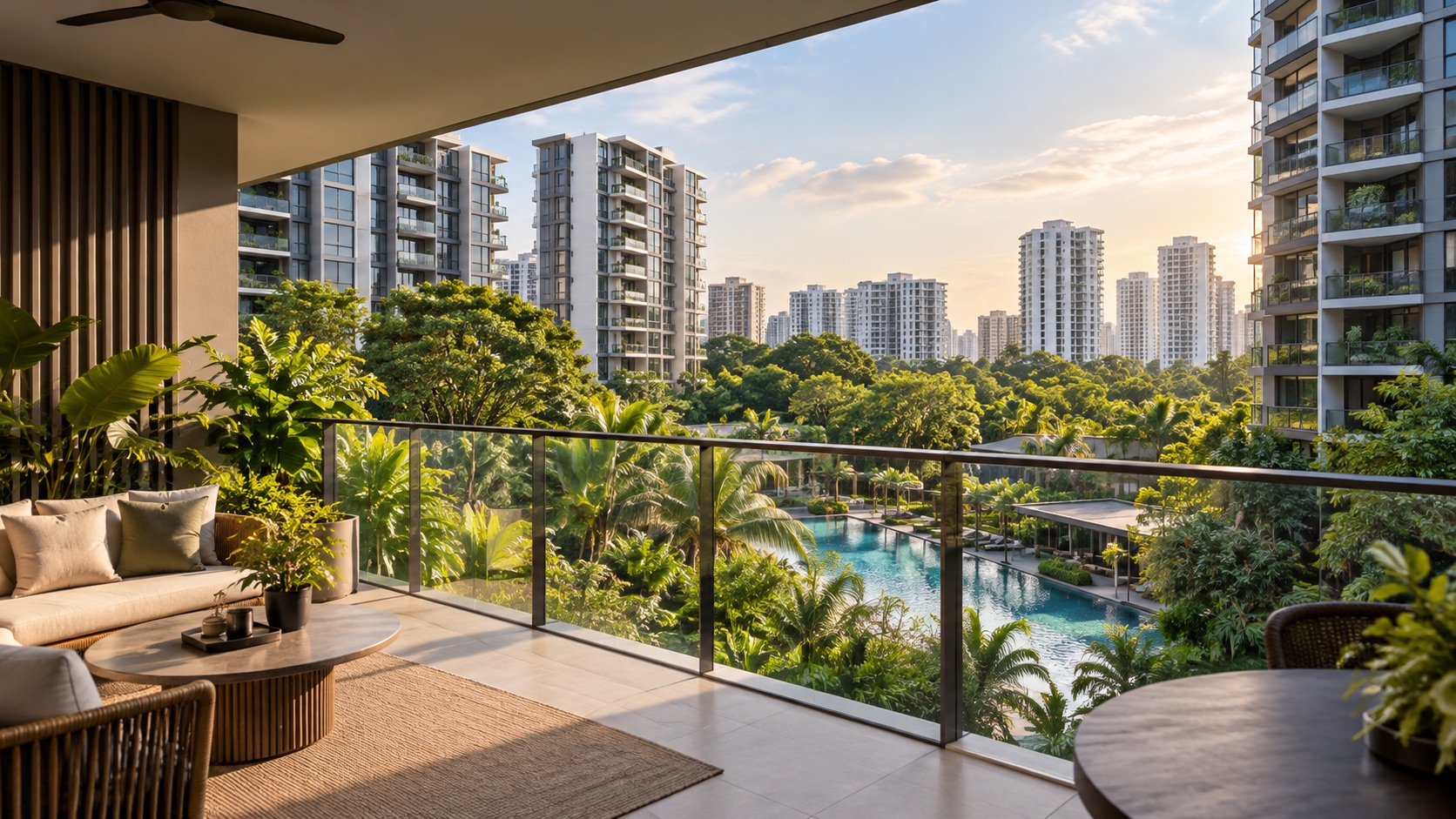
MBER on Upper Serangoon and Perennial Living at Parry Avenue: District 19 Is Building the Housing Tier Nobody Buys
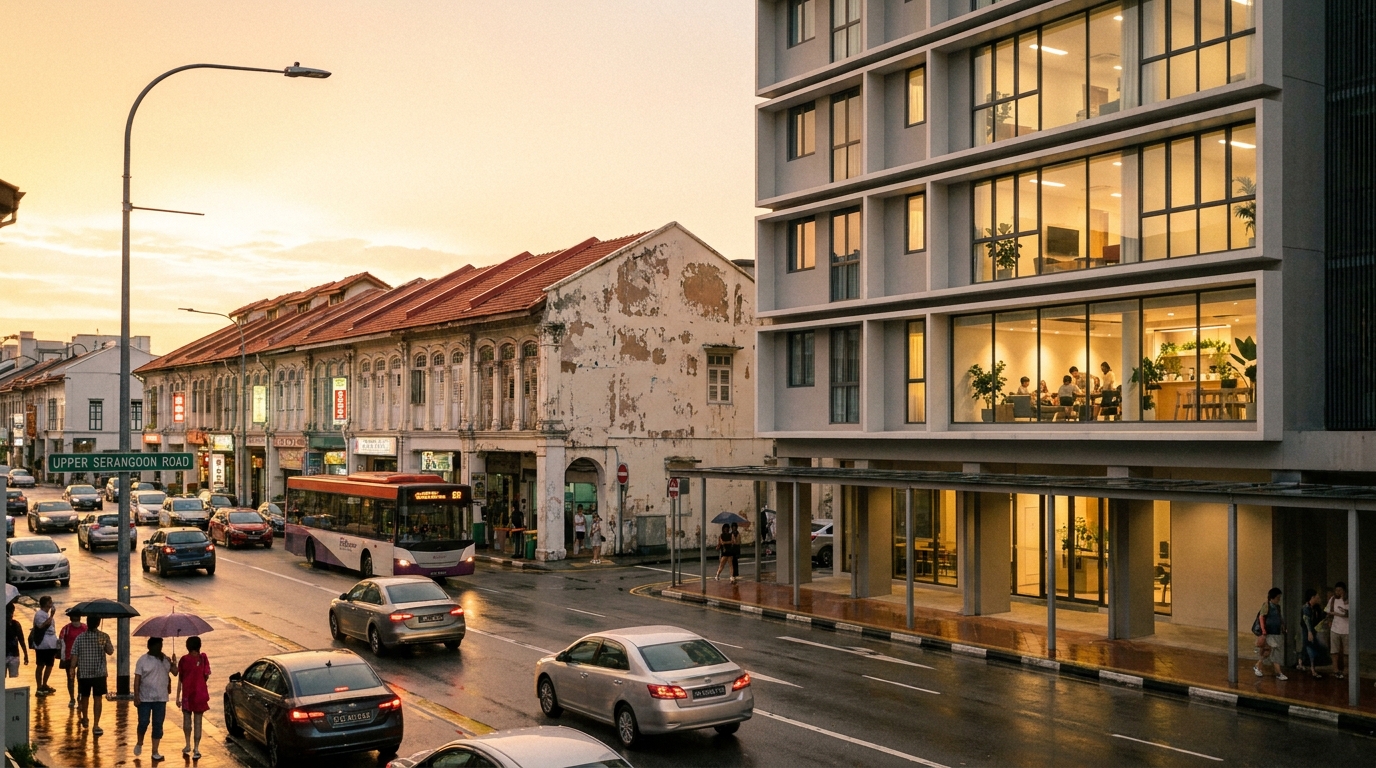
A 125-unit co-living and serviced apartment hybrid on a former wet market site, and Singapore's first commercial private assisted-living project a short drive away — Serangoon has quietly become the test bed for housing you rent by the month rather than buy.
The gist
- A 125-unit co-living and serviced apartment project sits on Upper Serangoon Road's former Lim Tua Tow Market site.
- Singapore's first commercial private assisted-living project at 28 Parry Avenue opened Phase 1 in August 2026.
- Co-living inventory reached roughly 10,000 rooms, with the top five operators holding over 65 per cent.
- Parry Avenue care packages start near S$8,000 monthly, versus S$60 to S$200 for HDB Community Care Apartments.
A former wet market site on Upper Serangoon Road now holds 125 purpose-built co-living and serviced apartment units. A short drive away, in Rosyth Estate, Singapore's first commercial private assisted-living development has opened its first phase. Neither sells a single unit to anyone — and that is exactly the point.
Two projects, one district, no title deeds
MBER Co-Living & Serviced Apartments sits along Upper Serangoon Road, on the site once occupied by Lim Tua Tow Market. It is the work of Aw & Sons Capital, whose managing director Josh Hu has taken a format that normally chases the city centre and dropped it into a neighbourhood of mature estates and old-school shophouses. The building pairs co-living rooms with serviced apartments, plus communal work and social spaces, wellness facilities and F&B.
Roughly the same postcode, a different demographic: Perennial Living at 28 Parry Avenue, in Rosyth Estate, District 19. Developed by Perennial Holdings, it is the country's first purpose-built commercial private assisted-living project, and Phase 1 opened in August 2026.
Put them side by side and a pattern emerges that the price indices cannot capture. District 19 now offers at least three ways to occupy a home in a mature estate without ever signing a sale and purchase agreement. That is a structural change, not a novelty.
Why co-living stopped chasing the CBD
Singapore's professionally managed co-living inventory has grown to roughly 10,000 operational rooms, and the sector has stopped behaving like a cottage industry. The Assembly Place listed on the SGX Catalist board in January 2026, raising S$18.3 million, and runs 3,520 operating keys with more than 2,100 in its pipeline. Coliwoo, spun off from LHN Group, operates over 2,900 keys across 25-plus locations.
Both have pushed hard into the Outside Central Region and city fringe — Boon Lay, Loyang, Bukit Timah, Clementi, Geylang, Serangoon. The top five operators now hold more than 65 per cent of total room inventory. This is an asset class with concentration, listed equity and a development pipeline.
The arithmetic explains the migration. A suburban common room runs roughly S$850 to S$1,400 a month, inclusive of utilities, Wi-Fi and housekeeping. A self-contained studio in the OCR or RCR sits at S$1,800 to S$2,800, against S$3,200 to S$4,500-plus for equivalent Core Central Region stock. When rents normalise, the tenant who was priced out of town does not leave the market — they move outward and downward in unit size.
And rents have normalised. The URA private residential rental index rose just 0.7 per cent in Q2 2026, with vacancy at 6.4 per cent, after a supply wave of more than 60,000 private units and executive condominiums across 2024 to 2026. A landlord letting a whole unit competes on price. An operator letting by the room competes on flexibility — and takes the yield premium that comes with running a hospitality business rather than collecting a cheque.
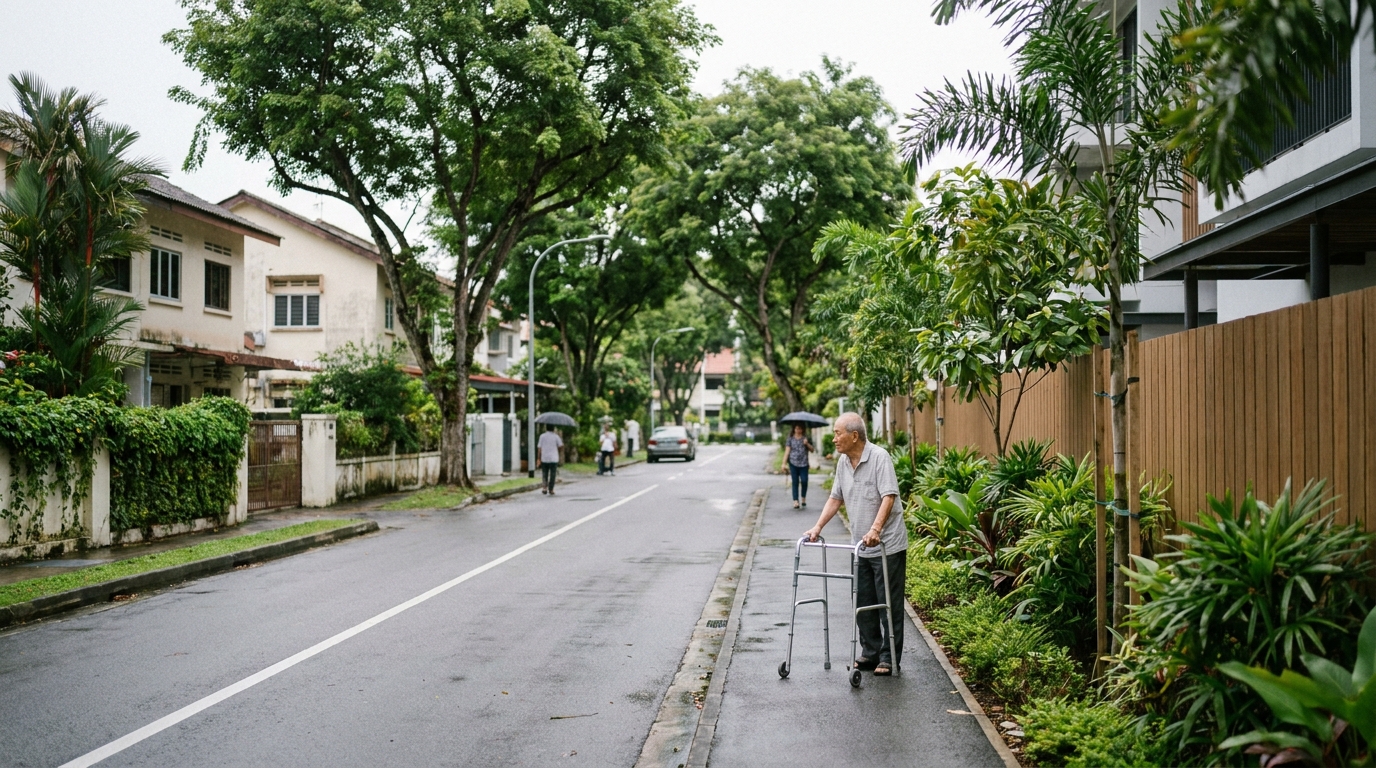
Serangoon now offers three ways to live in the estate without buying: a room by the month, a serviced apartment, and a care package. None of them registers in URA's price index — and all of them compete for the same households.
Parry Avenue: the state set the ratios, then the price
Perennial Living is not a private-sector improvisation. URA and the Ministry of Health launched the site through a Concept and Price Revenue tender in June 2023, awarded for S$71.99 million on a 60-year leasehold. Planning guidelines required at least 60 per cent of gross floor area for assisted living and 20 per cent for nursing care. The state fixed the product mix before a single design was drawn.
What was built on the 194,579 sq ft GFA reflects that: 200 assisted-living apartments ranging from 330 sq ft studios to 565 sq ft two-bedroom suites, a 100-bed nursing block, an integrated wellness centre spanning Western medicine, imaging, rehabilitation and TCM, and an adjoining 1.5-hectare public park. Total development value: S$260 million.
The price of entry is the headline that will follow this project for years. Monthly care and accommodation packages start at about S$8,000 and run past S$13,600 for the largest suites, scaling higher with acuity, with a three-month minimum stay. The developer is understood to be targeting 30 per cent occupancy in year one — a modest number that tells you how untested this demand is.
The gap in the middle is the real market
Singapore crosses into super-aged territory in 2026, with at least 21 per cent of citizens aged 65 and above. The public benchmark is HDB's Community Care Apartments — roughly 344 sq ft units on 15 to 35-year leases, bundled with a basic service package costing around S$60 to S$200 a month, with eligibility recently lowered from age 65 to 55.
Between a Community Care Apartment's monthly care package and Perennial Living's entry fee lies a gap of roughly forty times. That space is where the next decade of suburban housing product gets built.
Something is already filling it. After MOH mainstreamed its Shared Stay-in Senior Caregiving Services sandbox in late 2025, decentralised operators scaled up. Red Crowns Senior Living runs over 40 residential units in suburban HDB flats and condominiums housing around 300 seniors, at S$2,500 to S$5,000-plus per resident monthly. Boutique clusters — Minmed Homes, Happy Home's six landed houses in MacPherson, St Bernadette Lifestyle Village with 33 beds at Duku Road — typically charge S$4,000 to S$6,500 a month.
MOH's own framing is that "the majority of seniors prefer to age in their homes, where they can age actively, stay socially connected, and be cared for within their communities." Landed conversions in mature estates are the literal expression of that policy. The Singapore Land Authority has pushed the same logic further with intergenerational pilots including Commune@Henderson, in the former Henderson Primary School, and studies to convert around 20 black-and-white bungalows in Sembawang.
What this changes for buyers, not just renters
The buying implication is subtle and worth spelling out. A multi-generational family that once stretched for a dual-key unit or an oversized floorplate purely to house elderly parents now has an alternative: buy the right-sized home, and place the parent in a care setting within the same estate. That lowers purchase quantum and loan quantum in one move.
It also gives downsizers a second exit. A retiree sitting on a mature landed house or a large resale flat can monetise the asset and fund recurring fees — S$4,000 to S$6,500 at a boutique cluster, S$8,000-plus at Parry Avenue — without being confined to the Lease Buyback Scheme or Silver Housing Bonus.
For everyone else, heartland co-living is bridge housing. Upgraders waiting for TOP, couples waiting on BTO completion, owners who sold before their next home is ready, and families displaced by renovation all need the same thing: a furnished, professionally managed lease that does not lock them into 12 or 24 months. The MCCY/NYC pilot makes the intent explicit, offering discounted rooms at Coliwoo Boon Lay and 1925 Quarters from S$1,800 a month, roughly 30 per cent below open market, for young adults awaiting their flats.
With ABSD at 20 per cent on a citizen's second property and 60 per cent for foreigners, buying a stopgap home is not a rational option for most households. Renting flexibly is. That is a policy-created demand pool, and operators have read it correctly.
The risks investors keep underpricing
Co-living and assisted living are operating businesses wearing a real estate costume. Standard private residential properties face URA's cap of six unrelated occupants; running eldercare or scaled communal housing requires planning approval, and licensing under the Healthcare Services Act or MSF guidelines. Zoning friction is not a footnote — it is the moat, and the constraint.
Then there is manpower. Trained nurses, care staff and hospitality personnel are scarce and expensive, and margin pressure lands on the operator, not the landlord — until the operator fails, at which point it lands on the landlord. Anyone signing a master lease with a co-living or care platform is underwriting operator credit quality as much as location.
Cultural resistance is the quieter risk at Parry Avenue. Expectations around filial piety still lead many families to read a care facility as abandonment. Recurring fees of S$8,000 to S$17,000 a month at the premium end also deplete family savings fast over a multi-year stay. A 30 per cent first-year occupancy target is the developer conceding both points.
What to watch next
- Absorption at Parry Avenue. Occupancy and take-up over the next 12 months is the only honest test of whether private assisted living is a market or a showcase.
- Portable subsidies. Watch for MOH or CPF Board moves on long-term care insurance eligibility, CareShield Life payouts or CPF allowances applied to accredited private assisted living. That single policy lever would collapse the forty-fold gap faster than any developer can.
- The land pipeline. Future URA and MND tenders for dedicated assisted-living or hybrid living zoning in OCR and RCR sites will show whether Parry Avenue was a one-off pilot or the first of a series.
- Yield versus complexity. Room-by-room leasing beats vanilla letting on gross yield. Net of management, licensing and staffing, that spread is thinner than the marketing suggests.
The wider point is that Singapore's suburbs are acquiring a rental tier that was never planned for them. MBER puts a purpose-built co-living and serviced apartment product on a former market site in the heartlands; Perennial Living puts a priced, licensed care product in a landed estate. Neither will move the URA price index — private home prices rose just 1.4 per cent in the first half of 2026 — but both change the calculation a household makes before it buys.