The break-even premium · the duty · the exitmastplan
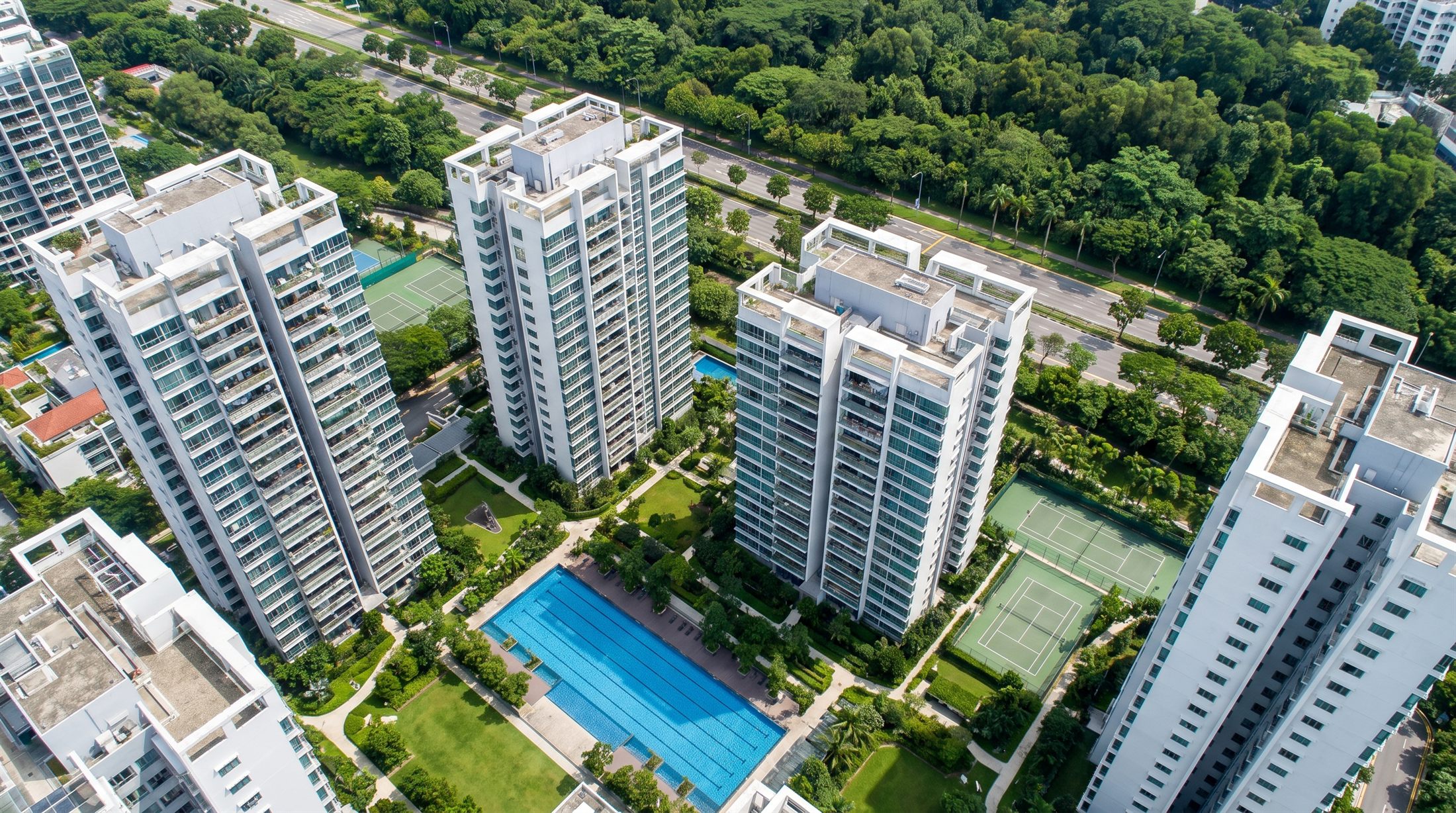
A dual key condominium is one title, one set of duties, and two front doors. The argument for it rests on a single piece of arithmetic — that two small leases out-earn one large one — and that arithmetic holds only up to a price. This page computes the price.
0%
ABSD if it is your first residential property
1.1pp
gap between one-bedroom and three-bedroom gross yields, island-wide
13.9%
price premium at which the dual key advantage disappears
Computed from published island-wide gross yields by bedroom count and from the rental split set out below. The third figure is arithmetic, not an opinion.
The mechanic
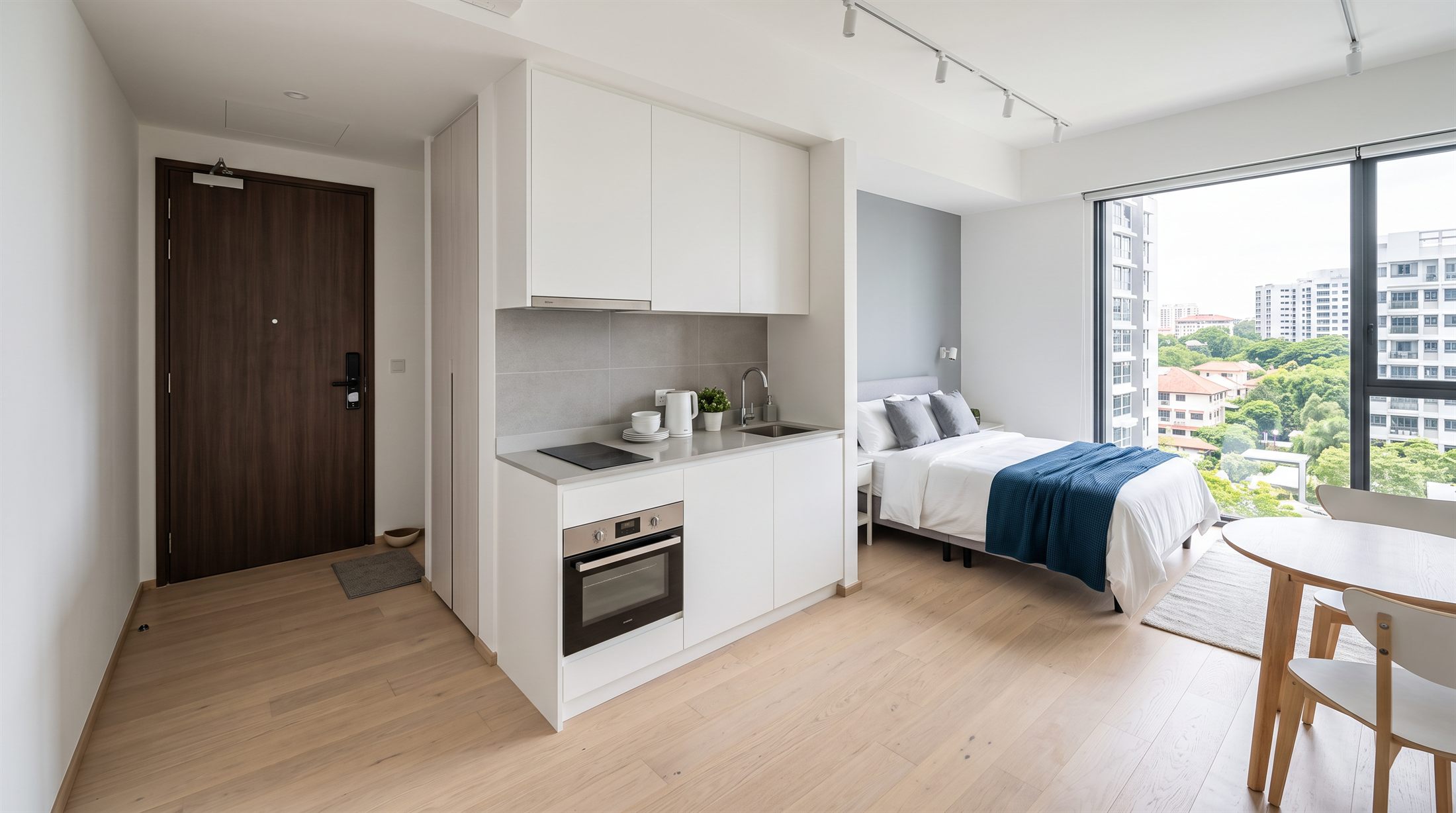
Nothing about a dual key is exotic. It is a normal condominium unit with an internal wall, a second entrance, and a second kitchen or kitchenette, sold under a single strata title. One property tax bill. One mortgage. One set of stamp duties. Two tenancies.
The reason anyone pays extra for that arrangement is a well-documented feature of the Singapore rental market: small units rent for more per square foot than large ones. A tenant renting 450 square feet is buying an address, a commute and a front door, and pays for all three across a small floor plate. A tenant renting 1,100 square feet is buying floor area, and floor area gets cheaper the more of it you take.
Island-wide, that gradient shows up cleanly in gross yields. Across 2024 resale and rental transactions, one-bedroom units averaged a 4.1% gross yield, two-bedroom units 3.3%, and three-bedroom units 3.0%. The dual key is an attempt to buy the three-bedroom quantum and collect part of it at the one-bedroom rate.
Gross rental yield by unit size
Island-wide average, 2024 resale and rental transactions
Published island-wide analysis of 2024 rental and resale transactions. Gross yields, before maintenance, property tax, vacancy and financing. Project-level yields vary widely around these averages.
Applied to a specific pair of units, the mechanic looks like this. A regular three-bedroom at 1,100 square feet lets as one tenancy at $4,300 a month. A three-bedroom dual key at 1,200 square feet splits into a roughly 750 square foot main unit at $2,800 and a roughly 450 square foot studio at $2,100. Two leases, $4,900 a month.
One tenancy versus two
Size
Rent
$ psf
Regular three-bedroom
1,100 sqft
$4,300
$3.91
Whole unit, one lease
—
—
—
Dual key three-bedroom
1,200 sqft
$4,900
$4.08
Main unit
~750 sqft
$2,800
$3.73
Studio
~450 sqft
$2,100
$4.67
Monthly difference
+100 sqft
+$600
+$0.17
mastplan
Illustrative, based on mass-market outside-central-region condominiums at mid-2025 market rents. The studio's higher rate per square foot is the entire mechanic.
Rent per square foot, by what you are letting
The studio carries the gradient; the main unit gives some of it back
Computed from the rental split above. Illustrative rents, not transacted medians.
The dual key does not create rent. It re-slices the same floor area so that more of it is priced at the small-unit rate. Whether that is worth anything depends entirely on what you paid for the re-slicing.
That last sentence is where most dual key analysis stops, and it is where the actual decision lives. Rent went up 13.9%. If the price went up less than 13.9%, the yield improves. If the price went up more, the yield gets worse — and you are holding a harder unit to sell for the privilege.
The curve below is the whole argument in one frame. It plots the dual key's gross yield against the premium paid over the equivalent regular unit, with the regular unit's own yield drawn flat across it. They cross at 13.9%.
The break-even premium
Dual key gross yield as a function of the price premium paid
Dual keyRegular unit
Computed from the rental split above on a $1.75M regular-unit basis. The vertical axis starts at 2.6%, not zero, so the crossing is legible. Gross yields, before costs.
The premium is not published anywhereDevelopers do not price a dual key as a line item. It is embedded in the unit's price per square foot and in the extra floor area you are obliged to buy to get the second door. Working it out means finding a comparable regular stack in the same project, on a similar floor and facing, and differencing the rate per square foot. That comparison exists in every project and almost nobody runs it.
A 100 square foot difference is not the whole premiumIn the example above the dual key is 100 square feet larger. At an outside-central-region rate of roughly $1,600 per square foot, that alone is $160,000 — about 9% on a $1.75M base, before any premium for the layout itself. Nine of the thirteen-point-nine percentage points of headroom are consumed by floor area you did not ask for.
Break-even moves with the rent split, not with the sales pitchIf the studio lets at $1,800 rather than $2,100, the rent uplift falls from 13.9% to 6.9% and the break-even premium halves. The studio's rent is the most volatile number in the whole calculation and the one most often quoted at its ceiling.
You have the arithmetic. Now the scorecard.
The ownership arithmetic is clear. Now see which units actually pass.
The headline arithmetic is only the first test. The full scorecard shows which layouts hold up once rental demand, resale liquidity and real ownership costs are considered.
The ten-factor scorecard — rental, exit and layout, with the failure condition written next to each factor.
Five projects graded — and the transaction spread between the dual key and the regular unit in the same development, including the two that lost.
The net yield walk — gross to net through maintenance, property tax, vacancy and income tax, then through the mortgage.
The traps — the layout faults behind an eleven-year hold that returned 1.6% a year, and the six questions to answer before you offer.
Open the full scorecard
Enter your details for instant access — about 30 seconds.
You're in.
The full scorecard is open below.
Instant accessNo account requiredRelevant follow-up only
The stamp duty argument
The second argument for a dual key has nothing to do with rent. It is that two income streams under one title attract the stamp duty of one property, and the alternative — buying a home and then buying an investment property — attracts Additional Buyer's Stamp Duty on the second purchase.
That is true, and it is the strongest single fact on this page. The rates below took effect on 27 April 2023 and have not moved since.
Additional Buyer's Stamp Duty, effective 27 April 2023
Buyer profile
1st property
2nd
3rd and after
Singapore Citizen
0%
20%
30%
Singapore Permanent Resident
5%
30%
35%
Foreigner
60%
60%
60%
Entity
65%
65%
65%
Trustee
65%
65%
65%
mastplan
ABSD is charged on the higher of purchase price or market value, and sits on top of Buyer's Stamp Duty, which everyone pays on every purchase. Reliefs exist for married couples and under certain treaties. Verify current rates before you transact.
So how much is avoided? The honest answer is that the number is 20% of whatever second property you did not buy, and there is no single figure. Source material on this subject routinely quotes $400,000, which is 20% of a $2.0M second property, next to a comparison table built on a $1.75M second property, where the correct figure is $350,000. Both are right on their own basis. Neither is a constant.
ABSD avoided, by the price of the property you did not buy
Singapore Citizen buying a second residential property, 20% rate
20% of purchase price. Effective 27 April 2023. Buyer's Stamp Duty is additional and is not shown here.
Set against the whole duty bill, though, the comparison is less flattering than it first looks — because the two routes do not buy the same amount of property. One dual key at $2.0M is $2.0M of real estate. A home plus an investment property at $1.75M each is $3.5M of real estate. The duty difference is enormous. So is the exposure.
Total duty payable, three routes
Buyer's Stamp Duty plus ABSD, Singapore Citizen
Buyer's Stamp DutyABSD
Buyer's Stamp Duty computed exactly on the schedule effective 15 February 2023. ABSD at the Singapore Citizen second-property rate of 20%, effective 27 April 2023. The third route acquires $3.5M of property against $2.0M for the second — the duty gap is not a like-for-like saving.
It is avoidance, not saving, and only while it is your firstThe moment you buy anything else residential, the 20% arrives on that purchase instead. The dual key defers the ABSD decision; it does not delete it. If your ten-year plan includes a second property, the duty is in the plan either way — it simply lands later.
You still pay more Buyer's Stamp Duty than on a smaller unitThe dual key in this comparison carries $12,500 more Buyer's Stamp Duty than the regular unit, because it costs $250,000 more. Buyer's Stamp Duty is marginal-rated at 5% through this band and 6% above $3M, so the duty rises with the premium you are paying for the second door.
Two properties diversify; one dual key does notA home in one district and an investment unit in another are two markets, two tenant pools, two exit windows. A dual key is one asset in one project, and both of its tenancies are exposed to the same submarket at the same time. That concentration is a real cost and it never appears in a duty comparison.
The scarcity thesis
The third argument is scarcity: developers are building fewer dual key units, so the existing stock becomes a closed set. The supply half of that is straightforwardly true. The demand half is where it needs checking.
New launch supply is thinning across every region
The wider new-launch pipeline is genuinely tightening. About 4,575 private residential units are slated for launch in the first half of 2026, against 4,725 in the second half of 2025, and the geographic mix has shifted hard to the suburbs — roughly 64% of 2026 launches outside the central region, 22% in the rest of central region, and about 14% in the core central region, down from around 23% a year earlier. Gross floor area harmonisation has cut average unit sizes by about 8%, and the design conversation has moved to dumbbell layouts and enclosed kitchens rather than to second front doors.
4,575
private units slated for launch in 1H2026
64%
of 2026 launches outside the central region
-8%
average unit size, after GFA harmonisation
Launch pipeline and regional mix from published 2026 market outlooks; GFA harmonisation effect as commonly reported across the industry.
Against that backdrop, four project-level data points get quoted as evidence that the dual key is becoming scarce. They do not all say the same thing.
Four projects, two different stories
Project
Dual key line
Outcome
Reads as
Nava Grove · D21
23 units, 4BR
0 sold, line scrapped
Demand failure
TMW Maxwell · D02
Mixed-use
0 sold
Demand failure
Grand Dunman · D15
2-bedroom DK
100% sold
Real demand
Aurelle of Tampines · D18
3-bedroom DK
70% sold, H1 2025
Real demand
mastplan
Independent commentary corroborates the two zero-takeup projects and adds two more — Parksuites and LakeGarden Residences — each of which moved a single dual key unit.
Share of the dual key line sold
Nava Grove
0%
TMW Maxwell
0%
Aurelle 3BR
70%
Grand Dunman
100%
mastplan
Nava Grove's 23 dual key units were reconfigured into regular four-bedroom-plus-study layouts after none sold. Percentages as reported; sales windows differ between projects.
A developer scrapping a dual key line because nobody bought it is not scarcity. It is the market pricing the layout at zero and the developer agreeing.
The distinction matters for exactly one reason: scarcity only supports a price if demand outlives supply. Where the dual key sold out — a two-bedroom format in a large District 15 development, a three-bedroom format in a mass-market District 18 launch — the thesis is intact and the resale pool will be thin in a good way. Where it did not sell at all, the same thinness on resale is a liquidity problem, not a moat.
Which of those two situations your target unit is in is a project-level question, and it is the first of the ten the framework below asks.
The ten-factor scorecard
Ten factors, in three groups. Rental factors decide whether the two leases materialise at the rents you underwrote. Exit factors decide whether anyone buys it from you. Layout factors decide both, because the wall is the whole asset.
The ten-factor scorecard
#
Factor
Fails when
01
Tenant depth within 2km
The submarket has one employer and no second-hand demand
02
Studio rent evidence
The $2,100 comes from a listing, not a transacted lease
03
Dual key premium on the stack
Above 13.9% against the comparable regular stack
04
Competing supply before exit
New launches land in the same submarket inside your hold
05
Resale depth in the district
Fewer than a handful of dual key resales in three years
06
Exit audience width
Only investors buy it; families and multi-generational buyers cannot
07
Development liquidity
A small project with no regular turnover to price against
08
Hackable wall
The dividing wall is structural and the layout is permanent
09
Both sides liveable alone
A windowless kitchen, a loft ceiling, a slanted balcony wall
10
Your own TDSR and LTV
The quantum works on paper and not at the bank
mastplan
The scorecard is a filter, not a score. A unit that fails factor 08 or factor 06 is not a lower grade — it is a different asset, and one with a materially smaller buyer pool.
Rental factors — 01, 02, 03, 10These decide whether the yield you underwrote exists. The single most common failure is factor 02: the studio rent used in the model is the top of an asking range in a good quarter, and the transacted rent is 10 to 15% below it. Because the studio carries the entire yield uplift, a 15% miss on the studio wipes out the advantage on its own.
Exit factors — 04, 05, 06, 07These decide whether there is a bid when you want out. A dual key sells to a narrower audience than a regular unit of the same size, and the audience narrows further if the wall cannot come down. In a soft quarter, a narrow audience does not mean a lower price. It means no offers at all, for months.
Layout factors — 08, 09These decide both of the above. A hackable wall converts the unit back to a regular three or four-bedroom at exit, which restores the wide buyer pool. A structural wall means the unit is a dual key forever, and every future buyer must want exactly that.
The wall is the asset — whether it can come down decides the exit
Five projects, five grades
The framework applied to five real dual key lines. The grades are a worked example of the ten factors, not a rating service — no published rubric converts ten qualitative factors into a letter, and this one is no exception.
Top five resales all dual key; MRT supports the letting
B+
Nava Grove
D21 · 1,464 sqft 4BR
None sold, line scrapped; no rental depth for the premium
C
mastplan
Format, tenure and floor area as marketed. The commentary is the framework's reading of each line, not a valuation of any unit within it.
Four of the five grades are decided by two factors: whether the wall comes down, and whether anyone other than an investor would want the unit.
The Gem Residences entry is the one worth pausing on, because it is the only line here where the format itself raises the income ceiling rather than merely re-slicing it. A triple key produces three tenancies from one title. The combined $5,300 against $4,300 for the equivalent regular three-bedroom is a 23% rent uplift — meaningfully above the 13.9% break-even computed earlier, and the only entry in this table with that much headroom.
Nava Grove is the inverse and the most instructive. It is not that the grade is low. It is that there is no market price for the unit at all, because none ever transacted, and the developer removed the line rather than discount it.
What the transactions say
Five developments where both a dual key line and a comparable regular line have resold. This is the only part of the dual key case that rests on transactions rather than on arithmetic, and it is worth reading exactly as it is.
First, a labelling correction that matters. These figures circulate under the heading annualised returns, and the footnote attached to them says they reflect total capital gain, not an annualised internal rate of return. The footnote is right and the heading is wrong. A 35.3% annualised return would be extraordinary; a 35.3% total gain over a multi-year hold is unremarkable. Everything below is labelled as total capital gain.
Total capital gain — dual key against regular, same development
Development
Dual key
Regular
Spread
Principal Garden · D03 · Redhill
30.1%
19.1%
+11.0pp
Gem Residences · D12 · Toa Payoh
27.4%
20.2%
+7.2pp
High Park Res. · D19 · Sengkang
35.3%
31.9%
+3.4pp
Arena Res. · D14 · Geylang
12.8%
17.4%
-4.6pp
Cocoapalms · D18 · Pasir Ris
14.6%
23.0%
-8.4pp
Mean spread
—
—
+1.7pp
mastplan
Computed from published transaction analysis of URA caveats. Total capital gain over the hold, not annualised. Individual transactions within each line vary widely around these figures, and the holds are not the same length across developments.
The dual key spread, by development
Dual key total gain minus regular-unit total gain, percentage points
Positive means the dual key line outperformed the regular line in the same development. The axis starts below zero to show both directions.
Three of the five went the dual key's way. Two did not, and the two that did not lost by more than the smallest win. The mean spread across all five is +1.7pp, which is positive, thin, and computed on a sample of five.
Plotted against each other, the picture is clearer than any average. Anything below the diagonal is a development where the dual key beat the regular unit. Anything above it is a development where owning the ordinary layout would have been the better decision.
Dual key against regular, same development
Below the diagonal, the dual key won. Above it, the regular unit did.
Same source as the table above. Five developments is a sample, not a market. The diagonal is the line of equal performance.
The two losses share a district profileArena Residences in District 14 and Cocoapalms in District 18 are both locations where the regular-unit buyer pool is deep and the dual key premium has to be justified against a large, liquid comparable set. The three wins sit where either the rental corridor is unusually strong or the development is large enough to give the format its own market.
A positive mean on five observations is not a findingFive developments, unequal hold periods, no control for floor, facing, stack or entry quarter. The table is useful as a demonstration that the spread runs in both directions. It is not evidence of a reliable premium and should not be underwritten as one.
The yield reality
The published dual key scenario and the published regular-unit scenario do not agree with the rental table they sit next to. Recomputing both on the same rents removes the entire advantage.
The scenario as circulated: $2.0M for a three-bedroom dual key outside the central region, a studio letting at $2,000 a month, gross yield of roughly 1.2% if you occupy the main unit and let only the studio, and roughly 4.0 to 4.3% with both sides let. The 1.2% figure is exact — $2,000 a month on $2.0M is 1.2% to the decimal. The 4.0 to 4.3% figure is not consistent with anything else on the page.
To produce a 4.15% gross yield on $2.0M you need $6,917 a month. The rental table two sections earlier puts the same three-bedroom dual key at $4,900. On $4,900 the gross yield is 2.94%. The regular-unit scenario, by contrast, checks out exactly: $4,300 a month on $1.75M is 2.95%, inside the published 2.9 to 3.2% band.
Gross yield: as published, and recomputed on the same rents
Both routes, $2.00M dual key against $1.75M regular unit
As publishedRecomputed
Published figures are the midpoints of the circulated ranges. Recomputed figures use the rents from the same source's own rental split: $4,900 for the dual key, $4,300 for the regular unit.
Recomputed on its own rents, the dual key scenario yields 2.94% and the regular scenario yields 2.95%. The gap is four basis points, in the regular unit's favour.
That is not an argument against dual key units. It is an argument against a $2.0M price on a unit whose regular equivalent is $1.75M — a 14.3% premium, which sits just the wrong side of the 13.9% break-even computed in the first section. The layout is fine. The price in the scenario is not.
Gross yield is also the wrong number to end on. Below is the same $2.0M dual key walked from gross rent down to what actually reaches you.
From gross rent to net, one $2.00M dual key, both sides let
Per year
% of price
Gross rent — $4,900 a month
$58,800
2.94%
Maintenance and sinking fund
-$5,400
0.27%
Property tax, non-owner-occupied
-$9,120
0.46%
Vacancy allowance at 6.0%
-$3,528
0.18%
Leasing commission, two leases
-$2,000
0.10%
Repairs — two kitchens, two bathrooms
-$1,800
0.09%
Net before income tax
$36,952
1.85%
Income tax at a 15% marginal rate
-$5,543
0.28%
Net rental income
$31,409
1.57%
mastplan
A model, not a quotation. Maintenance at $450 a month, annual value assumed at $54,000, vacancy at the 6.0% island-wide rate for completed private units at end-4Q2025, income tax at an illustrative 15% marginal rate. Your annual value, your marginal rate and your maintenance are all different.
Gross to net on the same unit
The same $2.00M dual key at each stage of the walk-down
Computed from the walk-down above. Still before any financing.
Independent commentary on Singapore private residential yields puts the island-wide gross average at roughly 3.1% in early 2026 and observes that net yields after property tax, maintenance, vacancy and financing are frequently closer to 2%. The walk above lands at 1.57%, which is inside that description and not a pessimistic case.
Property tax is not a footnote at this annual value
Annual value band
Owner-occupied
Non-owner-occupied
First $12,000
0%
12% on first $30,000
Next $28,000
4%
—
Next $10,000
6%
20% on next $15,000
Next $25,000
10%
28% on next $15,000
Next $10,000
14%
36% above $60,000
Next $15,000
20%
—
Next $40,000
26%
—
Above $140,000
32%
—
mastplan
Owner-occupier rates as adjusted with effect from 1 January 2025; non-owner-occupied rates as they stand from 1 January 2024. Letting both sides moves the whole unit onto the right-hand column. Letting only the studio while you live in the main unit does not. Verify the prevailing rates and any rebate before you model.
Then the mortgage arrivesAt 75% loan-to-value, a $2.0M purchase carries a $1.5M loan. At 2.5% over thirty years the instalment is $5,927 a month. Net rental income of $31,409 a year is $2,617 a month. The unit runs a cash shortfall of about $3,309 a month, of which part is principal you are repaying to yourself and part is genuinely gone.
Rates are low right now, and that is the assumptionFixed packages in early 2026 have been quoted from roughly 1.5% to 2.2%, with three-month compounded SORA around 1.20 to 1.30% at the end of 2025. The model above uses 2.5% to avoid underwriting the bottom of a rate cycle across a thirty-year loan. If you model at today's fixed rate, model what happens when it resets.
Two tenancies is two of everythingTwo lease renewals, two sets of agent commission, two deposits to return, two tenants who can leave in the same quarter. Dual key vacancy is not one risk at 6% — it is two independent draws, and the studio tenant is typically the shorter-staying of the two.
The mistakes that trap you
A dual key that fails on layout does not underperform gently. It sits, because the audience that would forgive the fault is the audience that cannot use the layout.
A kitchen with no windowVentilation is the single most common complaint in a split unit, because the second kitchen is usually carved out of interior floor area with no external wall to work with. Tenants tolerate it. Family buyers at resale do not, and they are the buyers who widen your exit.
A loft concept in the master bedroomIt shows beautifully and it removes the room from the family market. A loft ceiling means one usable bedroom fewer for a buyer with children, and it cannot be undone without rebuilding the volume.
An odd slanted wall in the balcony areaAny geometry that makes furniture placement a puzzle is priced by resale buyers as a discount and by tenants as nothing at all. That asymmetry is exactly how a unit ends up letting well and selling badly.
A structural dividing wallThis is the one that cannot be fixed. A hackable wall means the unit converts back to a regular three or four-bedroom at exit and rejoins the wide market. A structural wall means every future buyer must specifically want a dual key, forever.
Investor-friendly is not family-friendlyThe list above has a pattern. Every fault is invisible to a tenant on a two-year lease and expensive to a buyer holding for a decade. A unit optimised for the first audience is being sold to the second.
The layout that lets easily and the layout that sells easily are not the same layout, and you only find out which one you own at exit.
The case that makes the point: a couple bought a two-bedroom dual key in a mixed-use development in the rest-of-central-region. The master bedroom had a loft concept. The kitchen had no window. There was an odd slanted wall in the balcony area. It let without difficulty for eleven years.
When they tried to sell into a softer market, there were no offers for six months. They eventually exited at an annualised gain of 1.6% across eleven years — a total capital gain of about 19% over the whole hold. A regular unit in the same development performed materially better over the same window.
Eleven years, three growth rates
Total capital gain over an eleven-year hold
The 1.6% figure is the case study's realised annualised gain. The 3.0% and 4.5% columns are illustrative compounding at those rates over the same eleven years — they are a model, not a forecast, and not a claim about what any particular unit returned.
Six months without an offer is the part of that story worth underwriting. It is not a price problem in the ordinary sense — it is what a narrow exit audience looks like when the market turns. A regular three-bedroom in a soft quarter gets low offers. A faulted dual key gets silence, and silence has no floor you can negotiate against.
The lifecycle case
There is a version of the dual key case that does not depend on the yield arithmetic at all, and it is the strongest one. It treats the second door as optionality across a household's life rather than as an income product.
1
Years 1–5 · Early careerYou and your partner occupy the main unit. The studio lets for around $2,000 a month against the mortgage. The whole unit stays on owner-occupier property tax rates, because you live in it — a materially different bill from the non-owner-occupied column above.
2
Years 6–12 · Growing family, ageing parentsParents sell their flat and move into the studio. Close enough for daily care, separate enough for independence, and no second property, no ABSD and no second mortgage. This is the use case the layout was actually designed for.
3
Years 13–18 · Children independentThe studio returns to the rental market, now at whatever market rents have become. The unit reverts to a two-income asset without any transaction, any duty, or any agent.
4
Years 19+ · Exit or holdIf the wall is hackable, the unit converts back to a regular three or four-bedroom and rejoins the wide buyer pool. If it is not, you are selling a dual key into a dual key market. Factor 08 decides which of those two sentences describes your exit, and it was decided on the day the unit was built.
Read that way, the dual key is not a yield play with a family benefit attached. It is a housing decision with a yield option attached, and the option is worth most in the years when a household would otherwise be looking at a second property.
The chart below is what the ownership actually looks like on that path: a $2.0M purchase at 75% loan-to-value over thirty years, with the loan amortising underneath while the asset compounds at a deliberately modest rate above it.
Twenty-five years of one dual key
$2.00M purchase, 75% loan-to-value, 2.5% over thirty years
Asset valueEquityMortgage
A model. Asset value compounds at 2.5% a year, chosen deliberately below the long-run private residential index rather than at it. Mortgage balance is the exact amortisation of a $1.50M loan at 2.5% over thirty years. Nothing here is a forecast, and no transaction costs, duties or renovation are included.
The lifecycle case survives a bad yield year; the income case does notIf your parents are in the studio, vacancy is zero and the studio rent is irrelevant. If the studio is your yield, a soft quarter is a direct hit. The two cases have completely different risk profiles and they are routinely argued as though they were one.
It requires the wall to be the right wallEvery stage above except the last works with a structural wall. The last one does not, and the last one is where the money is. Factor 08 is not a layout preference — it is the difference between a wide exit and a narrow one, twenty years out.
Occupying the main unit changes the tax picture entirelyOwner-occupier rates start at 0% on the first $12,000 of annual value and reach 4% on the next $28,000. The non-owner-occupied column starts at 12% from the first dollar. Living in the unit while letting the studio is a materially cheaper structure than letting both sides, and it is the structure the lifecycle case assumes.
Six questions before you offer
Six questions. None of them is answerable from a brochure, a floor plan or a listing portal, and all six are answerable from public transaction data plus one site visit.
1
What is the tenant turnover rate within two kilometres of the project?Not the rent — the turnover. Two leases in a submarket with thin tenant depth is two vacancy exposures, not one. This is factor 01 and it is the cheapest question on the list to answer badly.
2
What is the dual key premium on the specific stack you are considering?Against the comparable regular stack, same floor band, same facing, on a rate-per-square-foot basis. If it is above 13.9%, the yield argument is already spent before you begin.
3
How many dual key resales has this district seen in the past three years?This is your exit liquidity, stated as a number. A district with a handful of dual key resales in three years does not have a dual key market — it has a queue.
4
Is the studio wall in your target unit hackable or structural?Ask for the structural drawing, not the marketing floor plan. This single answer moves the exit audience more than anything else on this page.
5
How many competing new launch units enter the same submarket before your planned exit?Your competition at resale is not today's stock, it is today's stock plus everything that completes between now and then. With about 64% of 2026 launches in the outside-central region, suburban dual keys carry the most of this risk.
6
Does your TDSR and loan-to-value position actually support the quantum?The dual key route works by concentrating your budget into one larger purchase. That only helps if the larger purchase is financeable at all — and rental income is haircut heavily in a total debt servicing ratio assessment.
The bottom line
The mechanic is real. Small units rent for more per square foot — 4.1% gross on one-bedrooms against 3.0% on three-bedrooms, island-wide. A dual key converts part of a large quantum into small-unit rent. That much is not in dispute.
It stops working at a 13.9% premium. The rent uplift in the standard example is 13.9%. Pay more than that over the comparable regular unit and the yield advantage is gone, and you are still holding the harder unit to sell.
The circulated $2.0M scenario is on the wrong side of that line. Against a $1.75M regular unit it is a 14.3% premium. Recomputed on the same rents, the two routes yield 2.94% and 2.95%.
The stamp duty argument is the strongest one, and it is not a saving. 20% ABSD on a second property is avoided while it remains your only property. It is deferred, not deleted — and the two-property route buys $3.5M of real estate against $2.0M.
Scarcity cuts both ways. Two of the four quoted scarcity data points are zero-takeup projects. A line nobody bought is a liquidity problem on resale, not a moat.
The transaction record is a 3–2 split. Five developments, mean spread +1.7pp, and the two losses are larger than the smallest win. That is not a reliable premium and should not be underwritten as one.
Net, after everything, is about 1.57% — before the mortgage. At 75% loan-to-value and 2.5% the unit runs a cash shortfall of roughly $3,309 a month.
Factor 08 decides the exit. Hackable wall, wide buyer pool. Structural wall, narrow one, permanently. Everything else on the scorecard is negotiable; that is not.
mastplan
How this was built
This page combines figures circulated in dual key marketing material with independent published data, and recomputes every number that could be recomputed. Where the two disagree, the disagreement is shown rather than resolved.
Stamp duty is exact. Buyer's Stamp Duty is computed on the schedule effective 15 February 2023; ABSD at the rates effective 27 April 2023. No rounding, no reliefs applied.
The break-even premium is arithmetic, derived from the rental split quoted in the source material itself. It moves the moment the studio rent moves.
Gross yields by bedroom count are island-wide averages from published analysis of 2024 rental and resale transactions. Project-level yields vary widely.
The five-development table is five observations, with unequal hold periods and no control for floor, facing, stack or entry quarter. It is shown because it runs in both directions, not because it establishes anything.
The net-yield walk is a model. Annual value, marginal tax rate, maintenance and leasing costs are assumptions and are stated where they are used.
The equity chart is a model too, at a deliberately conservative 2.5% asset growth rate. Only the amortisation inside it is exact.
Project grades are the source's, restated. No published rubric converts ten qualitative factors into a letter grade.
What could not be verified. No published dataset counts dual key units in Singapore, by project or in total, so the supply claim rests on project-level reporting rather than on a census. The $2,100 studio rent, the $2,800 main-unit rent and the $4,300 regular-unit rent are illustrative figures from the source material, not transacted medians, and every yield on this page inherits that limitation. The eleven-year case study is unnamed and unverifiable; it is included because the layout faults it describes are common and checkable, not because the return figure can be audited.
What is genuinely unknowable in advance. The dual key premium on your specific stack, because it is embedded rather than quoted. Whether your dividing wall is structural, because the marketing floor plan does not say. And how many competing units complete in your submarket before you exit, because some of them have not been launched yet.
The stack, not the format
Get the premium on your shortlist computed.
This page can price the format. It cannot price your unit — question two is the reason why. The dual key premium is embedded in the rate per square foot and only appears when you difference it against the comparable regular stack in the same project, on a similar floor and facing. Send us the projects on your shortlist and we'll come back with the premium on each, the resale depth in the district, and whether the wall comes down.
Your shortlist, on all ten factorsThe embedded premium, computedResale depth in your districtYield after every cost, not grossHackable or structuralDual key, regular, or neither
Got it.
We'll come back to you shortly with the premium on each project.
About the figures Buyer's Stamp Duty is computed exactly on the schedule effective 15 February 2023 and Additional Buyer's Stamp Duty at the rates effective 27 April 2023; both are indicative as at publication and subject to change — verify current rates with the relevant authorities before transacting. Property tax bands are the owner-occupier rates as adjusted from 1 January 2025 and the non-owner-occupied rates from 1 January 2024, and any prevailing rebate is not applied. Vacancy, rental index, launch pipeline and completion figures are drawn from published quarterly real estate statistics and 2026 market outlooks and are subject to revision. Rents, unit sizes, project grades and the five-development return figures are illustrative or single-sourced, are stated as such where they are used, and are not transacted medians. Yield, net income, mortgage and equity figures are models built on assumptions disclosed at the point of use; they are not projections and your outcome will differ. Published for educational purposes; nothing here is a valuation, an offer, or financial, tax or legal advice. Please check with a qualified professional before making any property decision. See our full Disclaimer.
Create your account or sign in
One account unlocks every gated resource. New members create an account here; returning members use the same form to sign in.