Zion Road Cleared, Upper Thomson Didn't: URA's Long-Stay Serviced Apartment Pilot Has a Location Problem
Three government sites tested the SA2 long-stay category. Only the prime one drew a bid — and that tells private landlords more about their own rental income than any index does.
The gist
- Of three SA2 pilot sites, only prime Zion Road cleared; Upper Thomson drew no bids, Media Circle was rejected.
- SA2 requires three-month minimum stays, 35 sqm average units, single ownership and no strata subdivision.
- Build-to-rent long-stay housing only stacks up where rents are high and tenant flow deep, near MRT.
- Flexible operators report roughly 65–70% skilled foreign professionals and 30–35% local tenants.
In December 2023, the Urban Redevelopment Authority put a new housing category on the market and asked developers to bid for it. Two and a half years on, the scoreboard is blunt: the prime site sold, the suburban site drew zero bids, and the one-north site drew a bid so low URA threw it out.
That is the real story of Singapore's long-stay serviced apartment experiment — and it matters far more to ordinary condo landlords than the phrase "pilot typology" suggests.
Three sites, three different answers
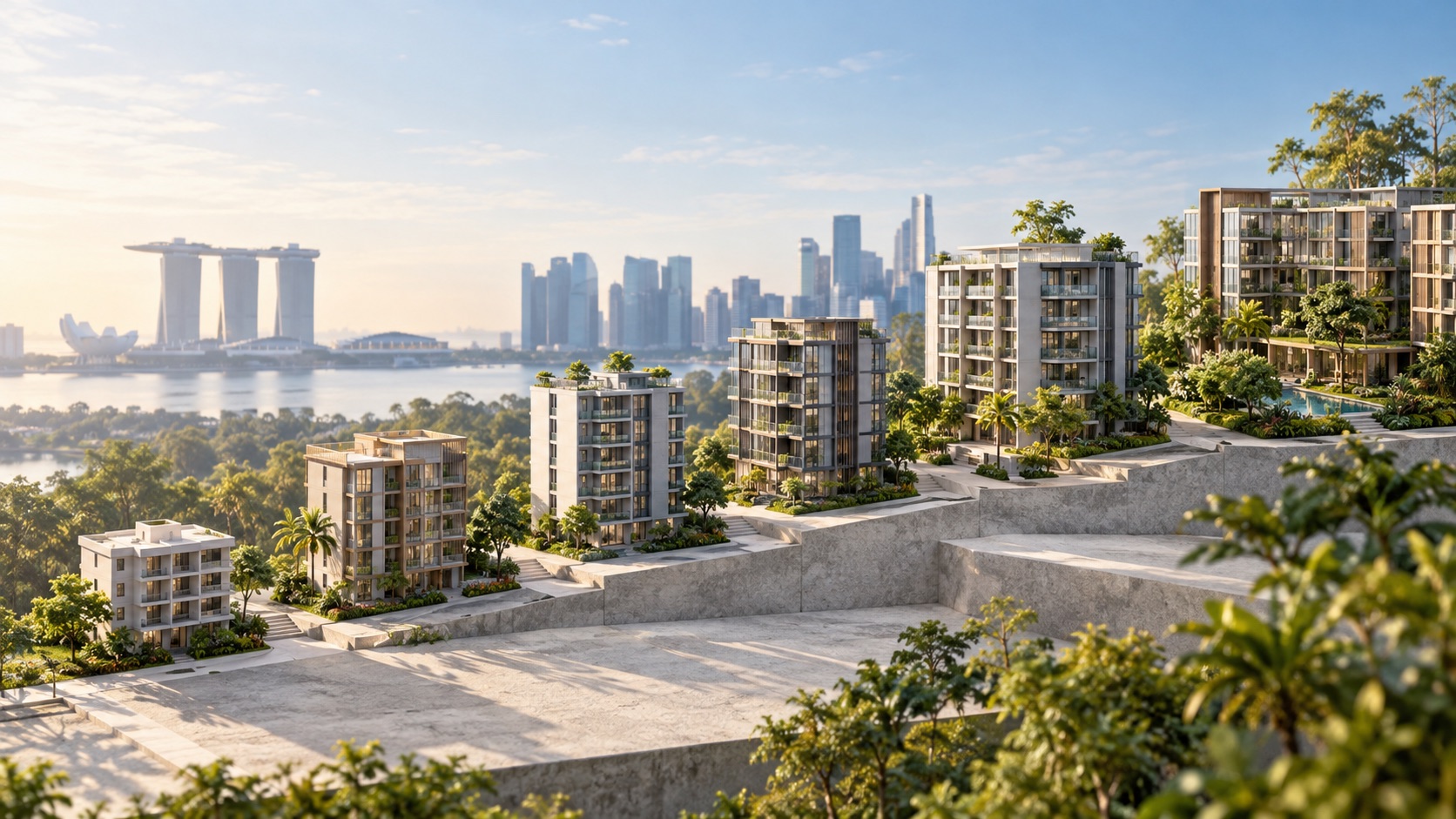
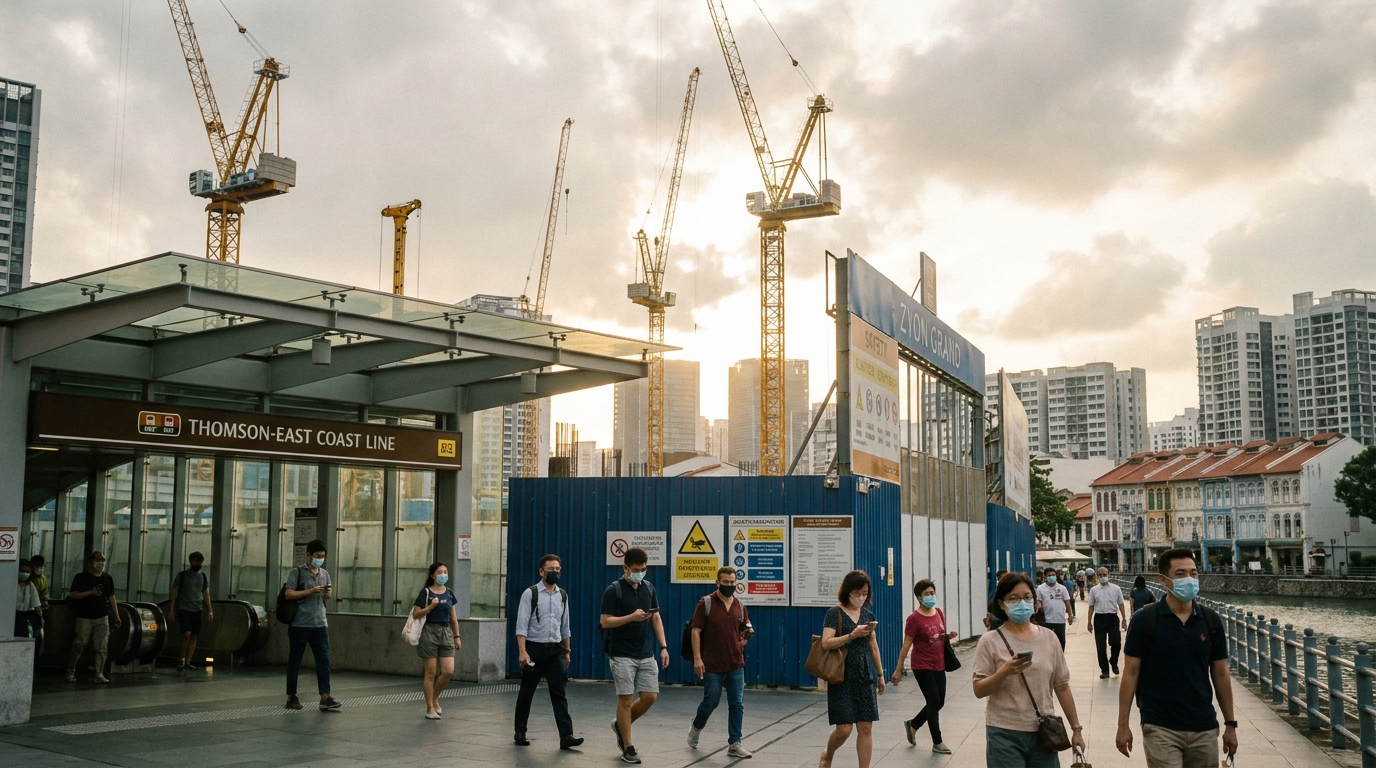
Zion Road (Parcel A), now Zyon Grand in District 9, was awarded in April 2024 to City Developments Limited and Mitsui Fudosan (Asia) for S$1.106888 billion, or roughly S$1,202 psf ppr. The 99-year leasehold scheme pairs 706 private residential units across two 62-storey towers with 373 to 435 long-stay serviced apartment units in a dedicated 36-storey tower, plus retail and childcare. The site connects directly to Havelock MRT on the Thomson-East Coast Line, and at least 20,000 sq m of GFA was committed to the serviced apartment component.
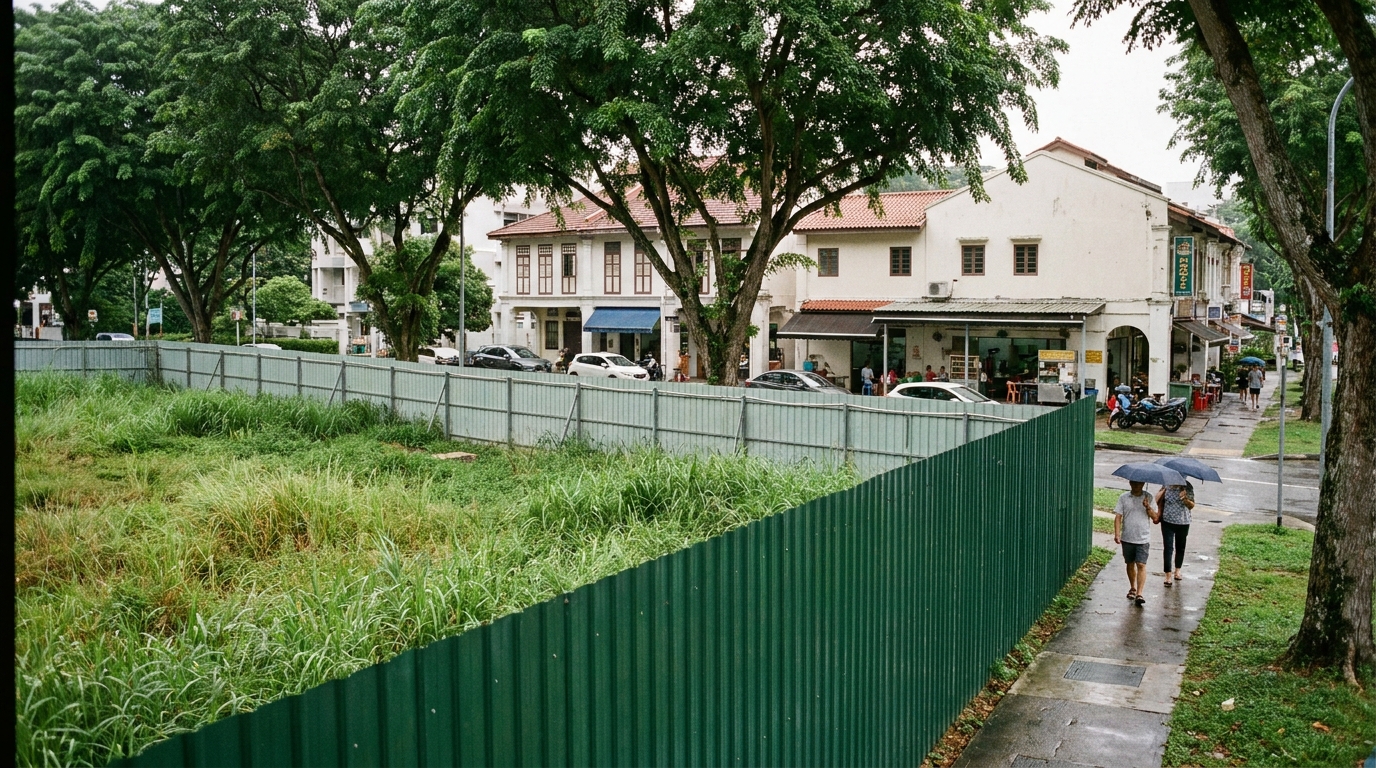
Now the counter-example. Upper Thomson Road (Parcel A) in District 26 was tendered in the same window with a smaller mandated component — roughly 100 long-stay serviced units. In June 2024, it attracted no bids at all. URA removed the SA2 requirement, retendered, and the site was awarded in October 2025 to Wee Hur Property at S$613.94 million (S$1,062 psf ppr) for 595 purely residential units.
The third data point is Media Circle in one-north: a 60-year leasehold, SA2-dedicated site planned for 520 units that attracted a single bid of S$461 psf ppr — rejected by URA as too low.
The pattern is not that flexible living has failed. It is that build-to-rent long-stay housing only underwrites in locations where the rent is high enough and the tenant flow deep enough to beat a straightforward build-to-sell condo. Prime and MRT-connected clears. Everything else, so far, does not.
What SA2 actually is, and why the three-month line matters
URA launched Serviced Apartments II (SA2) on 4 December 2023. The rules are specific. Minimum stay of three consecutive months. Minimum global average net unit size of 35 sq m. Units must be en-suite or clustered co-living. Everything sits under single ownership, with strata subdivision prohibited.
Set that against the older category. Conventional serviced apartments — SA1 — carry a seven-day minimum stay, also under single ownership. Private residential property carries a three-month minimum. HDB flats, six months.
So SA2 sits at the same minimum-stay threshold as a private condo lease. The difference is not duration. It is who runs the building. One is a single operator with centralised onboarding, housekeeping, bundled utilities and dynamic pricing. The other is several hundred individual owners each negotiating their own tenancy.
That is the competitive question for anyone asking about the difference between a serviced residence and a residential condo in Singapore. It is a management question dressed up as a planning category.
The tenant changed first; the stock is still catching up
The demand side has moved decisively. Corporate postings have shortened and relocation budgets have shifted toward flexible allowances. Expatriates, project teams and relocating executives increasingly want three- to six-month tenures rather than binding 12- to 24-month agreements — furnished, wired, with utilities and housekeeping on one bill.
The tenant mix has broadened too. Flexible operators now report a pool closer to 65–70% skilled foreign professionals and 30–35% local tenants — young Singaporeans wanting independence, couples bridging a renovation, families waiting on a BTO or a condo TOP. Temporary housing is no longer an expat-only product.
Increasingly, travellers aren't just looking for somewhere to stay; they're looking for somewhere to live, however briefly.
The operators have read this correctly for a long time. The Ascott Limited was founded in Singapore in 1984 with the opening of The Ascott Singapore, and now runs more than 1,000 properties worldwide. Its chief executive Kevin Goh put it plainly: "People away from home want more than a room. They want a space that works around their life. That need existed in 1984 and is far more widespread today."
Newer stock keeps arriving in the same direction — Oakwood Premier Raffles Place opened in April 2026, bringing that brand into the CBD at a more premium position, while social-living formats such as lyf Funan sit inside a mall with shared space at the core.
Why the economics favour the operator, not the individual owner
Here are the two numbers that should hold a landlord's attention. Gross rents in the Core Central Region typically track S$4.50 to S$6.50 psf per month. Fully furnished, professionally managed flexible units — inclusive of utilities, Wi-Fi, housekeeping and communal amenities — command S$10.00 to S$18.00+ psf per month.
A concrete private-sector case: at 11 Claymore Road in District 9, Royal Group paid S$75 million for a freehold site being redeveloped into a 102-unit SA2 project, with two-bedroom units of 452 to 484 sq ft and projected monthly rents of S$7,500 to S$8,000 — approximately S$16.00 to S$17.70 psf per month.
That gap is not free money. It is paid for with turnover, refurbishment, cleaning, concierge and platform overhead — costs that compress net yield hard. Operators absorb them because scale makes them absorbable, and because portfolio occupancies above 90% spread the fixed cost thin. An individual owner with one unit has none of that leverage.
The honest read on investing in serviced apartments versus residential property in Singapore is therefore not "one wins". It is that the flexible model delivers roughly 100 to 200 basis points of higher gross equivalent yield, and hands most of that back in operating cost unless you have scale.
Meanwhile, the ordinary rental market has stopped doing the work for you
The backdrop matters. After the 2022–2023 spike, private residential rents normalised. URA recorded annual rental growth moderating to 1.9% in 2025, with rents dipping 0.5% in 4Q 2025 and rising a mild 0.7% in 2Q 2026.
Supply explains most of it. More than 20,000 private units completed across 2024 and 2025, lifting the private residential vacancy rate to 6.4% in 2Q 2026, from around 4.2% in 2022. Gross yields for non-landed private homes now sit in a 3.0% to 4.2% band — CCR at the bottom around 3.0%–3.5%, suburban stock at 3.8%–4.2%.
The demand floor is still there. The 60% Additional Buyer's Stamp Duty on foreign residential buyers, in force since April 2023, keeps arriving foreign professionals in the rental pool rather than the sales pool. Employment Pass holders numbered 203,300 in December 2025. But a floor is not pricing power. With vacancy at 6.4%, the bare, unfurnished, take-it-or-leave-it unit is the one that sits empty longest.
What a private landlord can actually do about it
Three responses are available, and only one of them is doing nothing.
- Upgrade the product. Fully furnished, work-from-home ready, one-bill simplicity. Landlords who adapt this way — or who offer flexible three- to six-month terms — can capture rental premiums of 10% to 25% over a standard unfurnished long lease.
- Master-lease to an operator. Hand the unit to a co-living or extended-stay platform on a long lease. You trade upside for a contracted, recurring income and no turnover management.
- Buy for the tenant that exists. Rental demand in the CCR and RCR skews heavily to compact one- and two-bedroom units near MRT and commercial precincts — the same locational logic that made Zion Road bankable and Upper Thomson unbankable.
One rule is not negotiable. Private residential leases below three months are prohibited under the Planning Act, and enforcement is active. HDB stays at six. Chasing short-term rental yields on a home-sharing platform is not a strategy; it is an offence.
What to watch next
First, whether URA recalibrates SA2 land terms after the Upper Thomson and Media Circle results. The pilot has produced clear price signals — the state now knows roughly what developers will and won't pay to run rental housing on a 60-year lease in a non-prime location.
Second, delivery at Zyon Grand. Several hundred professionally run long-stay units landing beside Havelock MRT will compete directly with individually owned condo units in the same River Valley and Kim Seng catchment. That is the first real head-to-head test between institutional flexible stock and the retail landlord.
Third, the quarterly rental indices by region. If flexible formats keep pulling occupancy above 90% while private vacancy holds near 6.4%, the message for owners of plain units is not subtle.
The boundary between serviced apartments, co-living and private rental housing is dissolving into a single living-sectors market. Tenants stopped distinguishing between them some time ago. The landlords still marketing a bare unit on a two-year lease are competing in that market whether they accept it or not.