 plan
planSerangoon Garden’s $10.8m shophouse puts scarce frontage to a yield test
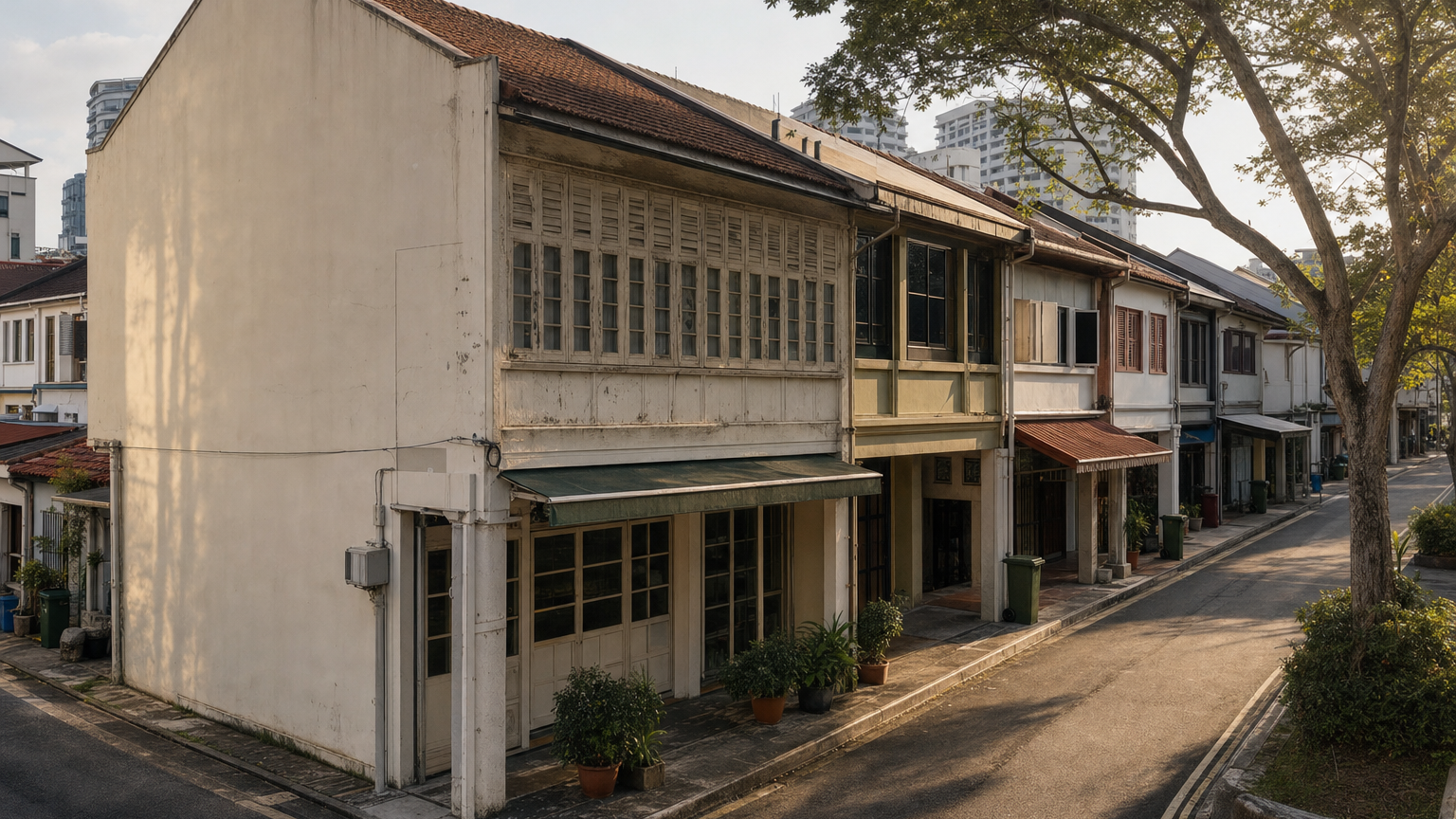
The 999-year tenure attracts attention, but the reported rent implies a gross yield of about 2.22%. This offering will test commercial demand—not reset nearby landed-home values.
The gist
- The 999-year tenure attracts attention, but the reported rent implies a gross yield of about 2.22%.
- A two-storey commercial shophouse in Serangoon Garden is being marketed at $10.8 million through an expression-of-interest exercise due to close at 3pm on 16 October 2026.
- The 999-year tenure supplies the headline appeal.
A two-storey commercial shophouse in Serangoon Garden is being marketed at $10.8 million through an expression-of-interest exercise due to close at 3pm on 16 October 2026. The property reportedly has about 2,600 sq ft of built-up area, including its five-foot way, with an F&B tenant downstairs and a fitness studio upstairs paying combined rent of roughly $20,000 a month.
The 999-year tenure supplies the headline appeal. But the harder investment case lies in the income: at the guide price, the reported rent translates into a gross yield of only about 2.22% before property tax, vacancies, repairs, financing and other costs.
This is therefore a test of how much buyers will pay for scarce neighbourhood commercial space and a long remaining tenure. It is not yet a completed sale, nor a new benchmark for Serangoon Garden’s landed homes.
The gist
- $10.8 million is a guide price, not an achieved transaction price.
- Reported annual rent of about $240,000 implies a gross yield of approximately 2.22% at the guide price.
- Commercial use can broaden the eligible buyer pool, but stamp duty, GST and planning treatment must be established from the property and transaction records.
- The listing may inform expectations for comparable commercial units, but it does not prove that nearby residential values have risen.
The income matters more than the tenure label
The basic calculation is straightforward. Multiplying the stated monthly rent of around $20,000 by 12 produces annual gross income of approximately $240,000. Dividing that by the $10.8 million guide gives a gross yield of 2.22%.
That is an arithmetic result, not a forecast of what an owner will retain. Gross rent excludes property tax, insurance, maintenance, professional fees, leasing costs, financing expenses and periods without a tenant. Major repairs or tenant reinstatement works could also make returns uneven from one year to the next.
The price is asking buyers to underwrite income first and scarcity second.
The two tenancies provide some diversification within one building, but they also create two renewal events. A buyer needs to know the remaining lease terms, rental escalations, renewal options, security deposits, break clauses and division of maintenance obligations. The reported monthly total reveals none of those details.
F&B occupation brings additional physical questions. Exhaust systems, grease management, power supply, fire-safety requirements and reinstatement obligations can affect both capital expenditure and the range of replacement tenants. A fitness studio upstairs likewise depends on access, floor loading, noise management and the approved use of the premises.
These are not reasons to reject the property. They explain why a headline rental figure cannot establish sustainable net income by itself.
A guide price is not a comparable sale
An expression of interest invites offers and gives the seller flexibility over whether and on what terms to proceed. Until a transaction is completed, the $10.8 million figure records a marketing expectation rather than the market-clearing value of the property.
The reported evidence from the precinct includes a June transaction at $15 million for a 999-year shophouse on a 2,146 sq ft site, occupied by Sushi Tei. Two adjoining units reportedly changed hands for $17.49 million in May 2023.
Those deals show that buyers have previously committed substantial capital to Serangoon Garden’s commercial strip. They do not provide automatic valuations for the current offering.
Shophouse comparisons are especially sensitive to site area, built-up space, frontage, visibility, condition, approved use and tenancy. A corner unit may command a different rent from an intermediate unit. A long corporate lease may be valued differently from a tenancy approaching expiry, even if the current monthly rents match.
The identity of the property also warrants care. The current report does not state its street number. An earlier $10.8 million offering at 28/28A Maju Avenue was described as having about 3,500 sq ft of built-up area and being offered with vacant possession—a materially different profile from the approximately 2,600 sq ft, tenanted property now reported.
Without a confirmed address, title documents or marketing particulars, it would be unsafe to assume the two reports concern the same asset. Buyers and neighbouring owners should not combine their specifications when judging value.
Why scarcity can support the price—but cannot settle it
The commercial rows sit within an established low-rise residential catchment near Serangoon Garden Market and Chomp Chomp Food Centre. The marketing agent estimates that the estate contains only 69 commercial shophouses.
URA’s street-block planning material for rows along Maju Avenue, Kensington Park Road and Serangoon Garden Way identifies commercial land use with a gross plot ratio of 1.4. This reinforces the essential distinction: the offering is a neighbourhood commercial property, not another piece of landed-residential stock.
A limited stock of shopfronts can support value when occupiers want access to the catchment and owners are reluctant to sell. Long tenure may also appeal to buyers who place value on retaining an asset across generations without the lease-decay concerns associated with a short lease.
But neither feature guarantees the guide price. Scarcity has economic value only when occupier and buyer demand remain durable. If rents cannot rise enough to compensate for costs and risk, a low initial yield leaves the purchaser heavily dependent on future rental growth or resale value.
That is the strongest counterargument to the scarcity case. A rare property can still be expensive relative to its income, particularly when alternative commercial assets offer higher yields or require less active management.
The relationship between price and rent will therefore be more revealing than the tenure alone. A sale near $10.8 million would suggest that at least one buyer accepted a low starting yield in exchange for location, tenure and scarcity. A sizeable discount would indicate that those qualities were not sufficient to bridge the income gap.
Commercial status changes the buyer pool, not every tax bill
A foreign person may buy a shophouse for commercial use without seeking approval under the Residential Property Act. A shophouse acquired for non-commercial use is treated differently, so the legal use and planning status matter more than the building’s appearance or its everyday label.
Commercial classification does not remove Buyer’s Stamp Duty. IRAS applies tiered BSD rates to non-residential property, with a top marginal rate of 5% for acquisitions from 15 February 2023.
If the full $10.8 million were treated as non-residential consideration, the published tiers would produce BSD of approximately $509,600. That is a calculation based on the guide price and prevailing non-residential rates, not a statement of the final duty on an uncompleted deal.
GST also requires qualification. Buyers must pay GST on a non-residential property purchase when the seller is GST-registered and the sale is a taxable supply. Although the listing is reported as having no GST payable, purchasers should verify the vendor’s status and contractual treatment rather than generalise that outcome to all commercial shophouses.
Additional Buyer’s Stamp Duty generally concerns residential property, but planning classifications can produce less intuitive results. IRAS treats land zoned residential, commercial-and-residential, residential with commercial at the first storey, residential/institution or white as residential property for ABSD purposes, even in some circumstances where the proposed development is non-residential.
The practical lesson is narrow but important: “commercial shophouse” is not sufficient tax or legal due diligence. The title, Master Plan zoning, approved uses, seller’s GST status and sale structure must align with the assumptions behind the purchase price.
What nearby owners and homebuyers can infer
For other Serangoon Garden commercial owners, the listing is a visible test of buyer appetite in a market where genuinely comparable transactions are infrequent. It may influence asking prices, especially for long-tenure units with established tenants and strong frontage.
It does not establish a valuation floor. That requires a completed transaction, together with enough information about its tenure, floor area, tenancy, condition and contractual terms to make a meaningful comparison.
For landed homeowners nearby, the implications are more indirect. A functioning food, retail and service cluster contributes to neighbourhood convenience and identity. Yet a tenanted commercial building is valued through income, permitted use and a buyer pool that differs from the market for owner-occupied houses.
The asking price should not therefore be converted into a residential per-square-foot benchmark or cited as proof that houses behind the retail strip have appreciated by a similar amount. The two property types share a locality, not a valuation method.
Prospective buyers face a similarly specific decision. The 999-year tenure reduces concern about near-term lease erosion, but it cannot compensate automatically for weak lease documentation, costly building work or a rent that proves difficult to sustain.
The next meaningful development is not the EOI deadline itself. It is whether a sale completes near the guide—and whether the eventual price, tenancy particulars and property identity confirm that buyers were willing to accept the listing’s low initial gross yield for Serangoon Garden’s scarce commercial frontage.