 plan
planMartin Modern and Wallich Residence Lead First Auction of Homes Forfeited in S$3 Billion Case
Ten confirmed units, priced from S$2.238 million to S$6.78 million, will test demand in two distinct prime-city markets—but guide prices are not proof of forced-sale bargains.
The gist
- Ten confirmed units, priced from S$2.238 million to S$6.78 million, will test demand in two distinct prime-city markets—but guide prices are not proof of forced-sale bargains.
- The first confirmed auction tranche of condominium units forfeited in Singapore’s S$3 billion money-laundering case comprises 10 homes, not the 23 suggested in the original assignment headline.
- The correction changes the property-market interpretation.
The first confirmed auction tranche of condominium units forfeited in Singapore’s S$3 billion money-laundering case comprises 10 homes, not the 23 suggested in the original assignment headline. Six units at Martin Modern and four at Wallich Residence are scheduled for auction on 23 September 2026, with published guides between S$2.238 million and S$6.78 million.
The correction changes the property-market interpretation. Ten varied homes across two developments do not amount to a sudden wave of distressed stock. They are better understood as the opening test in the progressive disposal of more than 80 properties: a controlled price-discovery exercise whose completed sales, rather than guide prices or criminal provenance, may become useful evidence for owners and buyers.
The gist
- The confirmed auction catalogue contains 10 units: six at Martin Modern and four at Wallich Residence.
- Published guides span S$2.238 million to S$4.98 million at Martin Modern and S$4.42 million to S$6.78 million at Wallich Residence.
- These homes are part of a pipeline of more than 80 properties expected to be brought progressively to market.
- Any completed sales may inform project-level valuations, but this small and varied batch cannot by itself establish a broad prime-market correction.
What is actually coming to auction
The Martin Modern selection comprises two-, three- and four-bedroom apartments measuring approximately 764 sq ft to 1,733 sq ft. The lowest guide is S$2.238 million for a 764 sq ft two-bedroom unit, while the highest is S$4.98 million for a 1,733 sq ft four-bedroom home.
Four larger apartments are listed at Wallich Residence. These are three- and four-bedroom homes of approximately 1,313 sq ft to 1,991 sq ft, carrying guides from S$4.42 million to S$6.78 million.
| Development | Confirmed units | Published guide range | Approximate size range | |---|---:|---:|---:| | Martin Modern | 6 | S$2.238m–S$4.98m | 764–1,733 sq ft | | Wallich Residence | 4 | S$4.42m–S$6.78m | 1,313–1,991 sq ft |
The lowest stated price-per-square-foot guides work out to approximately S$2,874 psf at Martin Modern and S$3,347 psf at Wallich Residence. These are calculations from the published guides and floor areas, not transaction records or independent valuations.
That distinction is central. A guide price is intended to attract and organise bidder interest. It is not necessarily the reserve, eventual sale price or evidence of what every comparable apartment is worth.
“This is a price-discovery event, not proof that prime-city homes have suddenly become cheap.”
Forfeiture does not automatically mean a fire sale
The case has an obvious “distressed property” narrative: assets linked to convicted criminals have been surrendered and must now be converted into cash. But these are not ordinary mortgagee sales in which a lender is trying to recover an unpaid housing loan as quickly as possible.
The units form part of an organised disposal of forfeited non-cash assets through appointed asset managers and property agencies. Proceeds from forfeited assets ultimately accrue to the State rather than to their former owners.
As at 31 December 2024, approximately S$2.8 billion in assets from 25 criminals had been ordered surrendered to the State. The pool covered real estate as well as vehicles, luxury goods and other assets.
The distinction does not guarantee aggressive pricing. An orderly seller can expose a property to the market, set an acceptable threshold and decline an inadequate bid. An auction merely concentrates the process around a stated date and competitive format.
Nor does criminal provenance determine the physical value of an apartment. Buyers will still differentiate units by floor, view, orientation, layout, condition, tenancy status and ease of inspection. Legal documentation and sale conditions also matter, but they must be assessed for each lot rather than inferred from the wider case.
Martin Modern and Wallich Residence test different demand pools
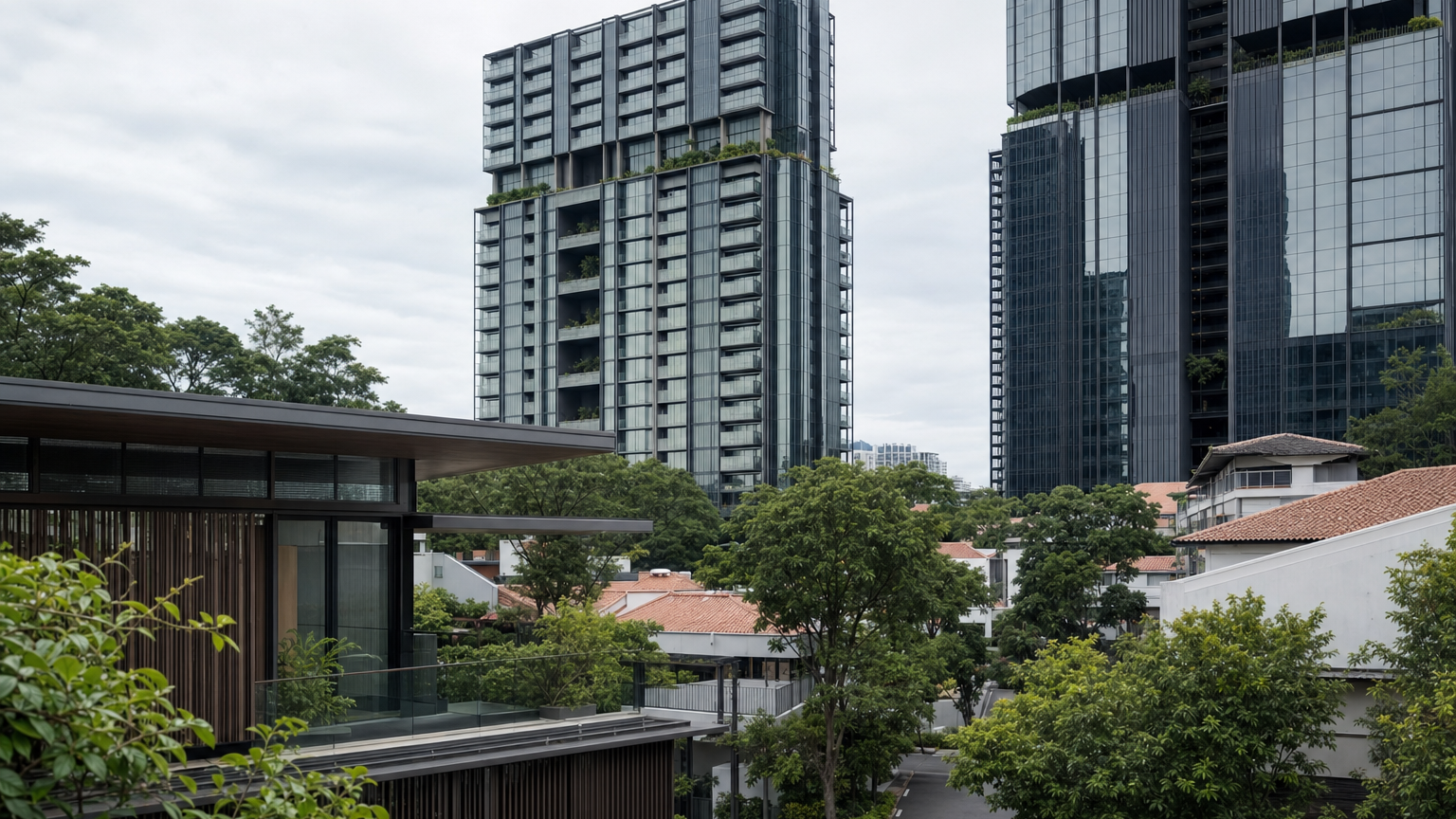
Grouping all 10 homes together risks obscuring the more useful property story. Martin Modern is a 99-year leasehold residential development in River Valley, while Wallich Residence forms part of the Tanjong Pagar Centre mixed-use precinct.
Their prices, apartment formats and locations address different segments of central Singapore demand. The auction is therefore two smaller tests, not one uniform measure of appetite for luxury homes.
Martin Modern’s entry guide of S$2.238 million gives its smaller units a wider potential buyer pool than the Wallich apartments, all of which start above S$4 million. Its mix also extends from compact two-bedroom homes to large family apartments, allowing bidders to respond to several budget and space requirements.
Wallich Residence presents a narrower luxury-CBD proposition. Its four units are at least about 1,313 sq ft, and the largest approaches 2,000 sq ft. Outcomes at this price level can be influenced by a small number of bidders and by highly specific attributes such as elevation and outlook.
A strong result for one high-floor unit would not automatically lift every apartment in the building. Equally, an unsold lot would not prove that demand has vanished. Thinly traded luxury markets often produce irregular evidence because apparently similar apartments can differ substantially and relatively few buyers are active at any one time.
What completed sales could mean for owners
For owners in either development, the auction results may become relevant comparable evidence. Their usefulness will depend on whether the apartments sell and how closely each one resembles the home being valued.
The most credible comparison would match development, tenure, size, bedroom count, floor range and major view or orientation characteristics. A 764 sq ft two-bedroom guide at Martin Modern says little about the value of a 1,733 sq ft four-bedroom unit simply because both share an address.
Completed transactions can affect expectations before they materially affect formal valuations. Prospective sellers and agents may refer to a conspicuous auction outcome when setting asking prices, while buyers may cite it during negotiations. Valuers and banks, however, will generally have a broader body of transactions and unit characteristics to consider.
The strongest counterargument is that 10 publicly marketed homes can still influence sentiment. If several sell promptly at levels materially below genuinely comparable transactions, buyers could become more cautious and owners may need to defend higher asking prices with clearer unit-specific differences.
That possibility should not be dismissed. But it remains conditional on actual outcomes. The published guides alone cannot demonstrate a discount because they have not yet been tested by bidding, and asking prices on other listings are not completed market evidence.
What buyers should—and should not—infer
The auction format may give buyers a defined opportunity to compete for units that might not otherwise have entered the market together. It does not remove the need to assess value independently.
A headline comparison between a guide and another owner’s asking price can create the appearance of a bargain. Yet the apparent gap may reflect different floors, layouts, renovation condition or occupancy arrangements. It may also disappear once competing bids are placed.
The relevant figure is the buyer’s eventual bid plus applicable taxes, financing costs and any expenditure required to make the apartment suitable for occupation or leasing. Nothing in the units’ forfeited status overrides the normal financial and regulatory obligations of a Singapore residential purchase.
Buyers should also separate the origin of the sale from the quality of the underlying property. Provenance may attract attention, but future resale demand will depend much more on the development, unit attributes, market conditions and price paid. Conversely, an unusual backstory is not a substitute for reviewing the auction’s legal conditions and property documentation.
This makes the auction neither an automatic opportunity nor a warning to avoid the homes. It is a transaction process in which the buyer bears the risk of bidding without confusing a low opening signal for a completed bargain.
The larger pipeline matters more than one auction day
The first 10 units are a small part of the eventual supply. More than 80 properties tied to forfeited non-cash assets are expected to be brought to market progressively, making the pace, concentration and results of later releases more consequential than one catalogue.
Staging the disposals reduces the risk of presenting the entire property pool to buyers at once. It also lets the appointed parties observe demand and adjust the timing or method of subsequent sales. That is an interpretation of the phased process, not a confirmed prediction of how future lots will be priced.
The wider programme may eventually offer a richer set of transaction evidence across several developments and market segments. If multiple comparable units within the same project are sold over a short period, their collective results could carry more weight than a solitary auction outcome.
For now, the evidence is narrower. There are 10 confirmed homes at two named developments, with guides from S$2.238 million to S$6.78 million. The result to watch after 23 September is not simply whether the catalogue clears, but whether sale prices differ systematically from recent like-for-like deals—and whether that pattern persists as the remaining forfeited properties reach the market.