 plan
plan75 Goodman Road Asks S$39 Million for Space Few District 15 Homes Can Match
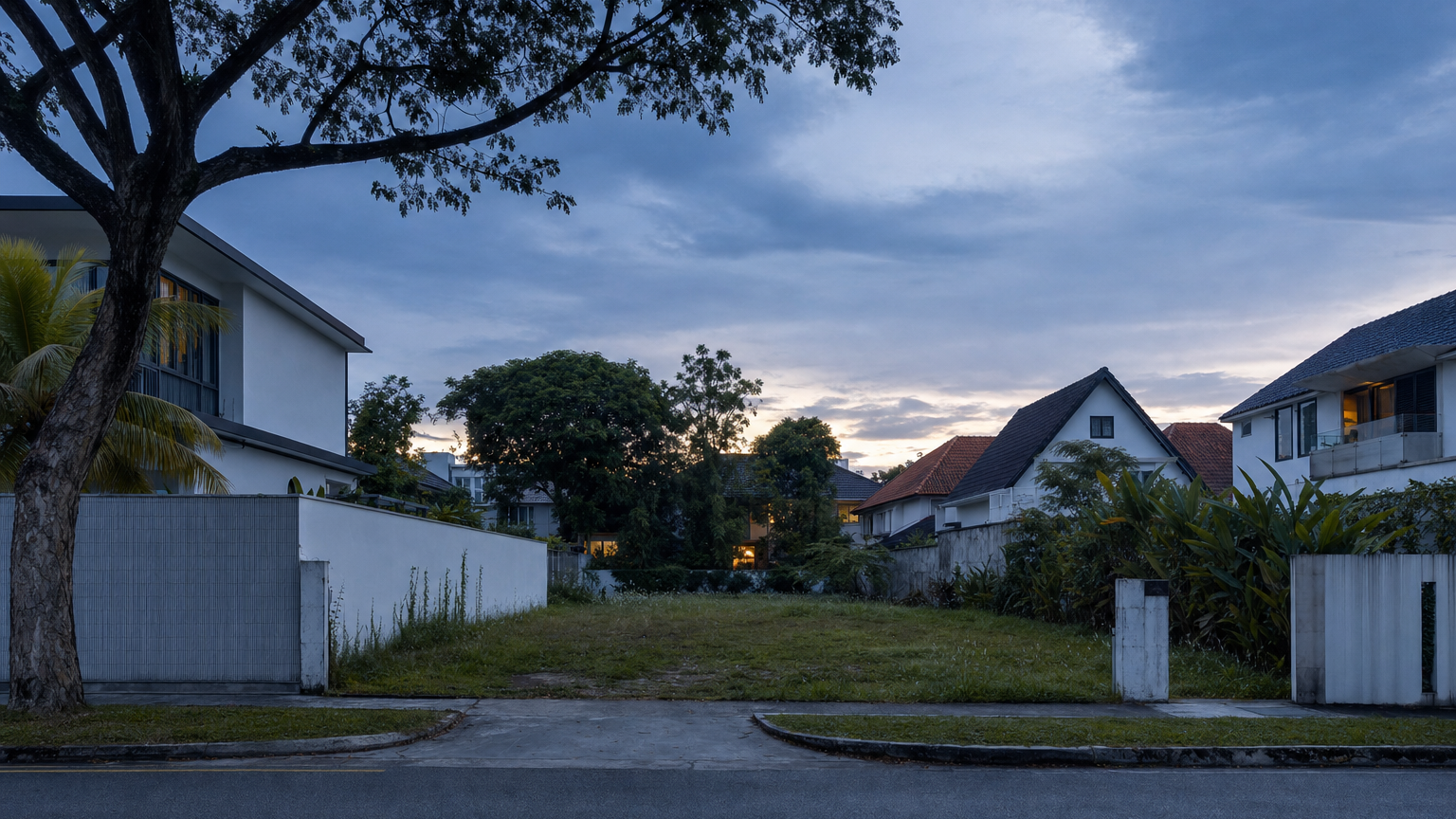
The reported 16,424 sq ft site has the scale associated with a Good Class Bungalow, but not necessarily the designation. Its asking price also reveals less about the seller and eventual buyer than the headline suggests.
The gist
- The reported 16,424 sq ft site has the scale associated with a Good Class Bungalow, but not necessarily the designation.
- A freehold bungalow marketed as 75 Goodman Road is asking S$39 million for a reported 16,424 sq ft of land and about 10,000 sq ft of built-up area.
- The exceptional feature is the land quantum, not proof of a new District 15 price benchmark.
A freehold bungalow marketed as 75 Goodman Road is asking S$39 million for a reported 16,424 sq ft of land and about 10,000 sq ft of built-up area. On those advertised figures, the price works out to approximately S$2,375 per sq ft of land.
The exceptional feature is the land quantum, not proof of a new District 15 price benchmark. The property has not been established here as a completed transaction, its owner and buyer have not been publicly identified, and a plot comparable in size with a Good Class Bungalow is not necessarily a GCB.
The gist
- The advertised S$39 million is an asking price, not an evidenced sale price.
- At about 1,526 sq m, the reported site exceeds the 1,400 sq m minimum plot size for a bungalow within a designated Good Class Bungalow Area—but plot size alone does not confer GCB status.
- Foreign individuals need approval to acquire landed residential property in Singapore, while the prevailing ABSD rate for most foreign residential buyers is 60%.
- This property principally suits a wealthy household seeking a long-term family compound, rather than a buyer relying on assured subdivision or redevelopment gains.
GCB-scale land without the GCB designation
The reported land area is roughly 9% larger than the minimum plot size for a bungalow within a Good Class Bungalow Area. That explains the “GCB-like” comparison, but it must be confined to physical scale.
URA’s planning controls distinguish between bungalows within and outside designated GCB Areas. Within a GCBA, a bungalow plot generally requires at least 1,400 sq m of land, a width of 18.5m and a depth of 30m; different plot requirements apply outside those areas.
A genuine GCB is therefore not simply any detached house occupying more than 1,400 sq m. Its location within a designated area and the planning controls attached to that location are fundamental parts of the classification.
That distinction affects how buyers should interpret scarcity. Goodman Road offers a substantial landed setting in District 15, but it is not interchangeable with Nassim Road, Cluny Road or another address within a recognised GCBA merely because the sites may be similar in size.
Buyers purchase the surrounding estate, planning context and address alongside the square footage. The better description here is a large freehold District 15 family compound with GCB-scale land, not a newly discovered GCB.
“The land is scarce, but an asking price does not show what the market will ultimately pay for that scarcity.”
S$2,375 psf is arithmetic, not valuation
Dividing the advertised S$39 million by the reported 16,424 sq ft produces an asking land rate of about S$2,375 psf. This is a calculation, not an independent appraisal, bank valuation or completed-deal benchmark.
That limitation matters particularly for unusually large landed homes. Asking prices may incorporate the seller’s expectations, refurbishment expenditure, replacement difficulty and the premium sought for keeping a large site intact. A buyer may assign very different values to the existing building, landscaping and future works.
Large sites also resist simplistic psf comparisons. A smaller plot may achieve a higher unit rate because its total price is accessible to more buyers. Conversely, a very large site can command a high absolute premium from the rare household that wants precisely that scale, even if its psf rate is lower than nearby smaller plots.
The strongest case for the asking price is scarcity. There are few freehold compounds of this reported size in the eastern residential districts, and assembling adjoining plots may be expensive, uncertain or impossible.
The counterargument is liquidity. A S$39 million house addresses a much smaller market than a conventional terrace, semi-detached house or modest bungalow. The eventual clearing price depends not only on land scarcity but on whether at least one eligible buyer values this particular compound as highly as the seller does.
Until there is evidence of an exercised option, caveat or completed transfer, the listing reveals a vendor’s price ambition—not a general repricing of Goodman Road or District 15 landed property.
Who is selling—and what can responsibly be said
The identity of the registered or beneficial owner is not established by the evidence available for this article. Nor is there evidence identifying a purchaser, an accepted offer or a completion timetable.
It would be easy to fill that gap with an appealing story: an old family estate being divested, an investor taking profit, or a multigenerational household moving on. None can be stated as fact without reliable ownership or transaction evidence.
The absence of a named seller also limits the conclusions that can be drawn from the asking price. It is not known whether the owner faces any particular timing constraint, has rejected previous offers or would consider substantially different terms.
Seller’s Stamp Duty is unlikely to be the central issue for a long-held property, but the actual position depends on when and how the seller acquired it. For residential properties bought on or after 4 July 2025, IRAS applies SSD where disposal occurs within four years, subject to the rules and exemptions; different holding periods apply to earlier acquisition dates.
Without a verified acquisition date, no definitive SSD conclusion should be attached to this bungalow. That uncertainty is another reason not to reverse-engineer the seller’s intentions from a marketing price.
The credible buyer pool is unusually narrow
The natural buyer is a Singaporean household that wants extensive private space and can hold a highly concentrated residential asset. Possible uses include multigenerational living, separate accommodation for relatives, substantial entertaining areas and outdoor space that smaller urban homes cannot reproduce.
Singapore citizens do not pay ABSD on their first residential property. They currently pay 20% on a second residential property and 30% on a third or subsequent one. Singapore permanent residents pay 5% on their first home, 30% on a second and 35% on a third or subsequent property.
For most foreign individuals, the current ABSD rate is 60% of the higher of the purchase price or market value for a residential acquisition, subject to applicable remission and free-trade-agreement treatment.
At a S$39 million purchase price, 60% would equal S$23.4 million before Buyer’s Stamp Duty and other costs. This calculation does not assert that a particular buyer would incur that bill; it shows why the foreign-buyer segment faces a formidable acquisition hurdle.
There is a second gate. Bungalows and other landed homes are restricted residential properties under Singapore’s foreign-ownership framework. A foreign person generally needs approval from the Land Dealings Approval Unit before acquiring one.
SLA says applications are assessed individually. Published considerations include whether an applicant has been a Singapore permanent resident for at least five years and has made exceptional economic contributions to Singapore, although satisfying a stated consideration does not itself guarantee approval.
That leaves a credible but compact audience: very wealthy Singapore citizens, qualifying permanent residents and the limited number of foreign purchasers able to obtain approval and absorb the tax burden. Corporate or trust structures introduce their own legal and stamp-duty questions and should not be presumed to provide a simple workaround.
A family compound is not automatically a redevelopment play
The home is marketed around its existing domestic utility: a refurbished two-storey house, six-bedroom arrangement, pool, lawn, courtyard and substantial entertaining space. These are seller-side descriptions rather than independently verified approved plans, but they help explain the intended audience.
For the right household, an already usable compound may be more valuable than theoretical intensification. Large bedrooms, separation between generations and genuine outdoor space can provide benefits that are difficult to replicate across several apartments.
But buyers should not equate land size with unlimited redevelopment flexibility. URA controls for landed housing address matters including building form, site coverage, setbacks, platform levels and boundary conditions.
Subdivision is also not automatic. URA’s bungalow controls include plot-size and width requirements, while any redevelopment proposal must respond to the site’s precise planning context and obtain the required approvals.
The property’s reported dimensions, title particulars, road access, drainage conditions and approved building records have not been presented here in enough detail to conclude that it can be split or intensified. Potential redevelopment value therefore remains an issue for professional planning and title verification, not a feature that should be priced as assured.
This is the central tension in the offering. The site’s greatest value may lie in remaining what it already is: one unusually spacious private home. A buyer focused mainly on extracting more units may be approaching the property with a value thesis that the planning framework does not support.
Scarcity comes with ownership friction
A compound of this scale gives its occupants privacy and control, but it also concentrates capital in one illiquid asset. The pool, garden, building fabric and extensive external areas require continued maintenance, while major rebuilding could involve significant professional, construction and approval costs.
Financing may further distinguish asking price from executable price. A bank’s valuation and willingness to lend are separate from the seller’s expectation, and a buyer’s loan-to-value limit can depend on existing housing loans and other regulatory factors. No financing terms for this property have been evidenced.
The exit market is similarly specialised. Scarcity can support value when several qualified buyers compete, but it can prolong a sale when the household requirements, price expectations and timing of the parties do not align.
That does not make the bungalow unattractive. It means its strongest proposition is lived utility over a long holding period—not rapid liquidity or a guaranteed uplift from its exceptional size.
The next meaningful evidence will be transactional or planning-based: a caveat showing the agreed consideration, a confirmed ownership transfer, or approved plans clarifying what can be done with the site. Until then, 75 Goodman Road remains a S$39 million asking-price story—an unusually large District 15 bungalow, but neither an established GCB nor a completed benchmark sale.