China's US$148 Billion Lease Expiry Problem — And What Geylang Lorong 3 Already Settled
Beijing is only now writing the rules for expiring land leases. Singapore wrote them decades ago, tested them in 2020, and prices them into every 99-year transaction.
The gist
- Over 1 trillion yuan (US$148 billion) of Chinese non-residential property sits on land with 20 years or less remaining.
- China's 1990s leases granted 40 years retail, 50 industrial and office, 70 residential — without any renewal mechanism.
- On 31 December 2020, 191 Geylang Lorong 3 terrace houses reverted to the State with no compensation or extension.
- Bala's Curve prices leasehold value at about 80 per cent at 60 years, 60 per cent at 30, nil at expiry.
China has spent five years trying to find the floor in its property market. It is now discovering that part of the floor was never built: nobody wrote down what happens when a commercial land lease runs out.
Singapore did write it down. It also enforced it, on 191 households, on the last day of 2020.
The number Beijing can no longer ignore
More than 1 trillion yuan (US$148 billion) of Chinese non-residential property — office towers, shopping malls, warehouses — now sits on land with 20 years or less of lease remaining, according to Andrew Chan, head of valuation and advisory services for Greater China at Cushman & Wakefield. That means these assets have passed the halfway mark of their tenure, or gone well beyond it.
The arithmetic is not mysterious. China wrote its current land leasing rules in the early 1990s, granting 40 years for retail plots, 50 years for industrial and office sites, and 70 years for residential. Almost all urban land is state-owned. A 1993 mall grant expires in 2033.
What was missing was the renewal mechanism. There has been little clarity on when — or how, or at what cost — an owner could extend. Shanghai officials have only in recent weeks circulated guidelines on lease renewal terms and costs, following a similar move in Guangzhou earlier in 2026. Drafts have floated renewal pricing at at least 70 per cent of benchmark land prices.
The damage in the meantime has been measurable. Office values in some major Chinese cities have fallen more than 40 per cent from peak, developers across the market have defaulted on around US$130 billion of debt, and groups including Parkview Group and New World Development have struggled to sell assets specifically because of dwindling lease terms. CBRE's Greater China research projects that by 2030, roughly 30 million square metres of prime office and retail space across 18 tier-one and tier-two cities will sit in the sub-20-year zone.
"Policy uncertainty over leasehold renewal has tanked appraisal values of commercial properties, hurt fundraising and impeded deals," said Song Hongwei, research director at Tospur Real Estate Consulting.
Singapore already ran the experiment — and it was small, quiet and absolute
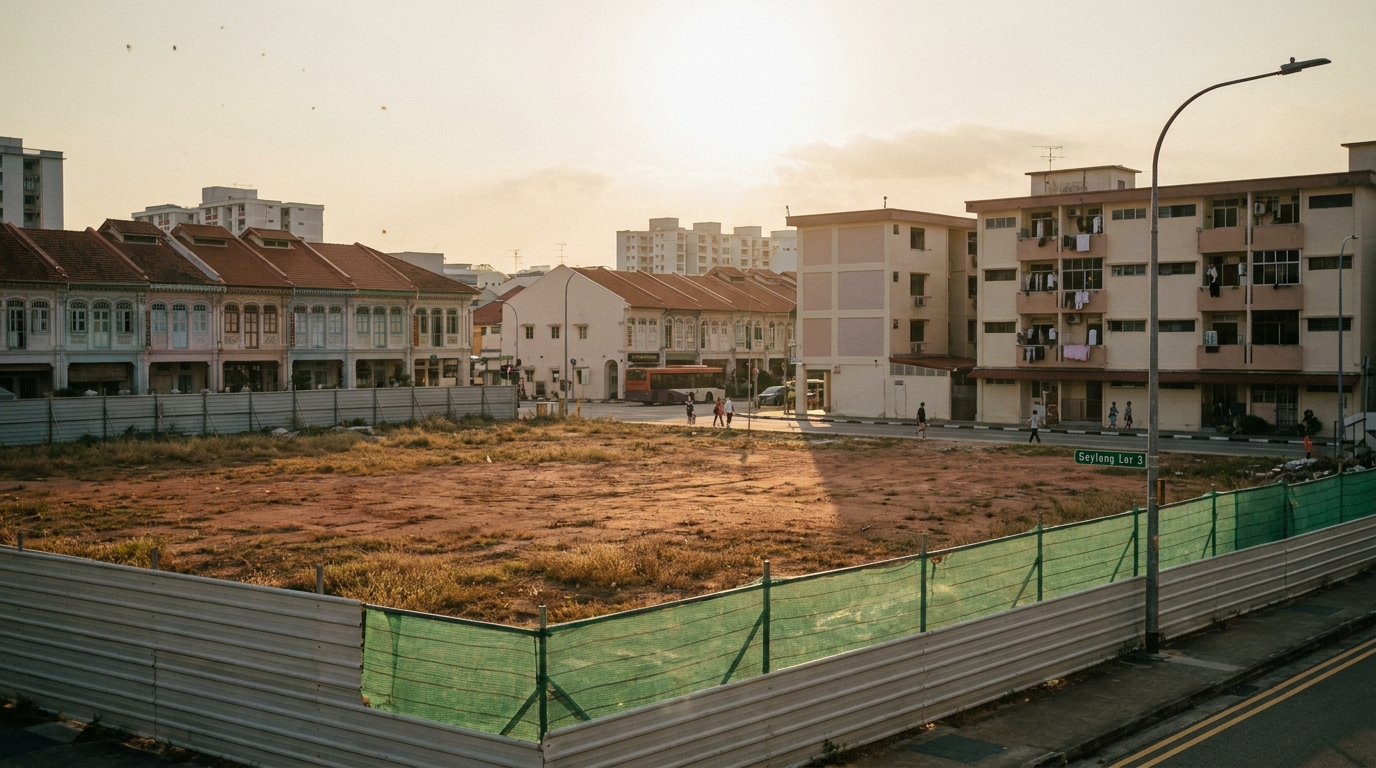
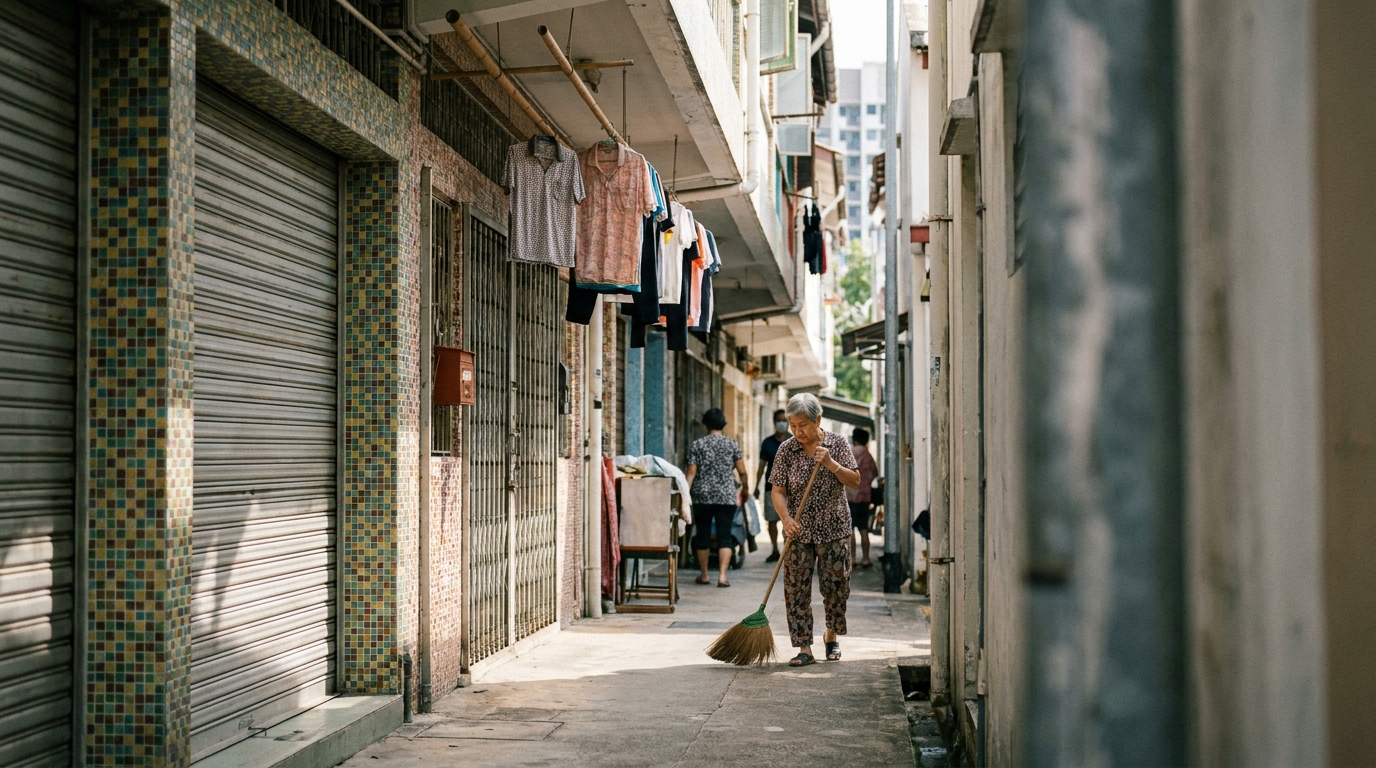
On 31 December 2020, the 60-year leases on 191 two-storey terrace houses at Geylang Lorong 3, issued in 1960, expired. The land reverted to the State. There was no compensation and no extension. The site was cleared and earmarked for future public housing.
That was independent Singapore's first residential land parcel to return fully to the State at lease expiry. It attracted a fraction of the attention it deserved, because it answered — in practice, not in theory — the question that is currently paralysing hundreds of billions of dollars of Chinese commercial real estate.
The Singapore Land Authority's stated position is that state leases will generally expire without renewal, so that land can be reallocated for broader socio-economic needs. Top-ups and extensions are assessed case by case, and usually require redevelopment, land intensification or a collective sale. A lease is a finite contract with an expiry date, not a slow-moving form of ownership.
Certainty is not the same as generosity
Here is the uncomfortable part of the comparison. China's problem is ambiguity; Singapore's system removes the ambiguity by making the outcome harsh and predictable. Predictability is what lets valuers, banks and buyers price the asset — but they price it downward, on schedule.
The SLA's leasehold relativity table, still known in the trade as Bala's Curve, is the reference point for lease top-up premiums and Land Betterment Charges. Its tiers are unsentimental:
- 99 years remaining: about 96 per cent of equivalent freehold value
- 60 years remaining: about 80 per cent
- 50 years remaining: about 74.7 per cent
- 30 years remaining: about 60 per cent
- Zero years: nil — land and building revert to the State
The curve is convex. Value bleeds slowly through the first three or four decades, then accelerates. The valuation cliff China is discovering the hard way is drawn on a Singapore government table, and has been for years.
China's crisis is that nobody knows what an expiring lease is worth. Singapore's discipline is that everybody does — 60 per cent of freehold value at 30 years left, and zero at expiry. Certainty protects the market, not the individual owner.
In Singapore, the banks reprice a lease before the valuer does
The Chinese lesson is that liquidity dies before the lease does. Buyers discount hard, deals collapse, and financing dries up long before the expiry date on the certificate.
Singapore has hard-coded that dynamic into policy. CPF funds cannot be used at all unless a property has at least 20 years of lease remaining. Full CPF usage and maximum financing require the remaining lease to cover the youngest buyer to age 95; fall short and both CPF withdrawals and the loan quantum are pro-rated. MAS guidelines and bank credit policies compress loan tenure and loan-to-value limits as leases drop through the 60-year and 30-year thresholds.
Read that as a market mechanism rather than a rulebook. Each threshold shrinks the pool of buyers who can pay a full price, which is why real-world lease decay on older 99-year condominiums and mature HDB flats often outruns the theoretical curve. Research from the NUS Institute of Real Estate and Urban Studies puts the freehold price premium over comparable 99-year leasehold units at 10 to 20 per cent — and that gap widens as tenure shortens.
Renewal exists here too. It is expensive, and it is not for owners
Singapore is not a no-renewal jurisdiction. It is a paid-renewal jurisdiction, and the payer is almost never the sitting owner.
Private residential owners cannot unilaterally extend a lease during normal occupation. A developer acquiring a site through a collective sale can apply to SLA to top the lease back up to a fresh 99 years, on payment of the Land Betterment Charge, which replaced the Differential Premium in September 2022. The premium effectively bridges the gap on Bala's Curve — from roughly 74.7 to 80 per cent back up to 96 per cent. Approval is discretionary, and turns on whether the redevelopment fits national planning intentions and intensifies land use.
That cost is precisely why the collective sale market has been sticky. High Land Betterment Charges compress developer margins, and URA's Government Land Sales programme remains the cleaner source of fresh 99-year parcels. Note how closely China's proposed renewal pricing — at least 70 per cent of benchmark land prices — mirrors the principle: extending tenure is a capital event that suppresses net yields, not a clerical formality.
The windfall assumption is the real risk in Singapore portfolios
Chinese owners assumed the state would sort out renewal. Singapore owners assume the state will sort out redevelopment. Both assumptions are doing a lot of unpaid work in valuation spreadsheets.
The public housing framework is explicit. SERS, introduced in 1995, offers market-value compensation and a subsidised replacement flat on a fresh 99-year lease — but has historically covered only 4 to 5 per cent of HDB flats, and applies only to precincts with high redevelopment potential. VERS is slated to begin rollouts in the 2030s for precincts aged 70 years or more, requires a collective vote, and is structured to be less generous than SERS by design — a managed exit, not a lottery ticket.
Everything else in the toolkit is about liveability and cash flow rather than land value. The Home Improvement Programme funds structural upgrading around the 30-year mark, HIP II around 60 to 70 years. The Lease Buyback Scheme lets owners aged 65 and above sell the tail of the lease back to HDB and top up their CPF Retirement Account, retaining coverage to age 95. These schemes help residents age in place. None of them stop the curve.
With around 1.14 million flats on 99-year leases and more than 13,000 reaching their five-year MOP in 2026, the aggregate exposure to lease decay in Singapore is a national balance-sheet item, not a niche concern.
What to do with this, in a flat market
The timing matters. HDB resale price growth moderated to about 2.9 per cent for 2025 and turned marginally negative at -0.1 per cent in Q1 2026, ending five years of steep escalation. The URA private index has held a moderate 3 to 4 per cent annualised pace, carried by upgraders in the Outside Central Region. Mortgage rates have settled into the 3.0 to 3.5 per cent range as SORA eased from its 2023–2024 peaks. The 60 per cent ABSD on foreign buyers and the 55 per cent TDSR remain in place.
In a market growing at low single digits, lease decay is no longer masked by price inflation. It becomes the dominant variable in the hold-or-sell decision for anything past the 40-year mark.
Three practical conclusions follow. First, remaining lease belongs in the underwriting at the same level of prominence as price per square foot — a keener psf on a shorter tail is often a worse trade. Second, exit liquidity should be modelled against the buyer's financing profile, not the seller's hopes: if the next buyer cannot cover their youngest name to age 95, the bid is structurally weaker. Third, Singapore investors and asset managers with Chinese commercial exposure — including large regional managers holding substantial mainland floor space on tenures of 20 years or less — now face a renewal bill, not a renewal question, and it will land in yields before it lands in headlines.
China spent five years learning that an unpriced lease expiry destroys value. Singapore prices it from day one. That is a better system for the market as a whole. It is also a warning to anyone still treating a 99-year lease as something other than a depreciating asset with a fixed end date.