Toa Payoh Rents Doubled to S$7.70 psf. The Leases Underneath Them Still Run to Zero.
Hongkong Land put premier Singapore commercial assets into a private fund rather than a Reit — and the heartland shophouse market sits several rungs further down the same capital ladder.
The gist
- Median privately held HDB shop rents more than doubled, from S$3.51 psf in Q2 2024 to S$7.34 psf in Q2 2025.
- About 8,500 HDB shops are privately owned; HDB permanently stopped selling shops in 1998.
- Around 730 to 740 units sit on 30-year leases, with over 80% having under 10 years left.
- Under SLA's leasehold table, value falls off a cliff below 30 years and reaches zero at expiry.
Median rents for privately held HDB shops more than doubled in a year, from S$3.51 psf per month in Q2 2024 to S$7.34 psf in Q2 2025, according to URA Realis data. That is the headline sellers are pricing off. It is not the number that decides whether the asset makes money.
Start with what institutional capital just did
In a Business Times column published on 24 August 2026, Leslie Yee — a former real estate investment banker, equities analyst and Reit senior manager — wrote that he was disappointed when Hongkong Land Holdings injected its interests in various premier Singapore commercial properties into a private fund, SCPREF, rather than a listed Reit.
His argument is about asset-light strategy and structure. But read it from the other end of the market and it says something blunter: even premier Singapore commercial property is now being routed away from the vehicle built for retail investors and into private hands.
If prime offices are debating between a Reit and a private platform, the ageing heartland shophouse is not in that conversation at all. It has no listed home. It never did. Its buyer pool is family offices, retail syndicates and cash-heavy individuals — and that is the whole ballgame.
15,500 shops, one door closed in 1998
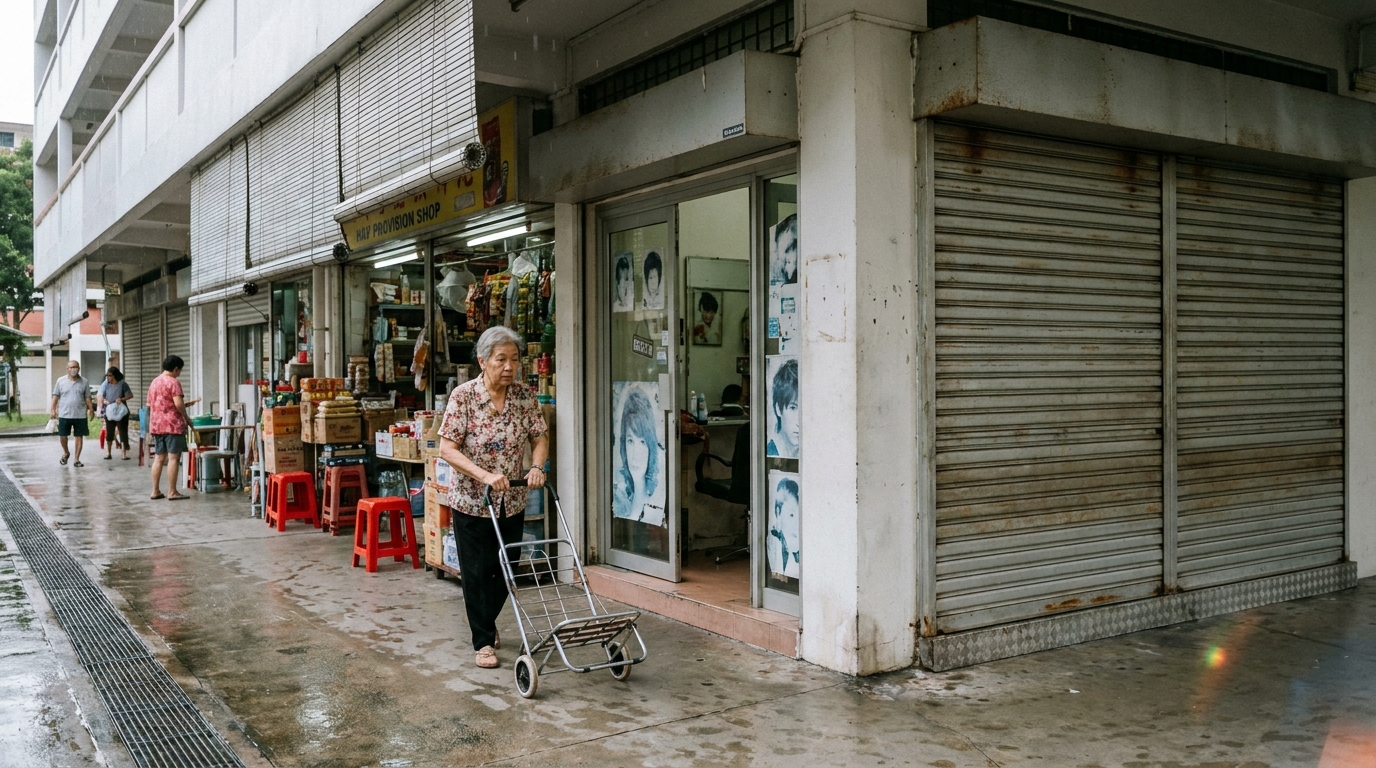
Singapore has roughly 15,500 HDB commercial shop units islandwide. About 7,000 are held and rented out directly by the Housing & Development Board on rolling tenancies. The other ~8,500 are privately owned, sold before HDB permanently stopped selling shops in 1998.
That closed door is the scarcity story every listing leans on. It is real. The pool of privately transactable heartland retail space is fixed and shrinking, which produces small local monopolies in mature town centres like Toa Payoh, Ang Mo Kio, Bedok and Clementi.
But scarcity of title is not the same as durability of value. Of those privately held units, roughly 730 to 740 were sold on 30-year leases in the 1990s — and more than 80% now have under 10 years left, expiring progressively between 2024 and 2045. The remaining ~7,700 sit on 99-year leases, many with 30 to 60 years to run.
When a 30-year lease expires, the unit reverts to the state. HDB has confirmed the sequence: incumbent owners are offered a short interim tenancy — a minimum of one year — and the unit is then tendered out under the Price-Quality Method. There is no long-term private renewal at the end of the road.
The rent is the bull case. It is also the bait.
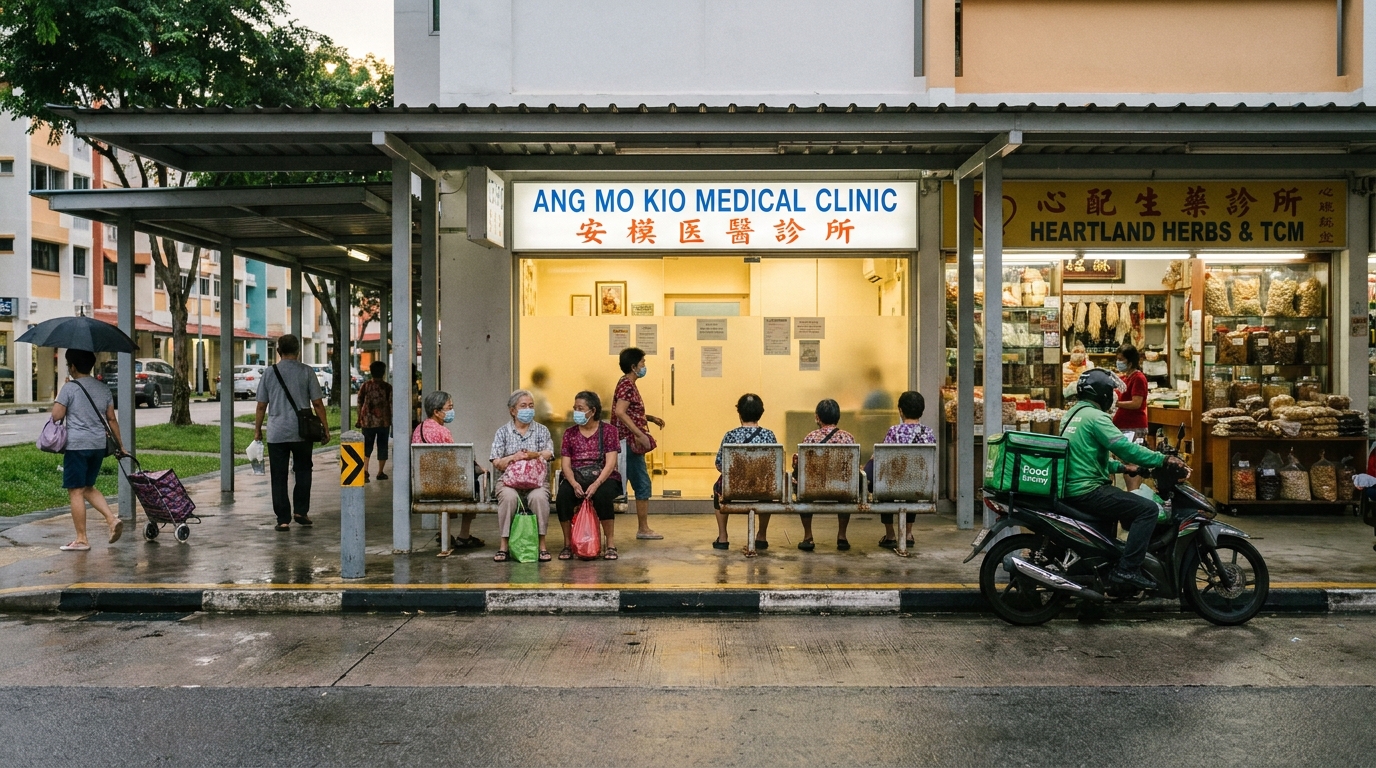
Heartland rents are genuinely strong. In Toa Payoh Lorong 6, median rents for privately held units rose 58.6%, from S$4.91 psf in Q4 2024 to S$7.70 psf by Q2 2025. Prime small-footprint ground-floor space and medical or clinic units have cleared above S$16 psf per month.
Transaction data followed. 63 HDB shophouses changed hands for S$122.5 million in the first nine months of 2024, beating the 44 deals worth about S$91 million in all of 2023, at an average quantum of roughly S$1.9 million to S$2.0 million.
Gross yields in the range of 4% to 6% comfortably beat prime private residential at 2% to 3% and conservation shophouses at 2.5% to 3.5%. Add the fact that pure commercial property attracts no Additional Buyer's Stamp Duty — while foreign residential buyers face 60% — and you can see why private wealth keeps drifting here.
A short-lease heartland shop is not an asset you own. It is an annuity you rent, and the rent has to repay the whole purchase price before the clock runs out.
The problem is that rising rent on a shortening lease is not compounding value. It is compensation for a wasting one. Those two things look identical on a yield sheet and are opposite in outcome.
Bala's Table does not negotiate
Under the Singapore Land Authority's leasehold relativity table, a 60-year leasehold interest is worth roughly 80% of freehold — and the curve steepens sharply below 40 years, then falls off a cliff under 30. At expiry, the value is zero. Not discounted. Zero.
That means the underwriting question for a heartland shophouse in Singapore is not "what is my gross yield". It is: will cumulative net rent, after tax, service charges and capex, exceed my entry price before the lease dies?
The one calculation that matters: take your net yield after property tax, conservancy charges and maintenance capex, then subtract the annual straight-line depreciation of the remaining tenure. On a 25-year lease that is roughly 4% a year of capital erosion — which can wipe out a 5% gross yield entirely.
Analysts at NUS IREUS and other industry commentators have made the same point repeatedly: leasehold heartland commercial space inevitably converges to zero land value, and paying a lofty entry premium on an ageing lease is a capital impairment risk unless offset by an extraordinary rental stream or a genuine redevelopment catalyst.
The bank is the gatekeeper, not the buyer
Here is where the theory becomes a cash-flow problem. CPF savings cannot be used for commercial property. Every dollar is cash or bank debt.
And the debt thins out fast. For commercial assets with fewer than 30 to 40 years of lease remaining, banks shorten loan tenures, cut loan-to-value well below the standard 70% to 80%, or decline to lend at all. Underwriting tightens as the tenure shortens.
The consequence is exit liquidity, not entry pain. If your buyer in year seven cannot get financing on a lease that is now four years shorter, your buyer pool collapses to all-cash investors hunting short-payback yield — and they will price accordingly.

Interest rates make this worse than it looks on paper. Even with easing through 2025 and 2026, borrowing costs remain well above the ultra-low decade that preceded them. The positive carry between yield and financing cost has narrowed, and capital has become far more selective about depreciating assets.
The state is a competitor, not just a landlord
Private heartland landlords are not operating in an open market. They are operating alongside 7,000 HDB-managed shops deliberately priced and curated to keep neighbourhood amenities affordable.
HDB's Price-Quality Method allocates 60% weighting to proposal quality — trade mix, affordability of essential goods, community value — and only 40% to bid price. That is a deliberate cap on rent-seeking on public retail land, and it anchors the rental ceiling in the precinct next door.
The policy signal has been explicit. National Development Minister Desmond Lee has framed the reversion of short-lease units into tenancies tendered by PQM as the mechanism that keeps heartland shop precincts vibrant and relevant. Senior Minister of State Sun Xueling has told Parliament that the government monitors heartland commercial rents closely and will selectively acquire privately owned HDB shops if needed to protect access to affordable basic goods and services.
Then there is the physical competition. Integrated developments such as Our Tampines Hub and Heartbeat@Bedok offer air-conditioning, unified management and coordinated marketing. Uncoordinated 1970s and 1980s shop rows with deferred maintenance are losing footfall to them, slowly and unevenly.
Why the bid-ask spread refuses to close
Prime heartland listings routinely test the market with guide prices from S$5 million to over S$30 million for single assets or portfolios. Sellers price historical footfall and irreplaceable title. Buyers price a finite lifespan and a hostile financing environment.
Market reporting through this cycle has described exactly that standoff: prolonged sluggishness in ageing shophouse deals, driven by price-expectation mismatch plus wariness over borrowing costs and lease decay. Volumes rose in 2024, but volume is not the same as agreement — it is the subset of deals where a seller finally accepted the discount.
For owners of the ~740 units on 30-year leases, the calculus is starkest. The endgame is not a sale at a premium. It is the transition from landlord to tender applicant, bidding under PQM for a tenancy on premises you used to own. Anyone in that cohort with under a decade left should be running the disposal maths now, not in year eight.
What to actually check before you bid
None of this makes heartland commercial property uninvestable. Defensive, non-discretionary footfall — groceries, F&B, clinics, enrichment centres — is a real advantage over CBD retail, and privately owned units can sublet to any allowable trade, unlike HDB tenancies bound to their tender terms. The asset class works. The price and the lease have to work with it.
- Net yield minus amortisation, not gross yield. If that number is negative, you are buying a losing trade with a nice monthly cheque.
- Bank credit policy on your specific tenure — including what a buyer will be able to borrow in five and ten years, not just today.
- HDB's Remaking Our Heartland precincts and the URA Master Plan, plus MRT expansion such as the Cross Island Line. A redevelopment or renewal catalyst is one of the few things that genuinely resets the maths.
- Change-of-use and compliance risk — URA and HDB guidelines on upper-floor living quarters, fire safety, and F&B kitchen exhaust in older shophouses.
- Proximity to state-managed stock and integrated hubs, which sets the practical rental ceiling regardless of what your valuation says.
Hongkong Land's move told the market that even trophy Singapore commercial assets are being matched to the capital structure that suits them, rather than forced into the one that is most visible. Heartland shophouses deserve the same discipline in reverse.
A 99-year unit with 50 years left and a defensible trade mix is a different security from a 30-year unit with eight years left, however similar the rent roll looks. Price the lease, not the footfall.