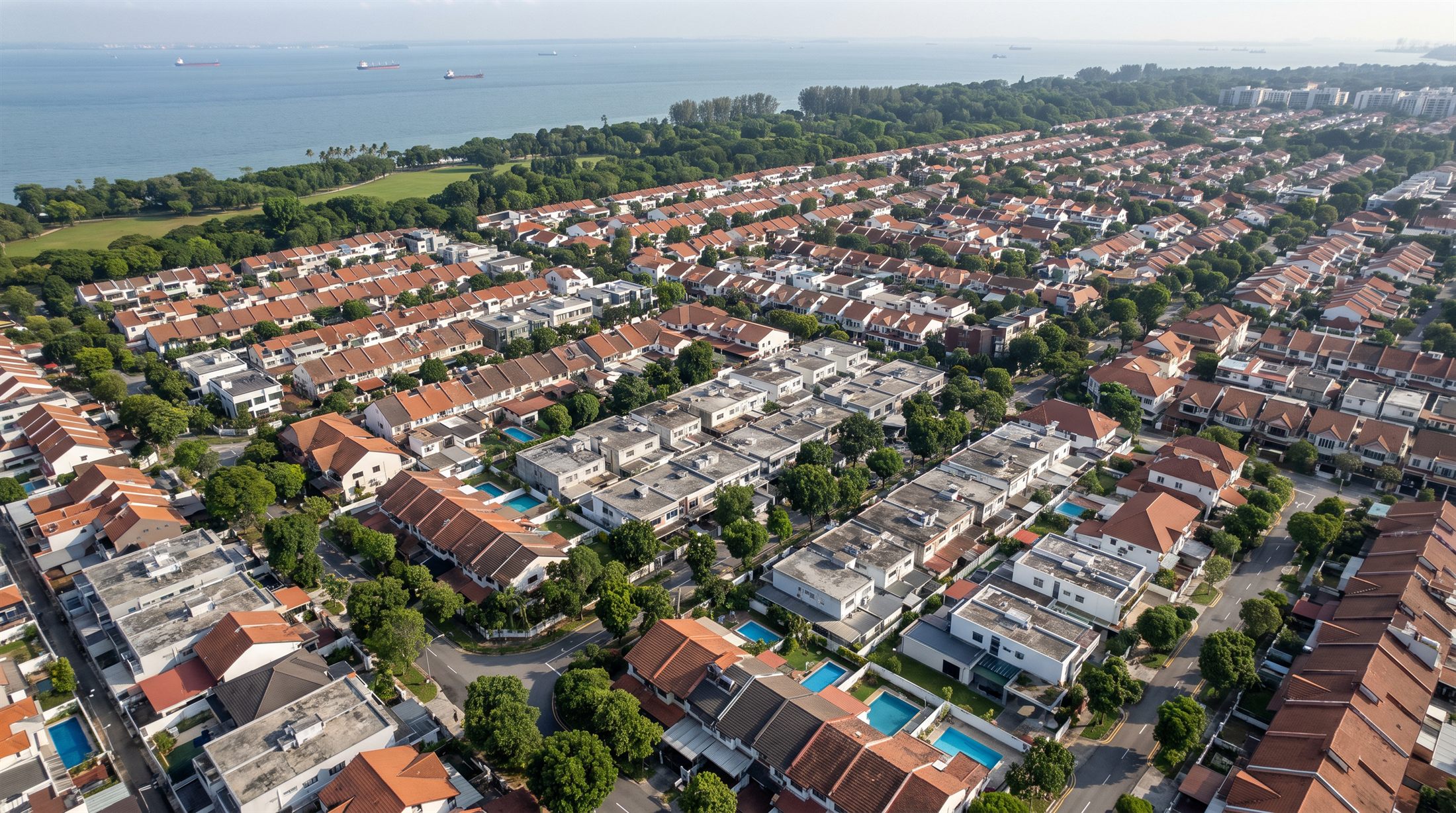
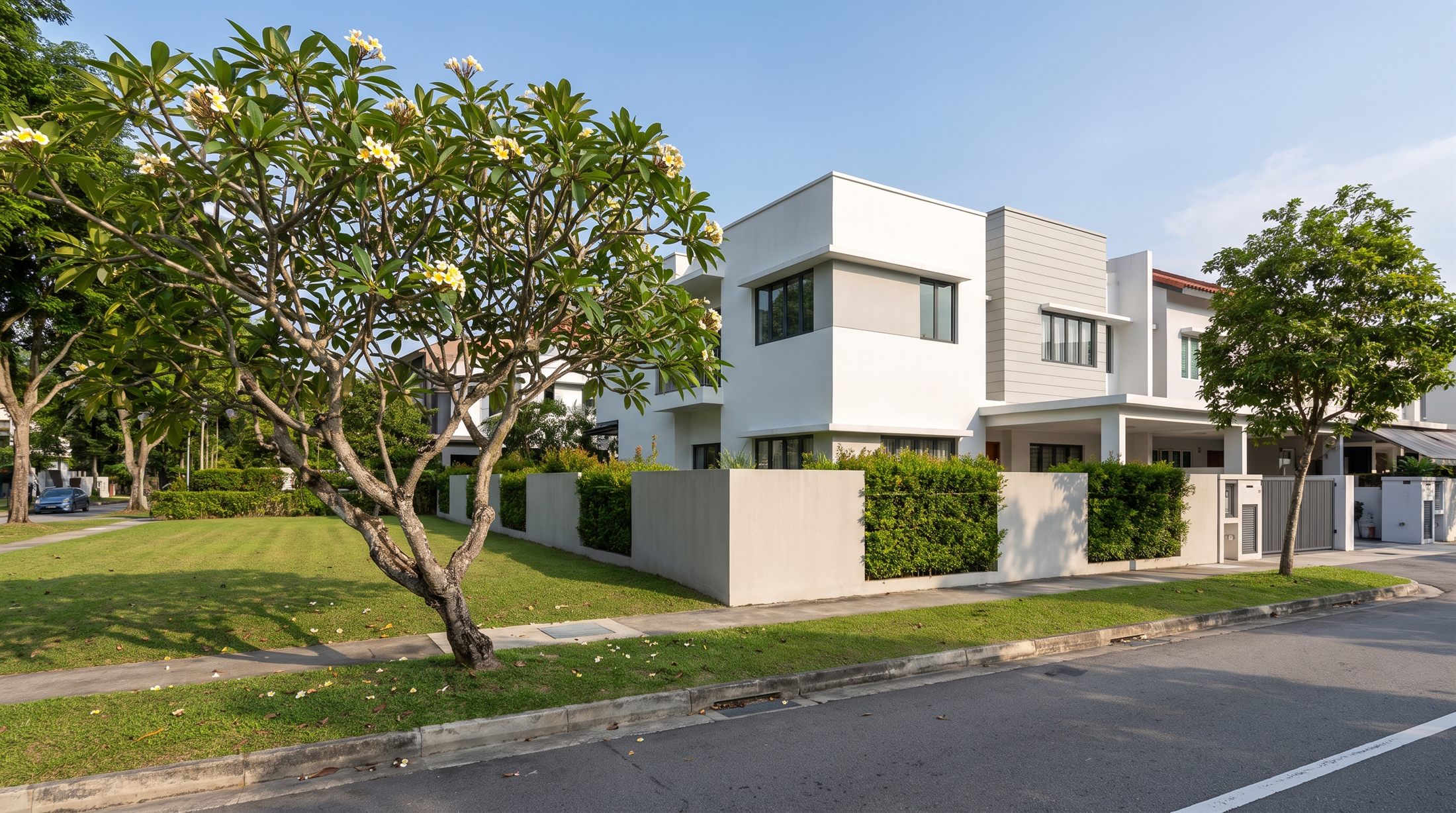
Four hundred and twenty-three freehold landed transactions in the Siglap, Frankel and Opera corner of the East Coast, read plot by plot. What the houses actually cleared at — and why the number your neighbour quotes you is almost certainly measuring the wrong thing.
423
freehold landed transactions, Sep 2021 – Jul 2026
+27–38%
land PSF growth since 2021, depending on the estate
$1,547–$2,843
the land PSF spread inside a single enclave
Where the number comes from
A landed price in this pocket is not one number. It is a stack of them: the estate, the house type, the plot size, the street, and the envelope you could build but haven't. Most owners know one of the five.
Everything below is computed on land PSF — the transacted price divided by land area, not built-up area. That single choice is what makes the comparisons hold. Medians are used throughout, never averages, and any cell drawn from fewer than five sales is flagged as thin.
Finding one — Opera Estate is not the cheaper estate. It is the smaller one.
Opera has a long-standing reputation as the affordable cousin of the three. On the asking price of a terrace, that is true. On the ground underneath it, the ranking flips completely.
Terrace transactions, by estate
Estate (terrace only)
Sales
Median price
Median plot
Median land PSF
Opera Estate
126
$3,980,000
1,689 sqft
$2,227
Frankel Estate
27
$4,080,000
1,755 sqft
$2,091
Siglap
54
$4,447,500
2,381 sqft
$1,758
mastplan
Median land PSF. URA private residential transactions, Sep 2021 – Jul 2026.
Opera has the cheapest house and the most expensive land. Siglap has the most expensive house and the cheapest land. The difference is plot size, not quality.
A buyer paying $3.98M in Opera and a buyer paying $4.45M in Siglap are not buying the same thing at different prices. They are buying 1,689 square feet of ground and 2,381 square feet of ground. Per foot, the Opera buyer is paying 27% more.
Land PSF growth since 2021, by estate
The smallest-plot estate grew slowest. The largest-plot estate grew fastest — the market has been re-rating land area, not addresses.
Median land PSF, 2021 vs 2026. Terrace transactions.
Read that alongside the table and the Opera position gets uncomfortable. It entered the period on the most expensive ground of the three and it has appreciated the least. The premium was already priced in.
You’ve seen the first estate comparison
The rest of the audit is free.
The preview shows the framework and one estate comparison. The full audit reveals how estate, house type, rebuilding potential and buyer demand shape your own number.
The full table — every estate, every house type, every median.
The quantum ladder — the floor, the middle half and the ceiling.
The rebuild equation — tiered costs, timelines and the envelope question.
Nine steps to run before you list, in order.
Open the full audit
Enter your details for instant access — about 30 seconds.
You're in.
The remaining six findings are open below.
Instant accessNo account requiredRelevant follow-up only
Finding two — your PSF is not a grade. It is a function of your plot size.
Two houses on the same street can sit 60% apart on land PSF and both be priced perfectly. This is the single most misread number in landed property, and it is not a subtle effect — across 423 transactions it is close to a straight line.
Bigger plots cost more and are worth less per square foot
Price rises 290% from the smallest band to the largest. Land PSF falls 39% across the same range. Both are true at once, and neither is a bargain signal.
Median priceMedian land PSF
Land size band, thousand sqft. Siglap, Frankel and Opera, Sep 2021 – Jul 2026.
The same six bands, in figures
Land size band
Sales
Median land PSF
Median price
Under 1,600 sqft
42
$2,525
$3.43M
1,600 – 2,200 sqft
105
$2,254
$4.05M
2,200 – 3,200 sqft
107
$1,943
$5.09M
3,200 – 4,500 sqft
89
$1,696
$6.35M
4,500 – 7,000 sqft
60
$1,658
$9.29M
Above 7,000 sqft
20
$1,547
$13.4M
mastplan
All three estates pooled, all house types. 423 transactions.
Same street, same tenure — two very different plots.
The trap for sellersYou look up a recent sale two doors down at $2,400 PSF, apply it to your larger plot, and arrive at a number no buyer will meet. The comp was smaller. Larger land always clears at a lower rate per foot because the buyer pool for a bigger quantum is thinner.
The trap for buyersYou find a 5,000 sqft plot at $1,650 PSF and read it as underpriced against the $2,250 terraces nearby. It is not underpriced. It is a different band, and it is priced correctly for that band.
A land PSF figure is only meaningful against the same house type in the same plot band. Every comparison in this audit holds both constant. Almost no conversation between neighbours does.
Finding three — inside Siglap alone, the same house type swings 80% street to street.
Estate-level medians hide the thing that actually sets your number. URA publishes street-level detail for Siglap, and once you split it out, the range inside one enclave is wider than the range between the three enclaves.
Median land PSF by street and house type — Siglap only
The land under a Palm Avenue semi-detached is worth 80% more per square foot than the land under a Jalan Ulu Siglap semi-detached. Same enclave, same house type.
Median land PSF, Sep 2021 – Jul 2026.
Siglap, street by street
Street & type
Sales
Median land PSF
Median price
Palm Avenue — semi-detached
6
$2,843
$8.69M
Siglap Road — semi-detached
6
$1,898
$5.07M
Woo Mon Chew Road — terrace
28
$1,832
$5.25M
Jalan Tanjong — terrace
10
$1,681
$4.40M
Siglap Road — detached
6
$1,634
$10.95M
Jalan Ulu Siglap — semi-detached
6
$1,581
$6.70M
mastplan
Street-level detail is published for Siglap only. Sep 2021 – Jul 2026.
A note on honesty. Four of those six rows rest on six sales each. That is enough to show a direction and not enough to set a price. The 80% gap is real and repeatable; the exact figure inside any one row will move as more transactions land. Treat the ordering as the finding, not the decimal.
Finding four — the house is from the seventies. The land is not.
Everything above this point is measured. This section is not, and it is labelled that way deliberately. Rebuild economics are industry ranges, not quotations, and they move with the tender market.
The reason it belongs in a pricing audit is simple: on a plot in this pocket, an original 1970s house is often a discount rather than a feature. The buyer is underwriting the cost of removing it. If you have never had that cost estimated, you are negotiating against a number the other side has already worked out.
What work on a landed house costs, per square foot of built-up area
Three different jobs that owners routinely quote as one number. The gap between the ends is the whole argument.
Indicative 2026 industry ranges, per sqft of built-up area. Not quotations.
TimelineEighteen to twenty-four months for a full rebuild, plus planning clearance before that and holding costs throughout. The holding cost is the line owners forget, and on a $5M plot it is not small.
The height envelopeTwo-storey zones are capped at 12 metres and three-storey zones at 15 metres, with an attic allowance above. If your standing house does not use that envelope, the unused volume is value you own and have never been paid for.
A&A or reconstruction?There is a widely-quoted rule that altering more than half the structure turns an A&A into a reconstruction. Treat that as shorthand, not statute — where the line falls is a judgement your qualified person makes against current URA and BCA submission practice, and it is worth confirming before you plan around it.
This is a seller question, not a renovation question. You are not deciding whether to rebuild. You are deciding whether the buyer gets to price your unused envelope for free. Get a preliminary envelope study before you list, not after.
Finding five — the full table. Every estate, every house type.
The complete picture, with property type held constant so the comparisons hold. Thin cells are marked; read them as direction, not as price.
Frankel owns the detached marketFifty detached sales against Frankel's name over five years, versus nineteen in Siglap and seven in Opera. If you own a detached house here, Frankel is where your comparable evidence lives.
Siglap semi-detached punch above the estateAt $2,038 PSF they clear above both Opera and Frankel semi-detached, and above Siglap's own terraces. That is the one place in the dataset where the plot-size gradient bends.
Finding six — the quantum ladder. What actually clears.
Owners anchor on the ceiling and buyers anchor on the floor, and both quote them as though they were the market. The market is the box in the middle.
Siglap terrace — the observed price range
Half of everything that traded sits inside the blue box. The whiskers are the extremes, and each of them is a single house with a specific reason.
Transacted price, terraces, last 24 months.
The ladder, in figures
Point on the ladder
Figure
Floor — cheapest clearing terrace
$2.50M
25th percentile
$3.81M
Median
$4.40M
75th percentile
$5.20M
Ceiling — top transaction
$6.91M
mastplan
Transacted prices, Siglap terraces, last 24 months.
Why the ceiling matters more than the floor. The floor tells you what a distressed or badly-positioned house does. The ceiling tells you what the market will pay when everything lines up — plot, street, condition and timing. If you are within reach of the top quartile on the measurable factors, the ceiling is the relevant number and the median is a trap.
Finding seven — what actually moves your number inside the estate.
Six factors, ordered by how consistently the transaction data supports them. The first two are the ones most often left out of a valuation conversation entirely.
Plot width and regularityA wide, rectangular plot rebuilds cleanly and takes a larger footprint within the same setback rules. A deep, narrow or triangular plot of identical area does not, and the market prices the difference.
Corner versus inter-terraceA corner terrace carries a real and repeatable premium — extra frontage, extra light, and the option of a side extension. It is the single most under-claimed feature in this pocket.
Road hierarchyA cul-de-sac or a quiet internal road clears above a main-road position of the same size and type. Second most under-claimed, and the easiest to evidence with comps.
Orientation and the west sunWest-facing living areas without shading are a genuine deduction here, and buyers who have lived through one know it. North-south orientation is a quiet premium.
Condition versus rebuild-readinessThe worst position is the middle: a house too tired to present and too intact to read as a clean site. Pick an end. Either present it move-in ready or present it as land.
Proximity to Siglap MRTTE28 opened in June 2024. A valuation carried out before that date does not have the station in it, and a lot of the reference points owners are quoting predate the opening.
Finding eight — the station is open, and the supply is not coming to your street.
Two structural changes sit under this pocket, and the common version of the story gets the timing wrong in a way that matters.
What changed, and whether it is priced in
What changed
Status
Read
Siglap TE28 on the Thomson-East Coast Line
Open since Jun 2024
already in the prices
Bayshore TE29
Open since Jun 2024
already in the prices
Bedok South and Sungei Bedok (TEL Stage 5)
Still to come
not yet priced
Bayshore housing precinct, ~10,000 homes
Progressive rollout
density, not competition
New landed plots in Siglap, Frankel or Opera
None
fixed supply
mastplan
Rail and supply position as at publication.
The correction worth making: Siglap and Bayshore stations both opened in June 2024, in the same stage of the line. Anyone still describing Bayshore as forthcoming is working from a two-year-old briefing. What genuinely remains ahead is the last pair of stations and the housing precinct itself.
Roughly ten thousand new homes will arrive in the precinct over the coming years. The number of landed plots in these three estates will not change by one. That asymmetry — rising density against fixed ground — is the most durable argument for holding land here.
It is also the reason to be careful with the word catalyst. The rail catalyst has already happened and is already in the transacted figures above. The precinct is a slower, more diffuse effect, and it does not arrive as a single re-rating event.
Finding nine — before the listing goes live, in this order.
The order is the point. Most of the value lost in a landed sale is lost in the first three weeks, before a single viewing.
1
Pull the transacted comps, not the asking compsYour neighbour's asking price is a wish. Hold house type and plot band constant — Finding Two is the reason this step comes first.
2
Establish your buildable envelopeA preliminary study of what could be built on your plot, against what stands on it now. The gap is value you own and have not been paid for.
3
Get a bank valuation before you set a priceThe bank's number is the one your buyer's financing will be tested against. Setting a price above it without knowing it is how deals collapse at week six.
4
Name your worst feature and address itWest sun, a drainage reserve behind, a main-road frontage. Hiding it makes the first viewing the last one. Pricing it in makes it a negotiation you control.
5
Declutter to neutral, then photographIn that order, never the reverse. Photographs of a full house cannot be un-seen by a buyer who has already scrolled past them.
6
Decide your timeline honestlyThere are two sellers: the one who needs a date and the one who needs a number. Pretending you are the second when you are the first is how six figures go missing.
The through-line of this audit
Land PSF is a function of plot size, not of quality. Compare like for like or the number is noise.
Opera holds the most expensive ground and has appreciated the least. Siglap holds the cheapest and has appreciated the most.
Inside one enclave the same house type ranges 80% street to street — the street is not a rounding error.
The unused build envelope is real value, and it is the part no public dataset can price for you.
The rail catalyst is already in the transacted figures. The supply asymmetry is what is still ahead.
mastplan
How this audit was built
423 landed transactions drawn from URA private residential transaction data covering September 2021 to July 2026, across Siglap, Frankel Estate and Opera Estate. Terrace, semi-detached and detached. All freehold.
All PSF figures are land PSF, computed on land area, not built-up area.
Medians throughout, never averages — a single $20M sale should not move an estate's figure.
Property type is held constant in every comparison.
Cells drawn from fewer than five transactions are flagged as thin.
Street-level detail is available for Siglap only; URA groups Frankel and Opera transactions at estate level rather than by street.
Two things sit outside public data and no audit can invent them: asking prices, because URA records only what transacted, and built-up area, which is not published. Both matter to your own number, and both are why the last figure in any audit belongs to the plot, not to the estate.
The plot, not the estate
Get your own plot read.
This audit can price the estate. It cannot price your house — Finding Two is the reason why. Three things move your number by six figures and none of them are in public data: your built-up area, your unused envelope, and your street position inside the estate. Send us the street and house type and we'll come back with a read on all three.
Your true comp setYour buildable envelopeYour realistic price bandHold or sellStreet positioning
Got it.
We'll come back to you shortly with your plot read.
About the figures Land-PSF, price, plot-size and sales-count figures are computed from URA private residential transaction data covering September 2021 to July 2026 (423 freehold landed transactions across Siglap, Frankel Estate and Opera Estate) and are indicative as at publication, subject to revision by the relevant authorities. Rebuild, A&A and renovation costs and construction timelines are industry ranges, not quotations, and move with the tender market. Building height and envelope parameters are subject to the prevailing URA guidelines for the specific plot and must be confirmed by a qualified person. Rail facts are as at publication. Published for educational purposes; nothing here is a valuation, an offer, or financial advice. Please check with a professional before making any property decision. See our full Disclaimer.
Create your account or sign in
One account unlocks every gated resource. New members create an account here; returning members use the same form to sign in.