 plan
planBedok’s S$1.425 Billion Land Bid Raises the Stakes Before Any Sale Is Awarded
The New Upper Changi Road tender reveals unusually strong developer conviction, but neither the land sale nor a near-S$3,000 psf launch has been confirmed.
The gist
- The New Upper Changi Road tender reveals unusually strong developer conviction, but neither the land sale nor a near-S$3,000 psf launch has been confirmed.
- The New Upper Changi Road government land sale site attracted a top bid of S$1.425388 billion, or S$1,537 psf per plot ratio.
- URA’s tender results for the New Upper Changi Road residential site have delivered a striking number: S$1.425388 billion.
The gist
- The New Upper Changi Road government land sale site attracted a top bid of S$1.425388 billion, or S$1,537 psf per plot ratio.
- That bid was about 13.8% above the S$1.252 billion second-place offer, a calculation based on URA’s published tender results.
- The tender has closed, but URA has explicitly said the results are not an announcement of award. Its current land-sales page still lists the site as “Tender closed”.
- Suggestions that the future condominium could start near S$3,000 psf are analysts’ estimates—not an announced price, launch plan or guaranteed outcome.
URA’s tender results for the New Upper Changi Road residential site have delivered a striking number: S$1.425388 billion. Submitted by United Venture Development (Daisy) and CL Sapphire, the leading offer works out to S$1,537 psf ppr.
That is the concrete development. But the land has not yet been awarded, and no future condominium price has been set. The significant story is narrower and more useful: one bidder has placed an unusually forceful valuation on a large site near Bedok MRT and the town centre, while accepting the commercial risk of turning that valuation into more than 1,000 saleable homes.
The bid is an important signal of developer conviction, not a completed transaction or a price guarantee.
A record bid, but not yet a completed sale
Four bids were submitted when the tender closed. Behind the S$1.425388 billion top offer were bids of S$1.252 billion, S$1.242664619 billion and S$1.215 billion.
The gap at the top matters. By mastREplan’s calculation from the published figures, the leading bid was approximately 13.8% higher than the next offer. It was not a marginal win produced by several developers arriving at almost the same land value.
That difference can support two interpretations. The optimistic one is that the leading consortium sees value others have underestimated: a scarce opportunity beside a mature town centre, strong transport links and a sizeable pool of households that may want to remain in the east when moving into private housing.
The more cautious interpretation is that the top bidder has simply underwritten more ambitious assumptions than its competitors. Those assumptions could concern selling prices, unit sizes, construction efficiencies, the pace of sales or the premium buyers will pay for a new home near central Bedok.
For now, even the identity of the successful tenderer remains conditional. URA’s tender-closing notice says expressly that it is not an announcement of tender award, and that the bids will be evaluated before a decision is made. URA’s live listing also describes the parcel as “Tender closed”, not “Awarded”.
Calling the site “sold” therefore gets ahead of the official process. An award may eventually validate the top bid, but the distinction matters when a land tender is being used to support claims about future home values.
Why this Bedok parcel attracted such conviction
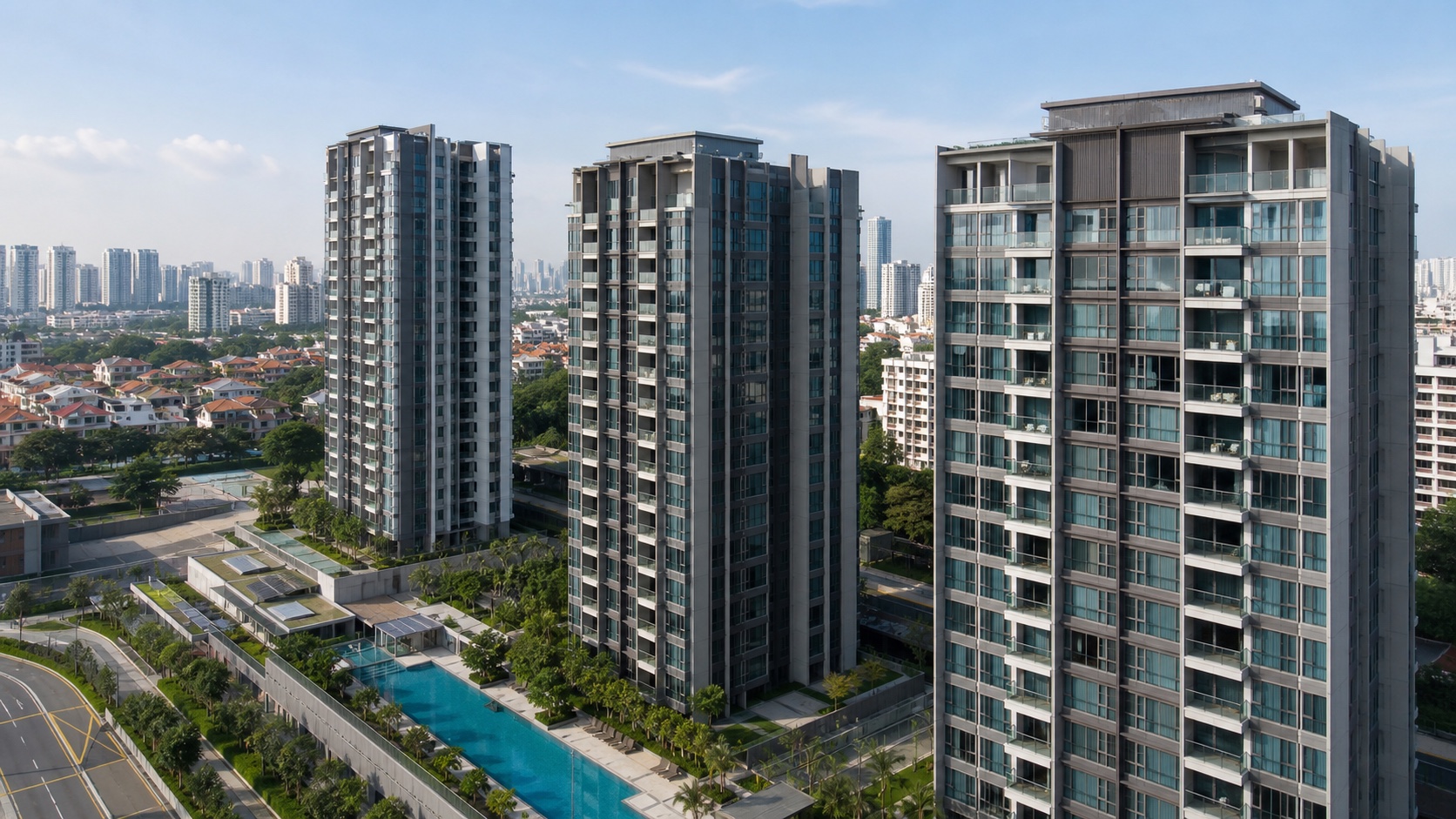
The 99-year leasehold parcel sits at New Upper Changi Road and Bedok South Road, close to Bedok MRT and the established amenities of Bedok Town Centre. It covers 30,769 sq m, permits a maximum gross floor area of 86,154 sq m and is estimated to yield about 1,010 homes.
Location is only one part of its appeal. Large residential sites near mature town centres give developers access to several potential buyer groups at once: existing private-home owners, HDB upgraders, families with ties to the east and buyers who value immediate transport and retail convenience.
Scale can also help a developer spread certain project costs across more units. But a 1,010-home estimate creates a corresponding sales challenge. A developer does not merely need to establish a high headline psf; it must persuade enough households to commit at viable absolute prices over the project’s selling period.
The land is also not a blank, cost-free plot. Tender materials address existing buildings, demolition and obligations concerning asbestos survey and sampling. These conditions are a reminder that the land rate is not the project’s total cost.
Construction, financing, professional fees, marketing, regulatory requirements and the cost of carrying unsold inventory all sit between a land bid and a profitable development. So does design: the eventual mix of unit sizes can materially affect both quoted psf prices and the sums buyers actually pay.
This is why multiplying the land rate by a rough industry factor cannot produce a dependable launch price. It may offer a shorthand scenario, but it is not a substitute for the developer’s cost structure, design decisions and pricing strategy—none of which has been formally announced.
The S$3,000 psf figure is a scenario, not a price list
Published analyst estimates have put possible opening prices at around S$3,000 psf, while another estimate suggested approximately S$2,850 to S$2,900 psf. These views help frame the economics implied by the bid, but they are not developer guidance or confirmed launch pricing.
There is not yet an announced project name, unit mix, sales date or pricing schedule in the cited official tender material. Even after an award, planning and product decisions could change the relationship between average prices, starting prices and individual unit prices.
“Starting from” figures also require care. A small number of compact or less-preferred units can establish an advertised entry point without describing the project’s overall pricing. Conversely, a high psf for a small apartment may still produce a lower purchase quantum than a larger home sold at a lower psf.
For HDB upgraders, total quantum is likely to matter more than the headline psf alone. At a purely illustrative S$2,900 psf, a 600 sq ft unit would translate to S$1.74 million before transaction costs; at S$3,000 psf, it would be S$1.8 million. These are mastREplan calculations, not predictions of unit sizes or prices.
The future developer could adjust layouts to protect entry quantum, but smaller homes do not make affordability constraints disappear. Buyers still face down-payment, financing and monthly repayment limits, while family households must decide whether the available space suits them.
The strongest case for a price near S$3,000 psf is straightforward: expensive land near an MRT station and mature town centre will require a meaningful selling-price premium. The strongest counterargument is equally important: developers cannot set prices solely from costs. Buyers must accept them, and competing supply can restrict how far prices move.
Nearby owners gain a reference point, not an instant windfall
For owners of private homes around Bedok, the bid is likely to become part of the market conversation. It reveals how one bidder appraises a prominent new-build opportunity and may strengthen expectations for well-located homes nearby.
But a government land bid is not a comparable residential transaction. It does not show what a buyer paid for a completed unit with a particular floor level, view, layout, age and remaining lease.
Existing condominiums may benefit if the eventual new project makes their resale prices look comparatively accessible. A buyer who finds a new launch beyond reach could turn to a larger or cheaper resale home nearby. That is a plausible substitution mechanism, not a guaranteed repricing effect.
Differences between projects remain decisive. A younger development with efficient layouts and convenient access may capture more of any spillover than an older property with higher maintenance needs or a less direct walk to transport. Freehold and leasehold homes also cannot be compared purely through headline psf.
Nor does the tender establish a resale floor. If the future project launches at a premium, some buyers may simply reject that premium, compromise on location or postpone their purchase. Resale owners still need actual transactions—not developer cost assumptions—to validate higher asking prices.
More supply complicates the scarcity argument
The Bedok bid arrives within a broader policy setting of sustained private-housing supply. URA said the Confirmed List for the full 2026 Government Land Sales programme would provide 9,320 private residential units.
URA also placed the overall private-housing pipeline at around 61,000 units, including approximately 32,000 unsold units that could be available for sale over the following two years or so. Those national figures do not tell us exactly how many buyers will compete for a central Bedok home, but they weaken any simplistic claim that all new private housing is becoming scarce.
Reported estimates indicate that four Bedok-area GLS sites released from 2025 onwards could collectively contribute about 3,185 homes. Location, launch timing and product positioning will differ, yet buyers considering the east may eventually have several alternatives rather than one unavoidable choice.
This creates the central tension. The New Upper Changi Road parcel possesses attributes that can justify a premium, but the developer may have to establish that premium while substantial supply is moving through the market.
A large project also has internal competition: every unsold unit competes with the next release within the same development. Pricing can be tested and revised by stack, floor, view and sales phase. A projected opening range cannot tell us the eventual average achieved price or the time needed to sell the project.
What buyers should take from the bid now
For buyers considering resale homes today, waiting has a real cost: the future Bedok development has not been awarded, designed or launched, and a completed home would arrive later still. Households with immediate housing needs may reasonably prefer certainty over a project whose configuration and price remain unknown.
But rushing to buy because this bid supposedly proves that all Bedok homes will soon cost more would be a weak reading of the evidence. The bid measures one consortium’s willingness to pay for one site under its own assumptions. It does not measure every household’s willingness or ability to fund the eventual homes.
For prospective upgraders, the most useful implication is that a future new-build option near Bedok’s town centre could carry a substantial premium. That makes preparation around total budget and required space more valuable than anchoring on a single psf estimate.
For nearby owners, the tender is best treated as a forward reference point whose relevance will strengthen only in stages: if URA awards the site, when the development details emerge, when prices are released and, finally, when buyers transact in meaningful numbers.
The next development to watch is therefore not whether commentary repeats the S$3,000 psf figure. It is URA’s award decision, followed by the eventual project’s approved design and actual sales evidence. Those steps will show whether the boldest land valuation in the tender can become a price Bedok buyers are prepared to pay.