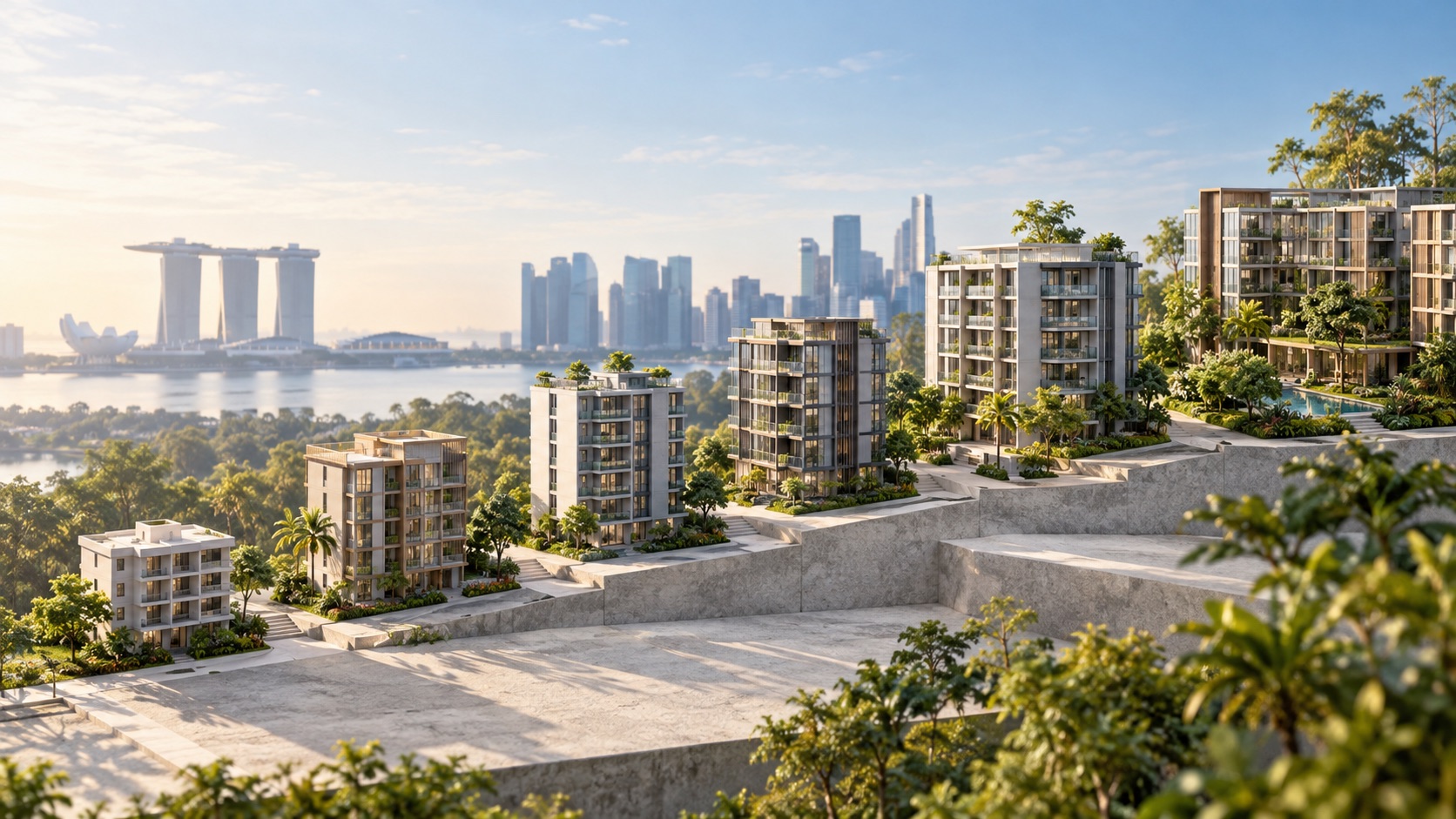
Promenade Peak Is Ripping Out a Transfer Slab. Woh Hup Pays. The 596 Buyers Wait.
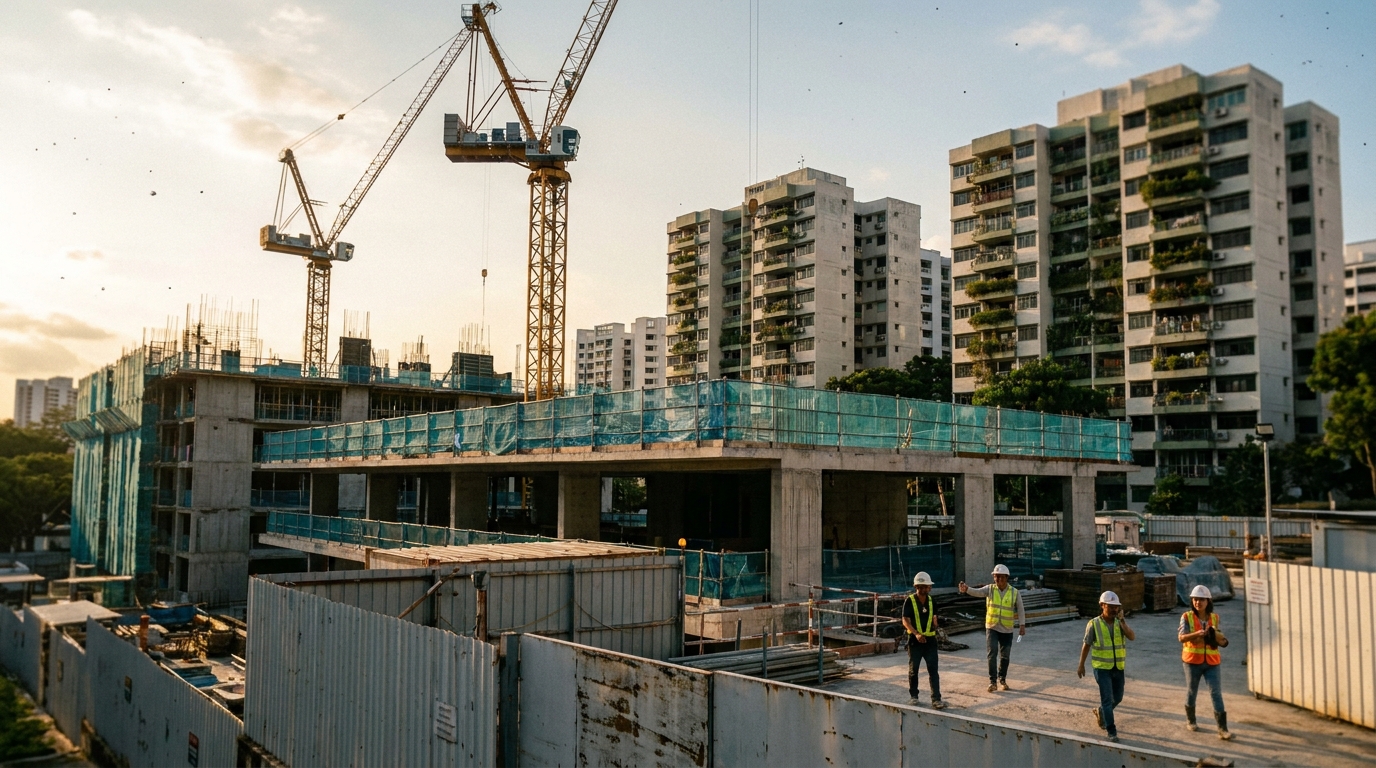
A failed concrete transfer slab at the 63-storey River Valley tower is being demolished and recast — and the episode is a live test of what buyers of uncompleted condos actually own before handover.
The gist
- A failed concrete transfer slab at the 63-storey Zion Road tower is being fully demolished and recast.
- Main contractor Woh Hup bears the entire rebuild cost; none passes to the 596 buyers.
- Completion targets 1Q2030, with an endeavour to finish by 2Q2030; only the S&P date binds.
- Progressive payments are certification-linked, so undone work generates no billing and pauses bank disbursement.
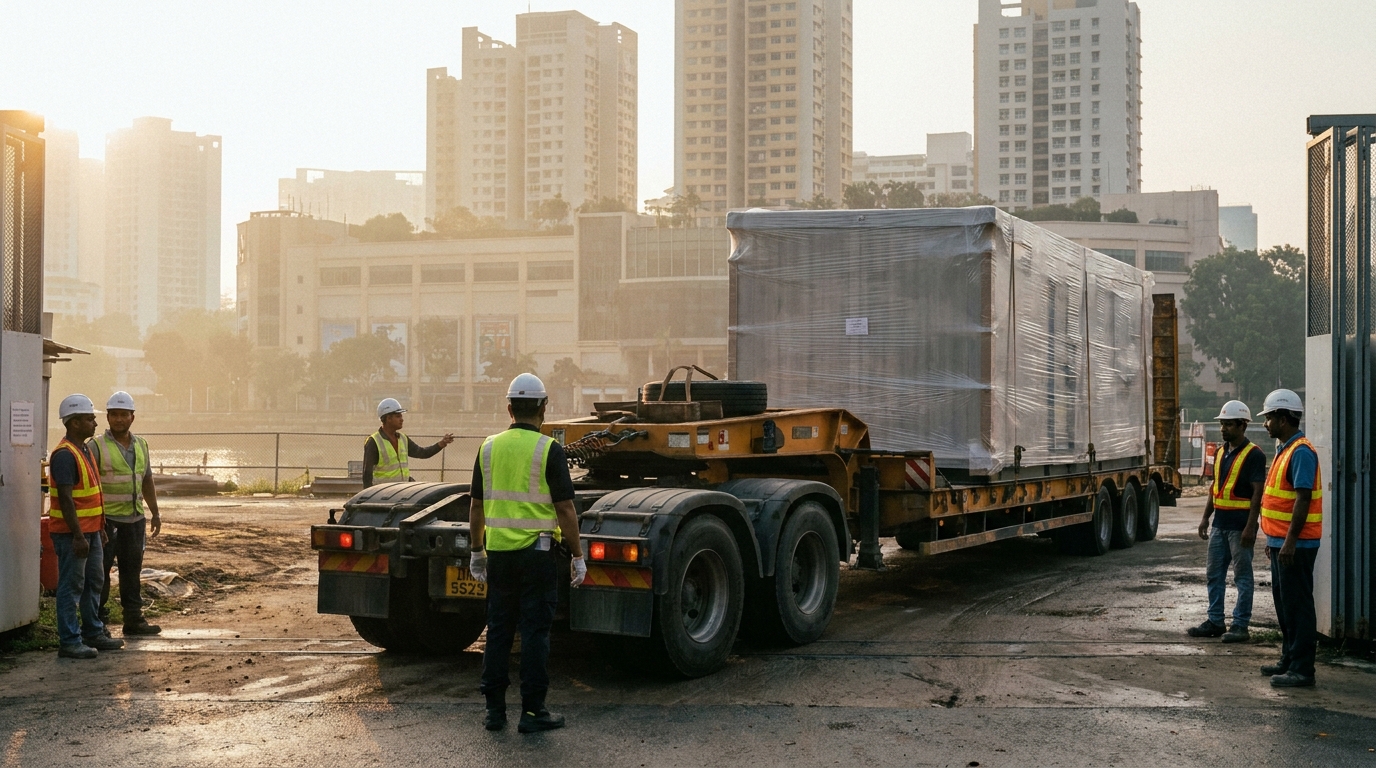
A concrete transfer slab at Promenade Peak, the 63-storey tower going up on Zion Road in River Valley, failed quality checks after concreting and is being dismantled and rebuilt in full. Demolition was visibly under way at the site by late August 2026. The engineering answer here is the right one. The more useful question for anyone holding an option on an uncompleted home is what, exactly, they control while it happens.
What failed, and why it is not a cosmetic problem
A transfer slab is the structural hinge of a tower like this. It redistributes load from upper floors — where the columns and walls sit in one arrangement — down to a different grid of columns and walls below, typically over a podium or carpark. It is not a finish. It is the thing the building stands on.
In a May construction update to buyers, Allgreen Properties managing director Tho Leong Chye wrote that during joint internal quality assessments with main contractor Woh Hup, “it was identified that the supporting concrete transfer slab did not meet stringent quality standards we have established for the project”. The decision was to replace it entirely, which Tho described as “the most prudent and responsible approach to safeguard and uphold the quality and integrity of the development”.
Neither the developer nor the project spokesperson has said what caused the slab to fall short. That gap is worth noting rather than filling. The Building and Construction Authority said issues involving concrete transfer slabs are uncommon, and confirmed the project parties ran further engineering assessments and tests, alerted the agency, and sought approval from the Commissioner of Building Control to carry out rectification.
The timing is the whole story
Promenade Peak is designed to be the world’s tallest residential building using prefabricated prefinished volumetric construction. Under PPVC, three-dimensional modules are built and fitted out off-site, then trucked in, hoisted and stacked. It is fast, and it is unforgiving: once stacking begins, the structure below is buried under everything above it.
So a defective transfer slab caught after concreting and before the tower goes up is a bad week. The same defect caught after 63 storeys of modules are sitting on it is a different category of event entirely.
A defective transfer slab caught before the tower goes up is a bad week. Caught after 63 storeys of modules are sitting on it, it is a different category of event entirely.
This is what Singapore’s layered supervision regime is built to produce. Under the Building Control Act, concrete is tested by accredited laboratories, Qualified Persons inspect at defined stages, and structural work is signed off before the next phase proceeds. The system did not prevent a bad slab. It caught one, at the stage where catching one still costs money instead of lives.
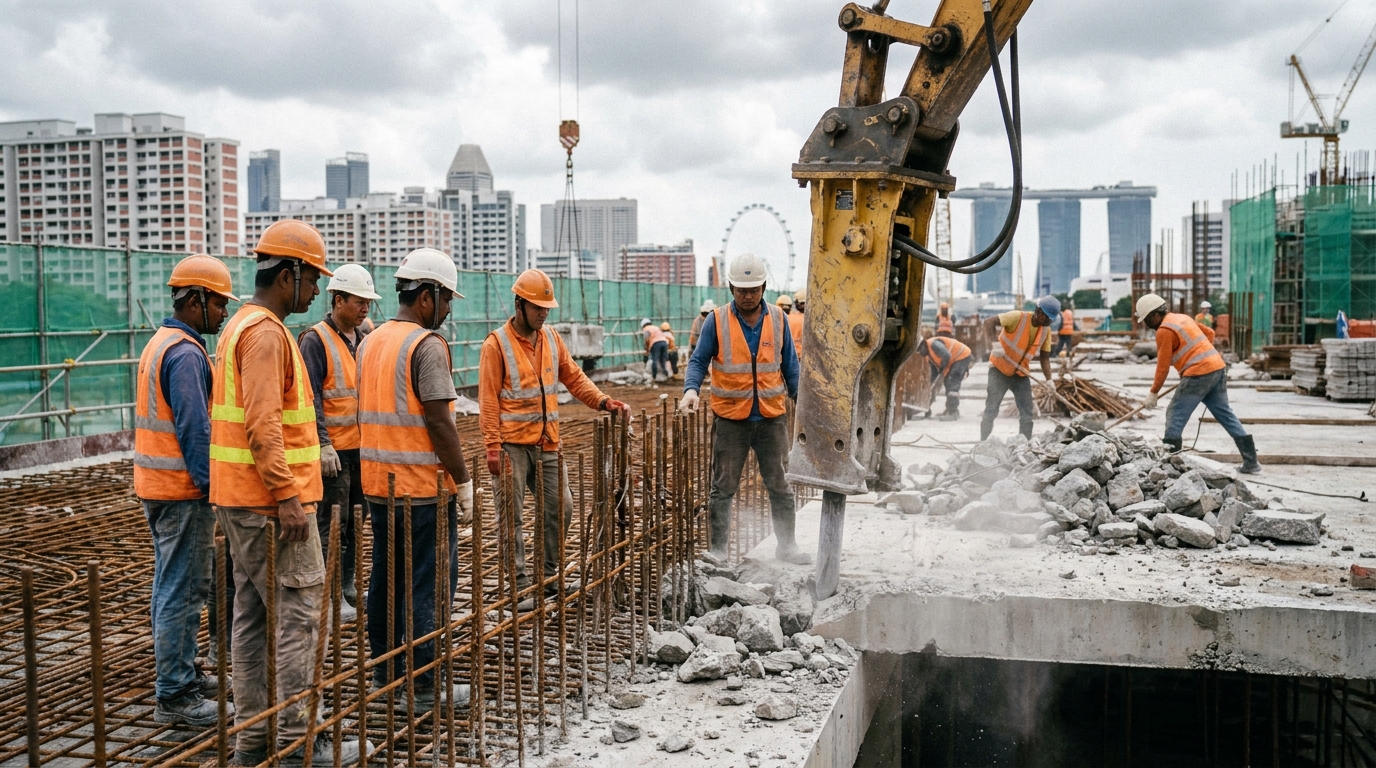
Woh Hup pays. That settles the money, not the calendar
The developer’s spokesperson confirmed that main contractor Woh Hup is bearing the entire cost of the demolition and reinstatement. No part of it flows to the 596 buyers. On the financial question, the risk allocation worked as contracts intend: the party that built it, fixes it.
Time is the harder currency. Asked about delays, the spokesperson said “the duration of the demolition works has been assessed and factored into the revised construction timeline” — and that the project is “still working towards achieving our estimated 1Q2030 completion, and will in any event endeavour to complete the development in 2Q2030”.
Read that carefully. There is a revised timeline, a target of 1Q2030, and a fallback framed as an endeavour to finish by 2Q2030. Those are three different things. Buyers who need a hard date do not have one from a press statement; they have one in their Sale and Purchase Agreement, and the two are not the same document.
The takeaway: the contractor absorbs the rebuild cost, so no buyer is billed for the slab. But the only date that carries legal weight is the delivery date in the S&P Agreement — not the 1Q2030 target quoted publicly.
The protection buyers actually have is procedural
Buyers of uncompleted private homes in Singapore are not passive because they are careless. They are passive by design. The safeguards sit in the Housing Developers (Control and Licensing) framework and the standard S&P Agreement, and they operate without the buyer lifting a finger.
- Progressive payments are certification-linked. Instalments fall due only when a Qualified Person certifies a completed milestone — foundation, reinforced concrete framework, and so on. Work that has to be undone does not generate a billing.
- Bank disbursement follows the billing. When vertical progress pauses, so does the drawdown, and so does the interest accruing on the undrawn balance.
- Post-handover cover continues. A 12-month Defects Liability Period runs from the Notice of Vacant Possession, with CONQUAS workmanship assessment and statutory periodic structural inspections layered on afterwards.
The financing backdrop softens the wait. Three-month compounded SORA has eased to roughly 1.0 to 1.5 per cent in 2026, down from above 3 per cent in early 2025. A buyer carrying progressive tranches through a slower construction phase is doing so at a materially lower cost than the same buyer would have faced eighteen months ago.
The two groups who should read their contract this week
Everyone else can watch. Two groups cannot.
First, upgraders. Anyone relying on completion to time the sale of an existing property is managing the six-month ABSD remission window against a delivery date that has just been described as revised. A shift from 1Q2030 to 2Q2030 is not fatal to that planning, but it is exactly the kind of drift that compresses a sale, a move and a tax deadline into the same quarter.
Second, anyone thinking about walking away. There is no general right to rescind a purchase because rectification works were carried out during construction — particularly where the works were disclosed, approved by the Commissioner of Building Control, and paid for by the contractor. What the S&P does contain is a defined delivery date, permitted extension provisions, and a liquidated damages mechanism if that date is missed. Those clauses, not the news cycle, are where any buyer remedy lives. Read the actual wording; do not assume the standard-form position applies without checking.
What it does to pricing in the Zion Road corridor
Promenade Peak sits on the Zion Road Parcel B site, awarded under the Government Land Sales programme in August 2024 for S$730.09 million, or about S$1,304 psf per plot ratio, on a 99,953 sq ft plot on a 99-year lease. That land cost is fixed and it is high. It is the floor under every price in the project.
The tower launched in August 2025 and is roughly 70 per cent sold, with pricing from about S$2,680 psf, averaging around S$2,894 psf for standard Promenade Collection units and S$3,343 psf for the premium Promenade Suites. Roughly three in ten units remain, and they will now be sold into a market that knows about the slab.
The immediate comparables have not moved because of this. River Green, Wing Tai’s 524-unit, 36-storey project beside Great World MRT, has indicative pricing from around S$2,846 psf. Irwell Hill Residences transacts in the S$2,700 to S$3,100-plus psf band. And the neighbouring Zion Road Parcel A went to a CDL–MCL Land joint venture at S$1.107 billion, or S$1,202 psf ppr, which sets the cost floor for the next launch in the corridor. The precinct’s economics are unchanged.
What may change is sentiment at the margin, and that is a subsale problem more than a launch problem. Broader conditions are already cool: URA data shows private residential prices up 0.9 per cent in 1Q 2026 and 0.5 per cent in 2Q 2026, with a medium-term pipeline of 55,000 to 60,000 units including ECs. With 60 per cent ABSD on foreign buyers, 20 per cent on citizens buying a second home and a 55 per cent TDSR cap, the marginal buyer here is an owner-occupier, not a flipper. Owner-occupiers care about build quality — and a slab that was replaced rather than patched is a better story in 2030 than a slab that was patched and forgotten.
What to watch from here
Three markers matter, and none of them is a headline.
Watch the certification trail: BCA is following up on the rectification, and the sign-offs on the replacement slab are the substantive checkpoint, not the developer’s next reassurance. Watch the quarterly construction updates to buyers for whether 1Q2030 stays a target or quietly becomes 2Q2030. And watch whether the industry moves — whether BCA tightens independent core-drilling or transfer slab inspection protocols for complex high-rise projects, which would be the durable outcome of this episode.
The uncomfortable truth for anyone buying off-plan is simple. You are buying a promise executed by parties you did not choose, verified by a regime you cannot see. At Promenade Peak the regime worked, the contractor is paying, and the tower will be built on a slab that passes. That is the best available outcome — and it still cost the buyers time they never agreed to spend.