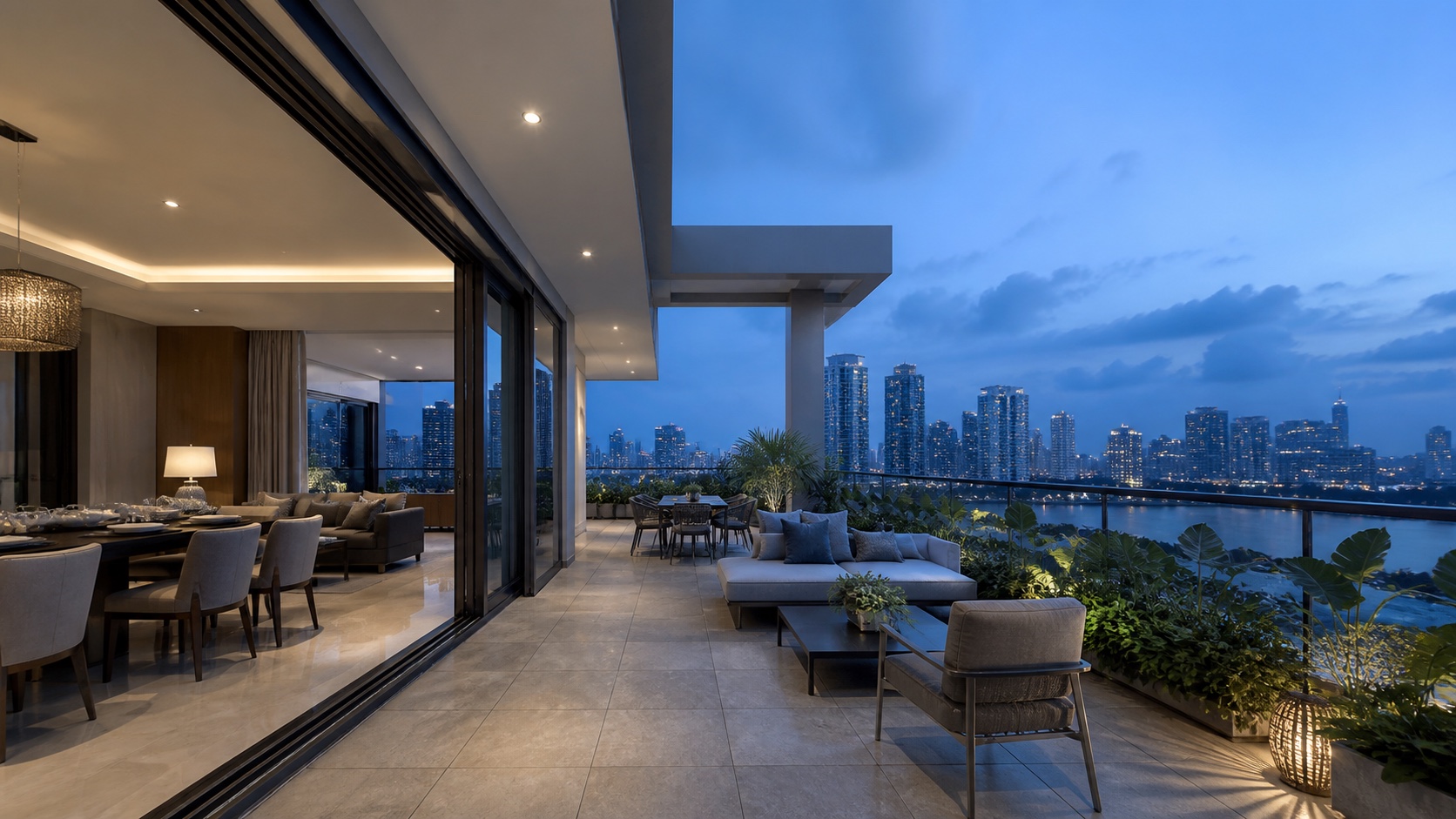
A penthouse can be meaningfully under-priced and meaningfully over-priced at the same time, and the gap between those two numbers routinely runs to seven figures. The cause is not sentiment. It is that a roof terrace does not transact at internal-area price per square foot, and almost every listing prices it as though it does — either at nothing, or at full rate. This is what the 2026 transaction data says about the buyer pool, and the arithmetic that sits between the two wrong answers.
188
private residential sales above $5 million in Q1 2026, against a three-year quarterly average of 137
16
transactions above $20 million in 2025 — there was one in all of 2024
30–50%
the band at which outdoor space actually prices against internal-area psf
The same unit, three defensible-sounding numbers
Take a real example and price it three ways. A 3,520 square foot penthouse — 2,518 internal, 1,008 of roof terrace — in a development where standard floors were transacting around $1,100 per square foot. Every one of the three numbers below has been argued in a listing meeting. They are not close to each other.
One penthouse, three pricing methods
3,520 sqft total · 2,518 internal · 1,008 outdoor · $1,100 base psf
Worked from a documented transaction. Illustrative model — the base psf and areas are actual, the three methods are applied for comparison.
The first number treats the terrace as free. It is the quiet default whenever a valuation is run off internal strata area, and it is how a penthouse sells in three months while leaving half a million on the table. The third number applies the project’s standard price per square foot across the whole title — which sounds rigorous, produces a figure that flatters the owner, and is why penthouses sit unsold for two hundred days. The spread between them is $1.1 million on a $3.3 million asset, or roughly a third of the value of the property.
The middle number is the one the market actually paid. It came from weighting the outdoor area at a fraction of the internal rate rather than at zero or at par — and the unit transacted within weeks of being repriced to it, after six months of no concrete offers at the third number. That single mechanism, and how to land on the right fraction for a specific unit, is what the rest of this report is about.
You know the market. Now price the unit.
The weighting is where seven figures get decided
You’ve seen the market range. The full playbook turns it into a defensible price by showing how outdoor space, buyer alternatives and total quantum change what your unit is worth.
The weighting formula and the four-factor score that sets it, with the dollar sensitivity of every band.
The quantum trap at which a leasehold penthouse starts competing with freehold landed — and what to do about it.
Two documented exits costed line by line, plus a live calculator that returns your target price and negotiation band.
Open the full playbook
Enter your details for instant access — about 30 seconds.
You’re in.
The rest of the playbook and the calculator are open below.
Instant accessNo account requiredRelevant follow-up only
The buyer pool is smaller than it was. It is not empty.
There is a persistent assumption among owners of large units that high-quantum demand has evaporated. The transaction record does not support it. Private residential sales above $5 million have now run ahead of trend for three consecutive quarters, reaching 188 in Q1 2026 against a three-year quarterly average of 137.
Private residential transactions above $5 million
By quarter, against the three-year quarterly average of 137
Compiled from caveat data on private residential transactions at or above $5 million.
The strength is concentrated at the top rather than spread evenly. Transactions above $10 million rose from 14 in Q4 2025 to 17 in Q1 2026, of which 13 were resale rather than new sale — the strongest resale quarter at that level in about three years. In the core central region, sales above $3,000 psf and above $5 million jumped from 54 to 75 in a single quarter, the highest count since Q4 2023. And the annual record for $20 million-plus deals went from one in 2024 to 16 in 2025.
Where the high-quantum activity actually sits
Measure
Q4 2025
Q1 2026
Transactions above $5M
186
188
Transactions above $10M
14
17
CCR sales above $3,000 psf and $5M
54
75
Luxury resale (not new sale)
139
133
Foreign buyer share of $5M+ sales
~27%
~31%
mastplan
Quarterly caveat counts. Category definitions vary between compilers and revisions to caveat data are normal; treat these as indicative of direction rather than exact.
Read that table carefully and the useful signal is the last two rows. Luxury resale volume held roughly flat while new-launch luxury rose — meaning the incremental buyer at the top of the market is being absorbed by new product, not by existing stock. If you own existing stock, that is the competitive set you are actually pricing against, and it is a set that shows the buyer a fresh lease and a show unit. The compensating advantage is space and format, which is the subject of the next section.
Four formats, four different exits
“Penthouse” is a marketing word covering four quite different assets. They attract different buyers, price by different logic and take different lengths of time to sell. Establishing which one you own is not a formality — it determines whether the framework in this report is essential or merely useful.
Format definitions as commonly used in the Singapore market. Buyer profiles are generalised.
The single-floor plate is the forgiving case: the unit immediately below yours is a real comparable, and adjusting from it is ordinary work. Duplex and triplex layouts are where money is lost, because there is nothing below them that resembles them and the psf maths that works everywhere else breaks. That is also where the supply story sits — developers across recent launches have moved decisively toward single-floor-plate top units, so the duplex and triplex resale pool is a finite, non-renewing supply. Whether that becomes a scarcity premium in three to five years is a reasonable hypothesis and not a fact; it should inform your patience, not your asking price.
Internal at full rate. Outdoor at a fraction.
The mechanism is one line, and everything else in this report is either an input to it or a sanity check on it. Internal area prices at the standard-floor rate for your development. Outdoor area — roof terrace, balcony, planter, patio — prices at somewhere between 30% and 50% of that rate, depending on how usable, sheltered and well-positioned it is.
The formula
Target price = (Internal area × base psf) + (Outdoor area × base psf × weight)
mastplan
Weight is a figure between 30% and 50% derived from the four-factor score in the next section. Illustrative model — a pricing method, not a valuation.
The reason outdoor space discounts rather than prices at par is climatic and practical rather than aesthetic. Singapore’s weather limits the hours an unsheltered terrace is genuinely usable, outdoor area carries maintenance and waterproofing liability that internal area does not, and the buyer who values it most is a narrower buyer than the one who values a bedroom. That discount is observable in transacted prices, and it is stable enough across the market that the 30–50% band holds for most of the stock.
Getting the base psf right matters more than getting the weight right, and it is the input people fumble. Pull the last twelve to twenty-four months of transacted prices for standard floors in your own development — same stack orientation and same bedroom count where you can get it. Not asking prices, which are a record of hope rather than of agreement, and not a single outlier, which will distort the band in whichever direction you were already inclined to go.
Then separate the areas from the actual floor plan rather than from memory. Roof terrace, balcony, planter and patio are outdoor. Everything under full ceiling with air-conditioning provision is internal. Most owners get this step right; the ones who do not are usually counting a large sheltered patio as internal because they use it that way, which inflates the answer by exactly the amount they wanted it inflated.
Four factors decide the weight
Score the unit one to five on each of four factors and total the result out of twenty. The total maps to a weight band. The point of scoring rather than guessing is that it forces the reasoning to be explicit — which is what makes the resulting number defensible when a buyer pushes on it.
The four factors, scored 1 to 5
Factor
Scores 1–2
Scores 3
Scores 4–5
Layout
Irregular or diagonal, awkward shape, half-master half-terrace
Regular but standard; functional, not exceptional
Generous, intentional, hostable, designed as the focal point
Finish
Original developer condition; outdoor unfinished or unsheltered
Renovated but dated; partial outdoor finishing
Pavilion or trellis, plumbed, integrated landscaping or pool
View
Partial blockage, facing carpark or internal pool, low floor
Decent; partial premium view from main rooms
Unblocked panoramic — city, sea or reserve; 15th floor and above
Building scale
Boutique or five-storey project; attic-level terrace
Mid-rise top floor with some elevation premium
High-rise, 20th floor and above, clear elevation advantage
mastplan
Score honestly. A five on layout means a buyer walks in and immediately understands that the outdoor space is the reason to buy the unit — not that you personally enjoy the terrace.
Total score maps to outdoor weight
Midpoint of each band
Band midpoints: 30–35%, 35–40%, 40–45%, 45–50%. Illustrative model.
Notice how little the bands move. The entire range from a poorly-configured terrace to an exceptional one is twenty percentage points of weighting — which sounds small until you convert it into money, which is the next section. The narrowness is deliberate: the framework is designed to stop the weight becoming the place where optimism hides. If your unit scores nine, it scores nine, and the answer is a 35–40% weight regardless of how much you like it.
What each five points of weighting is worth
Convert the bands into cash on a representative unit — 1,000 square feet of outdoor space in a development with a $1,800 base psf — and the reason for scoring carefully becomes obvious.
Value of 1,000 sqft of outdoor space, by weight applied
At a $1,800 base psf
Illustrative model at the stated assumptions. Not a valuation.
Every five percentage points of weight is $90,000 on this unit. The full span from the bottom band to the top is $360,000 — on a single input, derived from a four-question score, on a property where the whole outdoor component is a third of the floor area. Scale the terrace or the base psf up and the sensitivity scales with it: the same exercise on 1,500 square feet at $2,600 psf spans $780,000.
Sensitivity on a $1,800 psf development
Outdoor area
At 30%
At 40%
At 50%
Span
500 sqft
$270,000
$360,000
$450,000
$180,000
1,000 sqft
$540,000
$720,000
$900,000
$360,000
1,500 sqft
$810,000
$1,080,000
$1,350,000
$540,000
mastplan
Illustrative model. Multiply through by your own base psf to scale.
This is also the honest argument against over-scoring. A weight you cannot justify is a number you will have to defend in a negotiation with a buyer who has the floor plan, the transaction history and no emotional stake in your terrace. Landing at 40% with four specific reasons is a stronger position than landing at 50% with one, and the difference between them — $180,000 on the unit above — is far less than the cost of six months of silence.
The whole thing on four lines
Format is the variable that has no comparable below it
Put the inputs together and the working fits on four lines. Below is the representative duplex from the framework section run end to end, plus the negotiation band that should surround the answer.
Worked example — a 3,000 sqft duplex
Line
Input
Value
A · Internal area
2,000 sqft
—
B · Outdoor area
1,000 sqft
—
C · Base psf (transacted, standard floors)
$1,800
—
D · Outdoor weight (score 18/20)
50%
—
Internal value = A × C
—
$3,600,000
Outdoor value = B × C × D
—
$900,000
Target price
—
$4,500,000
mastplan
Illustrative model on the stated inputs. Not a valuation, an offer or a forecast.
The blended rate implied by that answer is $1,500 psf across 3,000 square feet, against a $1,800 base — which is the sanity check worth running every time. If your framework number implies a blended psf above the base psf for standard floors, you have made an arithmetic error somewhere, because outdoor area weighted below par cannot produce a total above par.
Treat the target as the centre of a band rather than as a ceiling or a floor. A reasonable buyer will open three to five per cent below it, and a well-marketed listing at a defensible number should clear within roughly ±5% — on this example, between $4.28 million and $4.73 million. If the answer sits more than ten per cent away from what you expected in either direction, the base psf is the input to re-examine first. It is wrong far more often than the weight is.
The quantum where your competition changes
There is a price band in which a leasehold penthouse stops competing with other penthouses and starts competing with freehold landed property. Historically that inflection has sat around $3 million, and above it the buyer with your quantum in hand has a genuinely different set of options — options that a narrow penthouse-focused listing strategy never positions against.
What the same money buys at $3M to $4M
Asset
What the buyer gets
What they give up
99-year leasehold penthouse
Large terrace, view, facilities, large internal area
A depreciating lease, a niche resale pool, longer time on market
Freehold inter-terrace
Freehold land title, capital preservation, broad resale pool
Smaller built-up area, no condominium facilities
Older freehold condominium
Freehold tenure, large internal area, broad resale pool
No view premium, no outdoor space
mastplan
Indicative comparison of what a similar quantum reaches across asset classes. Availability and pricing vary by estate and over time.
The relevant asymmetry is the size of the buyer pool on each side. A buyer looking at freehold landed at this quantum is drawing from a much deeper market than a buyer looking specifically for a duplex penthouse, which means your unit is being compared by people who were never in your segment to begin with — and being compared, silently, on the two attributes where a 99-year penthouse is weakest: tenure and resale depth.
There are two coherent responses and one incoherent one. You can price just below the competing asset class, giving up some upside to widen the pool materially, which is the right call when time matters more than the last five per cent. Or you can hold the framework number and commit to a longer marketing runway aimed at buyers who specifically want what only a penthouse gives — view, outdoor space, format — which preserves the premium but requires genuine patience. The incoherent response is to be unaware you are in the band at all, list at the framework number, and discover in month six that the competition was a freehold terrace nobody had positioned against.
Who is actually buying at the top
The composition of the high-quantum buyer pool has changed more in five years than the volume has, and the change runs directly counter to how the segment is usually described. The share of ultra-luxury purchases taken by foreign, non-permanent-resident buyers has collapsed, and what has replaced it is domestic.
Shares of ultra-luxury condominium purchases by buyer status. Residual to 100% is corporate and other categories.
Foreign non-resident buyers fell from 45.9% of ultra-luxury purchases in 2021 to 16.9% in 2025, while permanent residents rose to 52.5% and citizens to 30.5%. The 60% Additional Buyer’s Stamp Duty on foreign purchasers introduced in April 2023 is the obvious mechanical cause, and the effect on this segment has been near-total rather than marginal.
For a seller this matters in a specific and practical way. The buyer most likely to purchase your penthouse is now a resident household — someone who lives here, whose children go to school here, and who is buying a home rather than an offshore store of value. Resident buyers underwrite layout, liveability and the school catchment far harder than a non-resident buyer does, and they are considerably more sensitive to a floor plan that reads awkwardly on a viewing. Marketing written for an international investor audience is aimed at a pool that has shrunk by two thirds.
The counter-signal is worth noting for balance: the foreign share of $5 million-plus sales specifically rose from roughly 27% to 31% between Q4 2025 and Q1 2026 — 57 of 188 transactions. That is a small, recent move against a large, structural one, and a single quarter is not a trend. Plan for the resident buyer; do not be surprised by the other one.
Two documented exits, with the arithmetic shown
Frameworks are easy to assert and harder to demonstrate. Two transactions below show it working in opposite directions — one where the framework produced a number well below the original asking price and the unit sold in weeks, and one where two near-identical units in the same development separated on layout regularity exactly as the scoring predicts.
Case one · a 99-year leasehold six-bedroom, repriced
Line
Detail
Total area
3,520 sqft
Internal / outdoor
2,518 sqft / 1,008 sqft
Layout
Two 3-bedroom units fused; sheltered trellis on the roof terrace
Base psf, standard floors
~$1,100
Score
Upper band on layout, finish, view and scale
Weight applied
50%
Internal value
2,518 × $1,100 = ~$2.77M
Outdoor value
1,008 × $1,100 × 50% = ~$0.55M
Framework target
~$3.32M
Original asking price
$3.80M — six months, no concrete offers
Transacted
$3.30M, the highest penthouse price in the project
mastplan
Figures reconstructed from a documented transaction and rounded. Illustrative of method rather than a valuation of any comparable unit.
The instructive part is not the drop from $3.80 million to $3.30 million. It is that the $3.80 million was almost exactly the total area multiplied by the standard psf — the third column of the chart at the top of this report — and that the owner had not lost half a million by repricing. They had recovered value they were losing by failing to clear at any price for six months, in a market where every additional week on a portal teaches the next buyer to wait for a cut.
Case two · two freehold duplexes, same development
Unit A
Unit B
Living area
1,528 sqft
Slightly smaller
Outdoor area
937 sqft
Smaller footprint
Layout
Diagonal, irregular
Regular, squarish
Condition
Original
Renovated
Weight the score supports
30–35%
35–40%
Outcome
Transacted at $2.98M
Cleared roughly $100 psf higher
mastplan
Two comparable freehold duplex penthouses in the same development. Figures rounded.
The smaller unit sold for more per square foot. That is the whole finding, and the reason is resaleability: a regular floor plate is easier to sell again in five years, so today’s buyer pays more for it even at less area. The scoring framework rewards regular layouts with a higher weight, and in this instance the market did precisely the same thing, which is about as clean a validation of a pricing method as the transaction record ever offers.
Where penthouse listings quietly go wrong
Most penthouses that fail to clear are not over-priced in an obvious way. They are under-supported — priced by a method nobody can articulate, and marketed on the same playbook as a three-bedder in the same development. The patterns below are the ones that show up repeatedly, and any one of them is recoverable. Five of them together is a structural problem that a price cut will not fix.
The asking price is the project average psf times the total areaNo weighting, no framework, no reasoning that survives a question. This is the third column of the chart at the top of this report, and it is the single most common way a penthouse ends up sitting for two hundred days. The number came out of a calculator rather than out of a method, which means there is nothing to defend when a buyer pushes.
The outdoor space is photographed the way a balcony is photographedIf the terrace is the reason the unit is worth a premium, it has to carry the marketing. Phone photographs taken during a single afternoon visit, no twilight frames, no elevated or aerial view of the terrace and the outlook. A premium you have not shown is a premium the buyer will not pay for, and no listing description recovers it.
The strategy is to list on the portals and waitPortals are passive: a buyer finds you only if they are already searching at your exact quantum in your exact district. The penthouse pool is small enough that passive discovery is a genuine constraint rather than a minor inefficiency. Video and targeted distribution are how this segment is actually found now, particularly above $5 million.
Nobody can say specifically who buys this unitIf the buyer profile cannot be described concretely — where they are coming from, what they are buying instead if they do not buy yours, what they will compare it against — then the marketing is aimed at everybody, which in a niche segment means nobody. The crossfire comparison happens whether or not you participate in it.
The first response to slow interest is a price cutBefore establishing whether the problem is the price or the reach. A cut in month two teaches every subsequent viewer that more cuts are coming, and you arrive at month six having both reduced the price and still not sold. Decide the trigger for a price adjustment before you list — a number of weeks, a count of viewings — rather than in reaction to the first quiet fortnight.
The order to do this in
The sequence matters as much as the content. Listing prematurely is the most expensive mistake available to a penthouse owner, because a unit that hits the market unprepared trains the market to wait — and every week of that is deducted from the eventual price.
1
Pull twelve to twenty-four months of transacted prices for standard floors in your own projectTransacted, not asking. Same stack orientation and bedroom count where the data allows. Discard single outliers in both directions and take the band rather than the peak. This one input moves the answer more than everything else combined, and it is the input owners are most tempted to shade upward.
2
Separate internal from outdoor precisely, off the actual floor planRoof terrace, balcony, planter and patio are outdoor. Everything under full ceiling with air-conditioning provision is internal. Write down both numbers and check that they sum to the strata area on your title. A sheltered patio you use daily is still outdoor area, however much it functions as a room.
3
Score the unit on the four factors, then have someone unsentimental score it tooLayout, finish, view, building scale — one to five each. The second opinion is the point of the exercise: a score you arrived at alone will drift upward, and the difference between a 40% and a 50% weight on a large terrace is comfortably six figures. Take the lower of the two scores when they disagree.
4
Run the formula and set the band before you set the priceTarget price, then ±5% around it, then the specific number below which you will not go and the reasoning that supports it. Check the implied blended psf against the base psf — if the blend is higher, something is wrong. The band is the thing you defend, not the target.
5
Sanity-check against what else your quantum buys todaySearch freehold landed and older freehold condominium stock at your target price in the estates your likely buyer would consider. If credible alternatives exist, you are in the crossfire band and you need to decide deliberately between pricing into a wider pool and holding the number with a longer runway. Decide it before you list, not in month six.
6
Fix the marketing layer before you test the priceProfessional photography including the terrace at twilight, an elevated or aerial frame of the outlook, a walkthrough video, and a specific description of who this unit is for. Then set the price-discipline policy in writing — no reactive cut before day ninety, no move on the strength of one viewing’s feedback. The niche buyer takes months to surface; that is normal and not evidence of mispricing.
Seven questions worth asking before you list
Whoever markets the unit — including you, if you are doing it yourself — should be able to answer these specifically rather than in averages. Vagueness on any of them is the signal worth acting on, because a penthouse-capable plan has thought about the buyer pool and the competing asset classes in advance rather than inventing them in month five.
What to ask, and what a strong answer sounds like
The question
What a strong answer contains
What base psf are you using, and from which specific transactions?
Named transactions with dates, not a project average from a portal
What outdoor weight are you applying, and why that number?
A score against the four factors, with a reason for each
Who specifically buys this unit?
A described household — where they come from, what they buy instead
What is the reach into that profile beyond the portals?
Named channels, content formats, a distribution plan
What is expected time on market, and what triggers the first adjustment?
A number of weeks or a count of viewings, agreed in advance
What comparable format has been transacted recently, and what was learnt?
A specific unit, a specific strategy, a specific outcome
If it does not sell in six months, what is plan B?
A plan that exists before listing, not one invented in month five
mastplan
The consistent test across all seven is specificity. Answers given in averages are answers that have not been thought about for this unit.
Price your own unit
Your unit, not the average
Score it, weight it, price it
Enter your areas and the transacted base psf for standard floors in your development, then score the four factors honestly. The calculator returns the target price and the ±5% band — and shows you both of the wrong answers alongside it, so you can see exactly how much room there is to get this wrong.
Defensible target price
—
—
Total score—
Outdoor weight applied—
Internal value—
Outdoor value—
Implied blended psf—
If the terrace were priced at zero—
If the whole title were priced at base psf—
Spread between the two wrong answers: —
—
Indicative only, and a guide rather than financial advice or a valuation. The weighting bands are an illustrative pricing model, not a published standard, and the result is only as good as the base psf you enter — use transacted prices for standard floors in your own development over the last 12 to 24 months, not asking prices. Actual transaction outcomes depend on marketing, timing, condition, tenure and the buyer pool on the day, and can differ materially from any figure shown here. Nothing on this page is an offer, an appraisal or a projection of returns.
What this actually comes down to
The terrace is neither free nor full price. Pricing it at zero and pricing it at par are both errors, and on a typical duplex the gap between them is roughly a third of the value of the property.
The base psf is the input that decides the answer. It must come from transacted prices on standard floors in your own development, not from asking prices and not from a project average.
Score the four factors with someone unsentimental. Twenty percentage points of weighting separates the bottom band from the top — on 1,000 square feet at $1,800 psf that is $360,000 decided by a four-question score.
Above roughly $3 million your competition changes asset class. Freehold landed and older freehold stock enter the same shortlist, and the comparison happens whether or not you position against it.
The buyer is now overwhelmingly a resident household. Foreign non-resident buyers fell from 45.9% of ultra-luxury purchases in 2021 to 16.9% in 2025 — market the unit as a home, because that is who is buying it.
mastplan
Your floor plan, your comparables, your number
Get a penthouse pricing read on your unit.
A run through your actual internal and outdoor split off the floor plan, a base psf built from transacted comparables in your development, an honest four-factor score, and the resulting target price with the band around it — plus what else your quantum buys today. No obligation — you will leave with a defensible number either way.
Area splitTransacted comparablesFour-factor scoreTarget price & bandCrossfire checkMarketing plan
Got it.
We’ll be in touch shortly with your next step.
About the figuresTransaction counts above $5 million, $10 million and $20 million, the core-central-region high-psf counts, luxury new-sale and resale splits and the foreign buyer share are compiled from caveat data on private residential transactions; category definitions vary between compilers and caveat revisions are normal. The ultra-luxury buyer-composition shares for 2021 and 2025 are from published analyses of ultra-luxury condominium purchases. The Additional Buyer’s Stamp Duty rate on foreign purchasers follows IRAS. The two case studies are reconstructed from documented transactions and rounded; they illustrate a method rather than valuing any comparable unit. The 30–50% outdoor weighting band, the four-factor scoring bands, the sensitivity tables, the worked examples and the calculator are illustrative models compiled by mastREplan on the stated assumptions — they are a pricing method, not a valuation, an appraisal, an offer or a projection of returns, and actual outcomes vary widely with marketing, timing, condition, tenure and the buyer pool on the day. Rules and rates are stated as at publication and are subject to change. Nothing here is financial advice — please check with a qualified professional before making any property decision. See our full Disclaimer.
Create your account or sign in
One account unlocks every gated resource. New members create an account here; returning members use the same form to sign in.