Paragon at S$3.9 Billion, Asia Square Tower 2 at S$2.43 Billion: What Record Commercial Inflows Do — and Don't Do — for Home Prices
Singapore commercial property is on course for its biggest year on record, but the money is walled off from housing by design — and the URA price index proves it.
The gist
- Singapore commercial deals hit US$10.3 billion in H1 2026, with US$6 billion more possibly beating 2019's record.
- Commercial property carries zero ABSD, while foreigners pay 60 per cent and entities 65 per cent on homes.
- The URA private home price index rose just 1.4 per cent in H1 2026 despite record inflows.
- Buyers are paying for scarcity: prime vacancy near 5.6 per cent and no meaningful CBD commercial land pipeline.
US$10.3 billion of Singapore commercial property changed hands in the first six months of 2026, with another US$6 billion sitting in the pipeline, according to global index provider MSCI. If those deals close, 2026 overtakes the previous record of US$13.1 billion set in 2019. None of that capital is competing with you for a three-bedder.
The record is real. The read-across is not automatic.
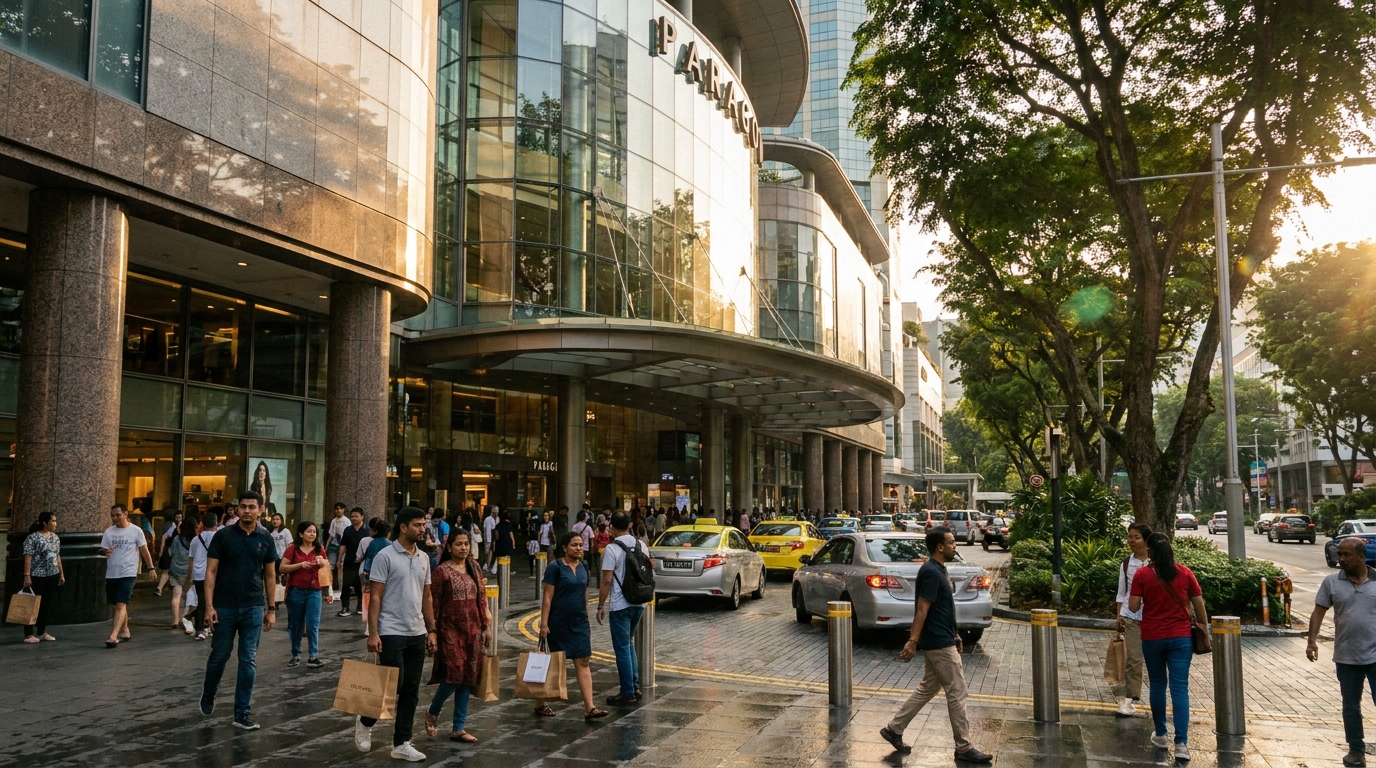
The headline transactions are unusually large, even by Singapore standards. CapitaLand Integrated Commercial Trust bought Paragon on Orchard Road for S$3.9 billion from Cuscaden Peak Investments. It sold Asia Square Tower 2 to IOI Properties Group for about S$2.43 billion, at an estimated net yield of roughly 3 per cent.
Below that tier, the list keeps going. Keppel REIT took an additional one-third stake in Marina Bay Financial Centre Tower 3 for S$1.45 billion. Lendlease Global Commercial REIT picked up 70 per cent of PLQ Mall for S$619.5 million. The Clementi Mall went to Elegant Group for S$809 million, and 78 Shenton Way traded in the S$600 million to S$630 million range.
Asia Square Tower 1 was injected into the Singapore Central Private Real Estate Fund at a valuation of roughly S$4.1 billion — a vehicle seeded with S$8.2 billion of prime offices and targeting more than S$15 billion in assets under management. That is not opportunistic trading. That is long-duration money buying core Singapore and expecting to hold it.
Read the trackers carefully — they disagree
Anyone quoting a single number for 2026 is being careless. MSCI counts US$10.3 billion of closed commercial deals in H1. Separate consultancy trackers put commercial investment sales at S$23.3 billion, a 238 per cent year-on-year jump, and total real estate investment sales somewhere between S$31.1 billion and S$35.2 billion for the same six months.
The spread comes down to definitions: what counts as an investment sale, whether Government Land Sales awards are included, whether fund injections and partial-stake deals are captured. All the trackers agree on direction. They do not agree on magnitude, and full-year projections ranging up to S$50 billion or S$60 billion should be treated as forecasts, not facts.
What is not in dispute is where the money is coming from. Cross-border capital made up 58.1 per cent of investment volume in Q2 2026 — roughly triple the year before. Benjamin Chow, head of private assets research for Asia at MSCI, put it plainly: Singapore's recovery has been driven in large part by overseas capital, with global investors accounting for a significant share of activity this year.
The single most important point: record foreign inflows into Singapore commercial property are a signal about Singapore's macro standing — not a leading indicator for private home prices, which are governed by a completely separate set of rules.
The ABSD firewall is working exactly as designed
Commercial property in Singapore carries zero Additional Buyer's Stamp Duty. Residential property carries 60 per cent ABSD for foreigners and 65 per cent for entities, both in force since April 2023. That is not a nuance. It is the entire architecture of the market.
Global funds, sovereign vehicles and REITs did not choose offices and malls over condominiums because they prefer retail footfall. They chose them because the residential door is bolted shut for institutional capital, while the commercial door is wide open. Foreign investor interest in commercial property Singapore-wide is the mirror image of foreign absence from housing.
Record cross-border inflows and a moderating housing market are not a contradiction. They are the same policy, viewed from two sides.
The result is a market where the URA Private Residential Property Price Index rose 3.3 per cent in 2025 — down from 3.9 per cent in 2024 and 6.8 per cent in 2023 — and just 1.4 per cent across the first half of 2026 (0.9 per cent in Q1, 0.5 per cent in Q2). Billions in foreign capital landed in the same city in the same window, and the housing index barely twitched. That is the firewall doing its job.
What the commercial money is actually buying: scarcity
Institutional buyers are not paying up for growth. They are paying up for supply that cannot be replicated. Core CBD Grade A gross effective rents are running at roughly S$11.36 to S$12.40 psf per month depending on the basket used, after five to six consecutive quarters of increases.
Vacancy in prime submarkets has fallen to about 5.6 per cent, and below 3 per cent in the tightest Core CBD baskets. Stock has been withdrawn for conversion under the URA CBD Incentive Scheme, and there has been no meaningful pipeline of pure commercial CBD Government Land Sales plots. Scarcity plus rising replacement costs is the whole thesis.
Financing has done the rest. Three-month compounded SORA has drifted down to about 1.07 per cent by mid-2026, from 1.18 per cent early in the year and roughly 3.6 per cent in mid-2024. Cheap debt widens the spread between commercial property yields and 10-year Singapore Government Securities, and that spread is what core funds underwrite.
The yield story most retail investors get wrong
Ask whether commercial property is a good investment in Singapore and you will get quoted yields of 5 to 8 per cent, against 2.5 to 3.5 per cent for residential. Both numbers can be true — but they describe different assets.
The trophy deals institutions just closed price far tighter than that. Asia Square Tower 2 traded at an estimated 3 per cent net yield. Bugis Junction Towers was brought to market at S$685 million, or roughly S$2,750 psf on net lettable area, at about a 3.5 per cent net yield. Core Singapore offices are a bond-like proposition, not a high-yield one.
The higher yields sit further down the risk curve — smaller strata units, secondary buildings, shophouses, older retail. And that segment has already repriced. Freehold strata office units averaged S$2,999 psf in 1H 2026, up 34 per cent on 2H 2025, while a 10-unit portfolio at GB Building on Cecil Street went for S$22.5 million, or S$1,787 psf. The spread between prime and secondary strata is wide, and buyers paying near-record psf for a strata office should be clear which one they are buying.
Three practical differences separate commercial from residential for private buyers:
- No ABSD on commercial, versus 20 per cent for a citizen's second residential property — the arbitrage driving family-office rotation into strata offices, retail units and shophouses.
- No CPF, and different loan financing terms — commercial purchases are a cash-and-bank-debt game, while residential buyers work within TDSR at 55 per cent and LTV at 75 per cent.
- Thinner exit liquidity. Residential resale remains deep — secondary transactions accounted for 62 per cent of all private residential deals in Q2 2026. Commercial exits are lumpier and slower, and tax treatment on disposal deserves proper advice before, not after, purchase.
So what should a homebuyer take from this?
The honest answer is: reassurance, not a trigger. Institutional conviction on Singapore reflects legal certainty, currency stability and an employment base — GDP grew 6.0 per cent year-on-year in Q1 2026, with the official full-year forecast at 2.0 to 4.0 per cent. Well-capitalised tenants in Marina Bay and Orchard Road support the incomes that underpin housing demand.
But the causal chain from a REIT buying a mall to a condominium repricing is long and leaky. High transaction volumes do not prove tenant expansion; landlords can trade buildings while occupiers rightsize. Residential prices in Singapore are set by domestic rates, the GLS pipeline and loan limits — not by deal velocity in the CBD.
And the supply side is deliberately heavy. The 2026 Confirmed List carries 9,320 private housing units, more than 50 per cent above the 10-year annual average, against a medium-term completion pipeline of roughly 55,000 to 60,600 private homes including ECs. Rentals have already cooled to +0.7 per cent in Q2 2026. That is a market being fed, not starved.
What to watch next
The interesting question for the second half of 2026 is not whether the commercial record falls. It is whether the money keeps arriving once the rate tailwind fades.
- SORA's trajectory. Yield spreads over SGS are the entire institutional case. If financing costs stiffen, the pipeline thins fast.
- Core CBD vacancy and pre-commitment rates. These tell you whether record dealmaking reflects real tenant growth or just capital rotation between landlords.
- Mixed-use GLS bid spreads. The Hougang Central integrated site went for S$1.5 billion; public land sales contributed S$11.60 billion across 30 awarded sites in 2025, up from 20 in 2024. Bid gaps show where developers actually see combined residential and commercial value.
- The URA divergence. Track the commercial rental indices against the private residential price index. If they keep moving apart, the two markets are decoupled — and should be analysed that way.
Record inflows into Singapore commercial property are worth celebrating on their own terms. They are evidence of a jurisdiction global capital trusts. Just do not mistake a S$3.9 billion mall trade for a signal about what the flat down the road is worth.