Neptune Court and the 100% Rule: Singapore's En Bloc Bill Opens a Door That Was Bolted Shut
The Land Titles (Strata) (Amendment) Bill 2026 finally brings long-leasehold non-strata estates into the collective sale regime — but consent was never the reason deals died.
The gist
- The 2026 Bill lets long-leasehold non-strata estates like Neptune Court sell collectively, replacing a 100% consent rule.
- Consent thresholds drop to 65% for estates 60 years and older, 70% for those 40 to 59.
- Only about 20,000 private non-landed units are 40 years or older, versus over 360,000 younger units.
- Unrealistic reserve prices, harmonised GFA rules and abundant Government Land Sales plots still block deals.
Most of the noise around Singapore's collective sale reforms has been about the numbers — 65 per cent, 70 per cent, six years, seven years. The quieter change buried in the Bill matters more to a specific set of owners: a handful of estates that, until now, could not sell collectively even if almost every household wanted to.
The estates where one holdout was the whole story
On 4 August 2026, the Ministry of Law tabled the Land Titles (Strata) (Amendment) Bill 2026 for its First Reading — the first serious rewrite of a collective sale framework that dates to 1999.
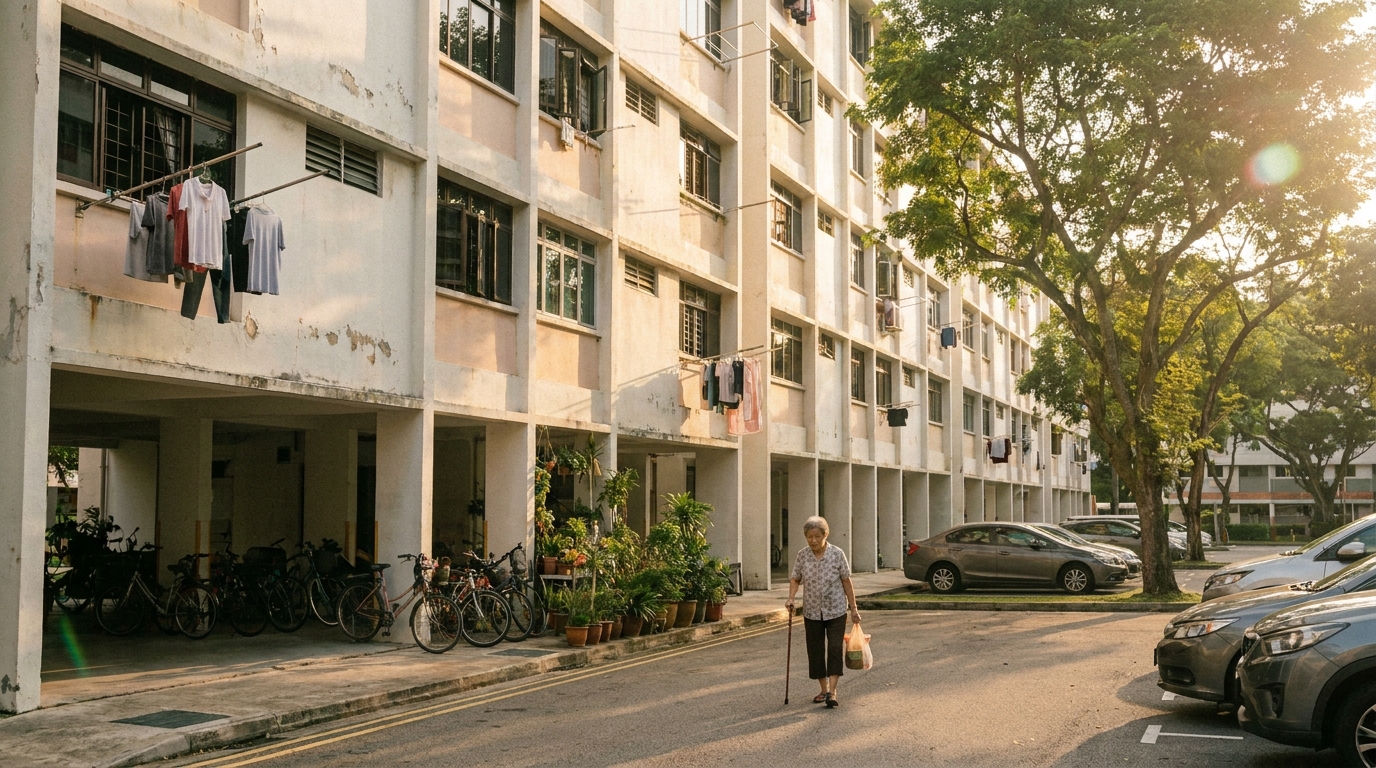
Alongside the headline threshold cuts, the Bill extends the collective sale regime to long-leasehold non-strata residential developments — estates where residents do not own the underlying land. Named examples include the former HUDC estate Neptune Court, plus One Tree Hill Mansions, Paterson Court, Orchard Court and Townhouse Apartments.
The historical hurdle for these estates was not 80 per cent. It was 100 per cent. Unanimous consent. In practice that meant one uncontactable owner, one estate in probate, one household with a grievance — and the entire exercise was over before it began.
For a small group of long-leasehold non-strata estates, the reform is not a lower bar. It is the first bar they have ever been able to clear — moving them from unanimity to a workable statutory process.
What the tiered thresholds actually do
For everyone else, the Bill recalibrates consent by the age of the development, measured by share value and strata area:
- 60 years and older: 65%, down from 80%
- 40 to 59 years old: 70%, down from 80%
- 10 to 39 years old: 80%, unchanged
- Under 10 years old: 90%, unchanged
The affected pool is smaller than the coverage suggests. Government data puts roughly 20,000 private non-landed units at 40 years or older, against more than 360,000 units under 40. That is the entire universe of estates the lower thresholds touch today — though it expands every year as stock ages.
Terence Lian, head of investment sales at Huttons Asia, has made the sharpest point about what this changes: sale committees are "less likely to be held hostage by the last few percentage points". That is real. It is also not the same thing as a deal.
Consent was never why deals failed
Look at what is actually sitting on the market. Pine Grove, the 660-unit estate along Ulu Pandan Road, is in the final leg of its fifth collective sale attempt at a reserve price of S$1.78 billion. Five attempts is not a consent problem. It is a price problem.
"Unrealistic reserve prices have caused more collective sale attempts to fail than a lack of developer interest." — Terence Lian, Huttons Asia
Developers bid on residual land value: expected selling prices, minus construction, financing and land betterment charges, minus margin. Lian's warning is blunt — they will not pay more simply because the voting rules softened.
And the cost stack has thickened. URA's harmonised gross floor area rules, in force since mid-2023, cut developer-saleable area by roughly 4 to 5 per cent. Ageing 99-year estates carry lease top-up costs on top of Land Betterment Charge. The headline developer ABSD structure — 35 per cent remittable plus 5 per cent non-remittable — has not moved at all.
The state is still the easier landlord to deal with
Every collective sale site competes with a Government Land Sales plot that comes with no tenants to vacate, no minority objections and no Strata Titles Board timeline risk. The GLS Confirmed List has been running at roughly 50 per cent above previous multi-year averages, and the medium-term private pipeline stands at about 57,000 units including ECs.
That is the discipline nobody legislated. As long as clean state land is plentiful, a developer weighing Pine Grove against a GLS parcel is comparing a discounted, litigation-exposed asset with a straightforward one.
The government has moved on the risk side. ABSD remission timelines now run to six years for large sites yielding 700 to 1,399 units, and seven years for mega sites of 1,400 units or more, with at least half the units sold by year six. Knight Frank's Leonard Tay called the alignment with physical project scale a "realistic and practical level" of risk management. It de-risks execution. It does not raise the price a developer can justify paying.
What clearing deals have in common
The transactions that have closed since 2024 are instructive, and they are not the giants:
- Tan Boon Liat Building (District 3) — S$950 million to Kingsford Group, July 2026
- Loyang Valley (District 17) — S$880 million to a SingHaiyi-led consortium, 2026
- Thomson View (District 20) — S$810 million, about S$1,176 psf ppr, to GuocoLand and Hong Leong Holdings, late 2024
- Delfi Orchard (District 9) — S$438 million, about S$3,397 psf ppr including land betterment charges, to CDL, May 2024
- Chiku Mansions (District 15) — a freehold boutique site at S$22 million, August 2025
Boutique to mid-quantum, mostly. Developers have been explicit about preferring smaller parcels that keep total exposure manageable. The newest test of that appetite is Hong Heng Garden in District 26, a 1987 freehold site launched in August 2026 at S$130 million, or S$1,128 psf ppr inclusive of 7 per cent bonus GFA and around S$18 million of LBC.
Set that against the mega sites. Pine Grove could yield some 2,000 units; Braddell View, at 918 units today, around 2,600. Those require consortium-scale capital and a reserve price conservative enough to survive a seven-year ABSD clock. Reaching 70 per cent consent does not solve either constraint.
Buying an old condo for its en bloc potential just got harder
Here is the irony for investors. The same Bill that lowers consent also makes the speculative en bloc play less attractive.
The signature-gathering window for a Collective Sale Agreement compresses from 12 months to six months. The requisition threshold to convene a meeting to form a sale committee rises from 20–25 per cent to 35 per cent. The restriction period after a failed attempt lengthens from two years to three. Dissenting owner compensation caps double, to 0.5 per cent of sale proceeds or S$2,000, whichever is higher.
Translated: fewer speculative attempts, shorter runways, longer dead time after a miss. Anyone buying a 40-year-old unit purely on en bloc hope is now underwriting a three-year lockout risk on top of rising sinking fund contributions and repair levies. The rental yield had better stand on its own.
No 2018 repeat — and the price data says why
The 2017–18 cycle ran on cheap money and rising launch prices. Neither condition holds. URA data shows overall private residential prices rose 3.3 per cent in 2025, after 3.9 per cent in 2024 and 6.8 per cent in 2023 — the slowest streak since 2020. Buyer borrowing sits under the 55 per cent TDSR ceiling, and land acquisition financing remains structurally dearer than pre-2022.
PropNex chief executive Kelvin Fong has framed the reforms as supporting urban renewal and land intensification near expanded MRT networks without overheating the land market. Mohan Sandrasegeran's read is similar: estates that narrowly missed past thresholds will re-enter, but developers will keep weighing them against GLS sites with clean conditions and no legal complexity.
So expect more attempts, not more windfalls. The reforms remove a procedural blockage; the market sets the number.
Four things worth watching
- Parliamentary passage of the LTSA Bill — particularly transitional provisions for sale committees already in motion
- Bi-annual GLS supply announcements — the single biggest determinant of whether developers pivot to private sites
- Land Betterment Charge revisions, adjusted each March and September, which move baseline bid viability directly
- Tender outcomes at Pine Grove and Braddell View — bidder counts, not just clearance, will show whether mega-site appetite has genuinely returned
For owners at Neptune Court, One Tree Hill Mansions, Paterson Court, Orchard Court and Townhouse Apartments, the arithmetic has changed in a way it never has before. For everyone else in an ageing estate, the mandate got easier and the maths did not.