 plan
planUpper Changi Density Changes Create Capacity, Not Confirmed Homes
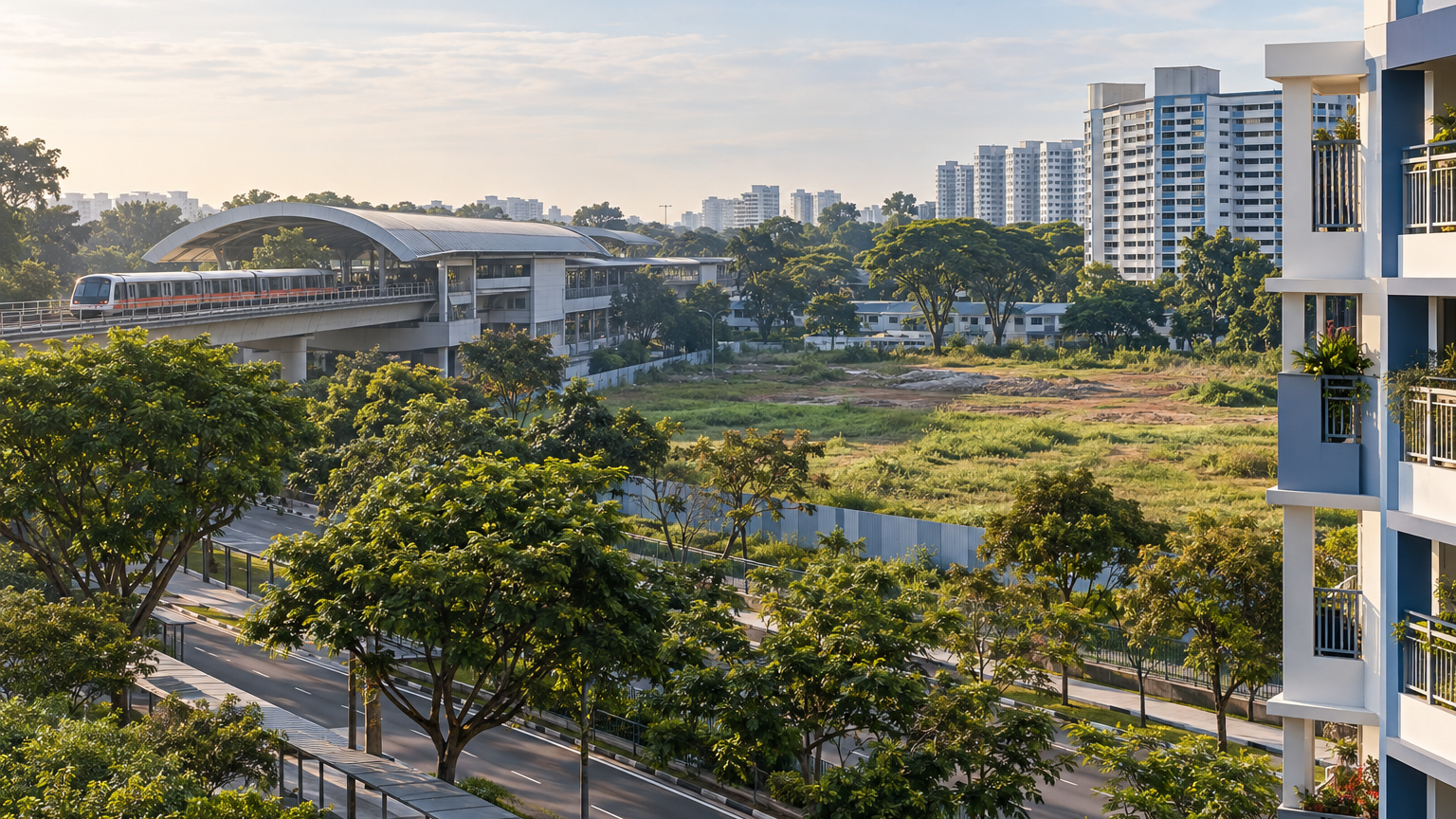
Three sites could support substantially more floor area near MRT stations, but tenure, unit numbers and development timing remain unconfirmed.
URA’s proposed planning changes would allow three residential sites around Upper Changi and Simei to be developed more intensively. Two could move from a maximum gross plot ratio of 2.1 to 3.5, while the third could rise from 2.1 to 3.4.
For property buyers and owners, the immediate answer is straightforward: this makes additional housing more plausible, but it does not confirm a BTO project, private condominium launch or construction date. The meaningful change is greater planning capacity—and clearer notice of where Upper Changi’s relatively low-density character may eventually change.
Higher plot ratios create capacity, not confirmed homes
A gross plot ratio controls how much gross floor area may be built relative to a site’s area. Raising it from 2.1 to 3.5 represents a 66.7% increase in maximum floor-area capacity, assuming the same site boundary. A rise from 2.1 to 3.4 represents a 61.9% increase. These are calculations from the proposed ratios, not forecasts of actual built floor area.
That distinction matters because the permitted ratio is a ceiling. The realised development can be less intensive after authorities and project teams account for site configuration, access, infrastructure, urban design and other technical constraints.
Nor can plot ratio be converted reliably into a unit count without assumptions about average home size, common areas, housing type and layout efficiency. One published scenario estimated that the three sites might accommodate about 1,580 to 1,680 flats if developed as public housing, but no agency has committed to that number or tenure.
Density is now a planning permission ceiling, not a construction timetable.
The amendments therefore carry more weight than a broad long-term planning idea, but less certainty than an HDB sales exercise, Government Land Sales tender or approved development proposal.
The Upper Changi plan is becoming more specific
The affected land is around Upper Changi Road East, Upper Changi Link, Simei Road and Simei Lane, within the wider Upper Changi, Expo and Simei rail corridors. The amendment package also addresses roads, parks, open space and a waterbody-to-park change.
This is not an entirely new direction. Earlier long-term planning material identified the Upper Changi MRT area as a place where public housing and amenities could be introduced alongside existing private estates. The stated intention was to create a better mix of public and private housing while improving access to facilities and opportunities for social interaction.
The latest proposal narrows that broad intention to identifiable parcels and proposed intensity limits. That reduces one kind of uncertainty—whether the area is being considered for denser housing—even as the eventual tenure, design and delivery sequence remain unknown.
The location also fits Singapore’s established approach of coordinating land use and transport. URA describes the Master Plan as guiding development over the medium term, rather than promising that every mapped possibility will be built immediately.
Existing owners face highly local trade-offs
Nearby owners should expect any eventual effects to vary building by building. A home directly facing one of the plots may experience a changed outlook, while another property several streets away could gain access to future amenities without bearing the same construction or privacy trade-offs.
More residents can strengthen the case for shops, community facilities, pedestrian links and greater use of existing transport. That is the strongest positive interpretation, particularly where added homes make better use of established MRT infrastructure.
Station environments can also contribute to neighbourhood identity beyond transport: Singapore’s MRT network includes station-specific public artworks and architectural features. That broader placemaking context is real, although it offers no evidence that these particular housing amendments will deliver new artwork or facilities.
The counterargument is physical rather than theoretical. Denser development may bring taller or bulkier buildings, additional traffic at particular junctions, construction disturbance and a reduced sense of openness. The current planning material does not provide final block positions, heights, access arrangements or construction phasing.
Owners should consequently avoid treating the ratio revision as an automatic price uplift. Planning certainty can be valuable, but some buyers pay for open views and a low-density setting while others prioritise rail access and nearby services. The same neighbourhood change can affect those preferences differently.
For sellers, the defensible description is that denser residential development is proposed nearby. Claims about guaranteed appreciation, new facilities or a fixed number of homes would run ahead of the evidence.
Buyers should separate mapped risk from launch speculation
The proposal gives buyers useful information even before a project is confirmed. It identifies where future development risk is concentrated, allowing a more precise assessment than simply labelling the whole Upper Changi or Simei area as “up-and-coming”.
A practical comparison should focus on the relationship between a particular unit and the sites:
| Buyer consideration | What is known now | What remains uncertain |
|---|---|---|
| Development intensity | Maximum ratios of 3.5, 3.5 and 3.4 are proposed | Actual floor area, height and massing |
| Housing supply | More residential capacity is being planned | Unit count, tenure and dwelling mix |
| Timing | The sites have entered a formal planning process | Sale, construction and completion dates |
| Neighbourhood impact | Roads, parks and open-space changes form part of the package | Final access, facilities and construction effects |
These distinctions follow directly from what the planning documents specify—and what they leave open.
Buyers hoping for a future BTO opportunity should not make plans around unannounced prices, eligibility conditions or application dates. Equally, private-home buyers should not assume that the revised ratios signal an imminent land tender or a particular condominium format.
The strongest bullish case is that allowing more housing near MRT stations should eventually broaden choice in a supply-constrained location. That may prove correct, but allowable capacity influences housing choices only after land is assigned, projects are launched, homes are built and residents move in. Until those steps occur, the immediate effect is mainly informational.
The next decision matters more than another unit estimate
The planning process is the first gate, not the last. The more consequential signal will be an agency action that converts one of these parcels into a deliverable project—such as an HDB announcement, inclusion in the Government Land Sales programme or a detailed development application.
That next step would answer questions the ratios cannot: whether the homes will be public or private, how many will be built, how access will work and when construction could begin.
For now, the measured conclusion is that Upper Changi’s housing direction has become clearer without becoming imminent. Owners and buyers can map the likely areas of change, but should price neither the benefits nor the disruption as though a finished project already exists. The development to watch is the first formal site-release or housing decision that turns this additional capacity into committed supply.