 plan
Unfinished Tuas industrial building goes on sale with approval to house 200 workers
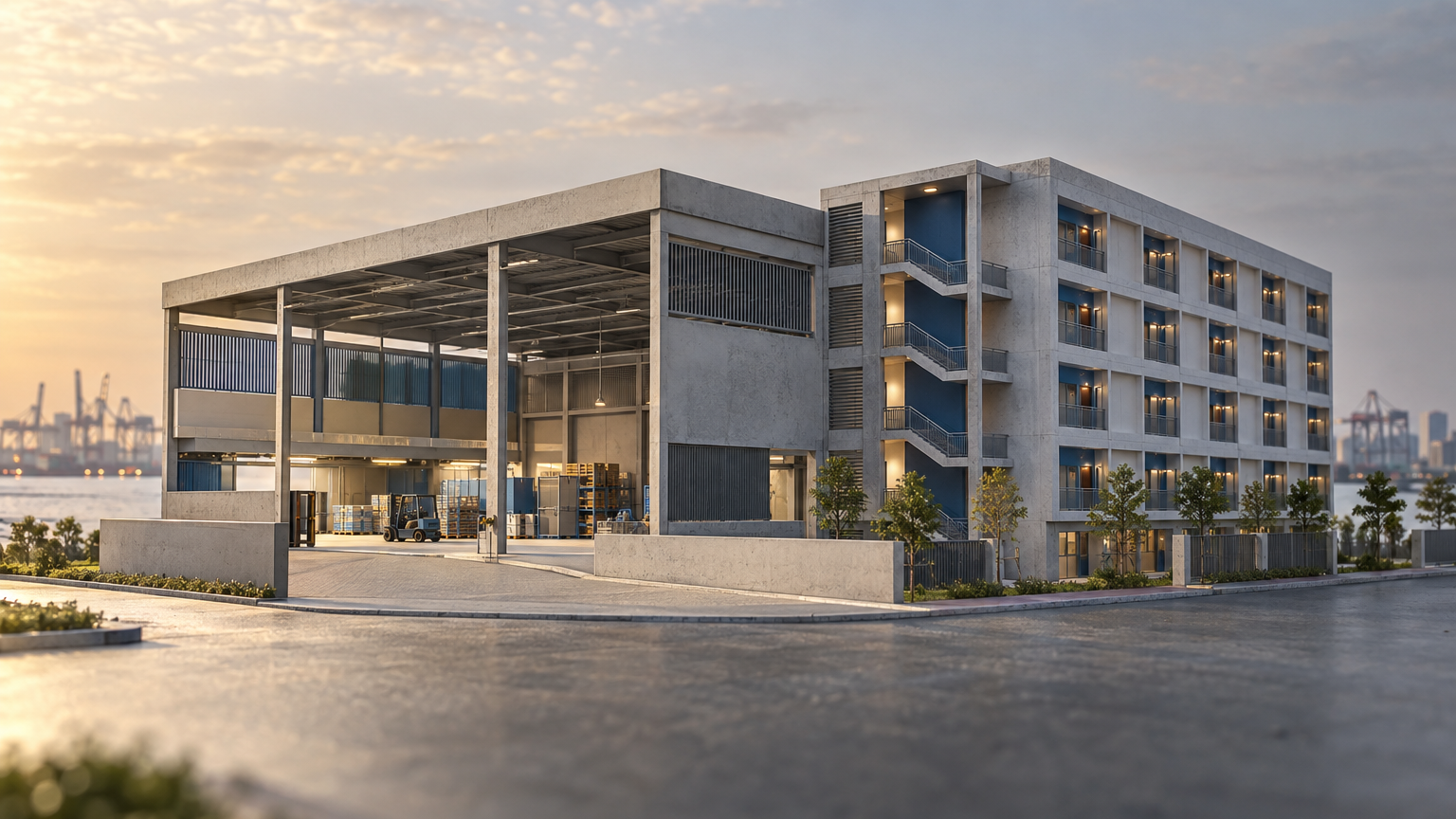
The S$20 million guide-price offering targets end-2027 TOP; a nearby completed, income-producing property is available separately or as part of a S$45 million pair.
A five-storey industrial building still under construction in Tuas has been put up for sale with a S$20 million guide price and approval to accommodate 200 workers. The sale launch, reported on October 30, 2026, combines production facilities, workers’ accommodation and a ground-floor minimart within one development.
For an industrial business, that puts workplace and workforce housing into the same purchase decision. There is also a second option: the owner is offering a nearby, completed industrial property with approved accommodation for 196 workers, allowing buyers to consider either building separately or both together.
What the S$20 million offer includes
The unfinished property occupies approximately 14,800 sq ft of land, with 36,983 sq ft of built-up area. Its reported accommodation approval is for a 200-person secondary workers’ dormitory, alongside the production facilities and minimart. The building is jointly marketed by Alan Lin and Alvan Ng of SRI.
The expected milestone is its temporary occupation permit, or TOP, by end-2027. That makes the construction timetable central to the offer: this is a purchase proposition for a building being developed, rather than a completed property matching the nearby asset’s reported income-producing status.
The sale is being marketed through an expression of interest, commonly shortened to EOI—a process for inviting buyer interest and offers. S$20 million is the guide price, not an achieved sale price; the reported event is the launch of the sale exercise.
The distinctive feature is the combination of uses. A purchaser would be assessing industrial space and approved workforce accommodation together, rather than valuing the building solely as production premises. That makes the accommodation component part of the operational choice, as well as part of the property purchase.
The nearby alternative is already completed
The same owner’s second property is a four-storey industrial building on the same road loop. It obtained TOP in 2026 and is reported to be generating rental income, with a S$25 million guide price. Its site measures 17,097 sq ft and its built-up area is 32,406 sq ft.
That creates a useful contrast. The unfinished building has 4,577 sq ft more built-up area, calculated by subtracting 32,406 from 36,983 sq ft, while its guide price is S$5 million lower. But these are not interchangeable assets: one remains under construction, while the other has reached completion and is producing rental income. The price gap therefore accompanies a difference in readiness, rather than establishing a like-for-like saving.
Their approved accommodation capacities are much closer: 200 workers for the unfinished building and 196 for the completed one. The two guide prices are attached to broadly similar approved bed counts, but different amounts of built space and different stages of delivery.
For a buyer choosing between them, the clearest comparison is future delivery versus an existing income-producing property, not simply more beds versus fewer beds. The completed property’s rental-income status is a practical distinction for someone considering when the asset could serve their business or generate income.
What buying both would add
The combined guide price is S$45 million, and the properties can be acquired together or separately. Their currently approved dormitory capacities add up to 396 workers, alongside the industrial production facilities. The package guide price is exactly the sum of the two individual guide prices.
There is a possible further change at the completed property. An application is underway to raise its accommodation capacity from 196 to approximately 250 workers, subject to regulatory approval. That proposed increase is separate from the current combined approved capacity of 396; it is not an additional approval already secured.
Both sites have the same reported tenure framework: URA-administered industrial land on 60-year leases beginning in 1996, with approximately 30 years remaining. A newly completed building and a fresh land lease are therefore different things here. The buildings’ completion dates should be read alongside that shared lease commencement date.
Two milestones to watch
For the S$20 million building, the next concrete development to watch is progress towards the expected end-2027 TOP. For the completed property, the pending capacity application could change the accommodation proposition if approved. These are separate milestones attached to the two assets.
The 200-worker figure describes the accommodation approval attached to the unfinished development, rather than an account of residents already living there. Keeping that distinction clear matters when comparing it with the completed property’s reported rental-income status.
The offer ultimately gives an industrial purchaser a specific choice: commit to an unfinished building combining production space and workforce housing, pursue the nearby completed asset at a higher guide price, or acquire both. The immediate question is which proposition attracts a buyer—and how any eventual sale price compares with the owner’s guides.