 plan
planTwo-Car LRT Rollout Brings More Room to Sengkang and Punggol
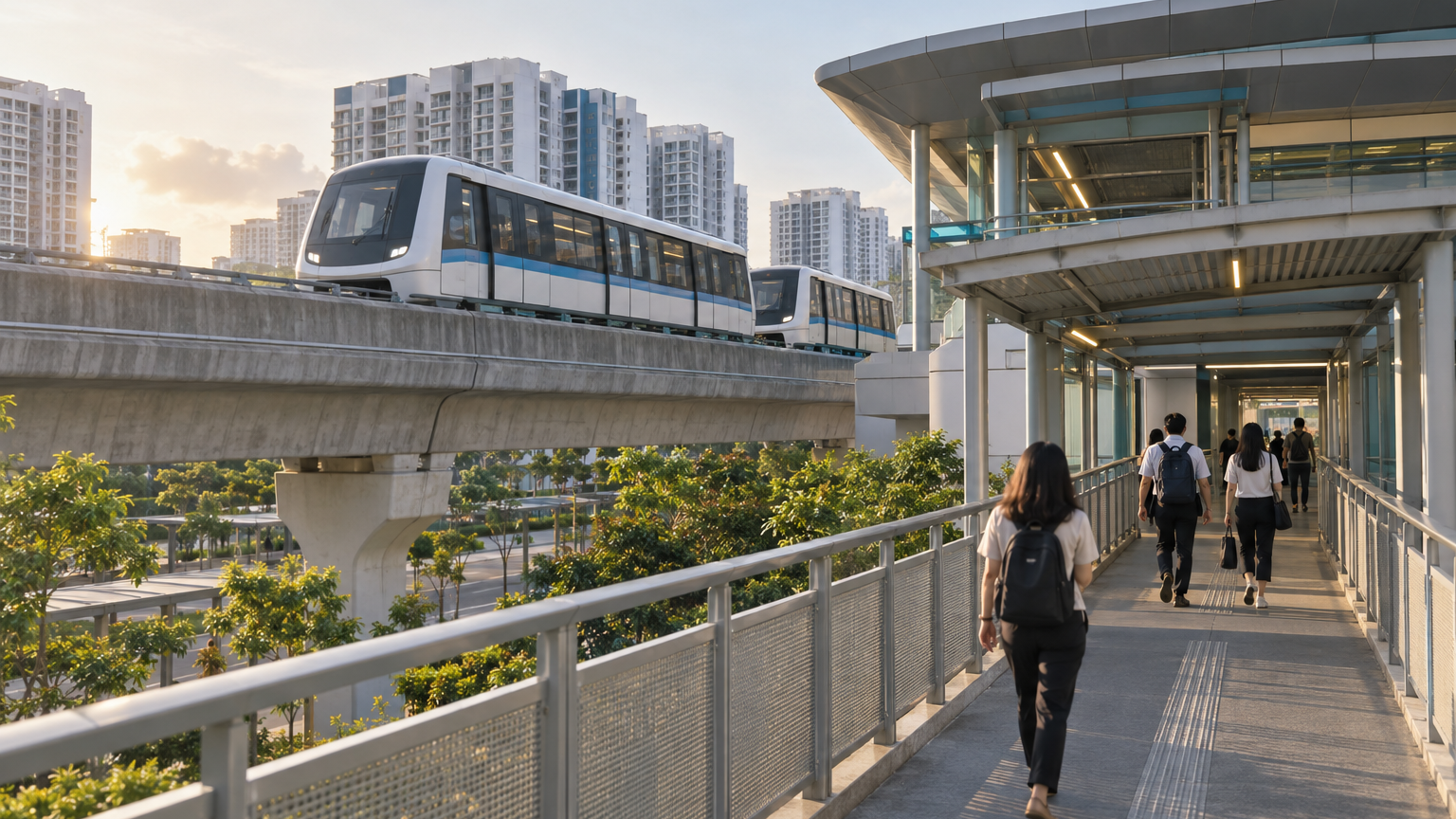
Seven new trains are reaching the loops first, while 18 await depot works. Here is what the staged upgrade changes for commuters and home searches.
For a commuter waiting at Rivervale, Compassvale or Punggol Field during the morning rush, the useful change is easy to picture: the next light rail vehicle may have two cars instead of one. That means more room on the short feeder ride to Sengkang or Punggol MRT—not a new route or a magically shorter journey.
The rollout is under way, but the headline number needs some untangling. The order for eight additional two-car trains was announced in May 2023; it expanded an earlier order of 17 to create a programme of 25 new trains. The current news is that these trains have started carrying passengers, although most are not expected to enter service until depot-expansion work is completed.
Seven new trains first, with 18 still to come
The first two new two-car light rail vehicles began passenger service on the Punggol loops on 15 July 2025. By the end of February 2026, seven were due to be deployed: four on the Punggol loops and three on the Sengkang loops.
The remaining 18 new trains are scheduled for progressive deployment from early 2027, after expansion work at the Sengkang-Punggol LRT depot is completed. The exact order will depend on operating requirements and passenger loads, so residents should not assume that every loop or time slot will receive the same number of two-car services immediately.
These new trains will progressively replace the original fleet of 25 one-car and eight two-car vehicles. Eight newer two-car trains already in service will remain, leaving the network with an all-two-car fleet once the wider renewal is complete.
That distinction matters. This is not simply eight extra trains appearing at once, and it is not yet a completed network-wide capacity upgrade. It is a staged replacement and expansion programme whose everyday effect will grow as more trains enter service.
What two cars change—and what they do not
Sengkang and Punggol each have a 14-station LRT network connecting residential neighbourhoods to their respective town-centre MRT stations and bus interchanges. For many households along the loops, the LRT is therefore the first or final leg of a longer trip rather than the main journey.
A larger two-car fleet increases the space available on each service. Its clearest potential benefit is less crowding, particularly where one-car trains struggle with peak demand. It may also make boarding less uncertain: a commuter who cannot squeeze onto a crowded vehicle effectively suffers an extra wait even when the published service interval has not changed.
But there is no official route-wide estimate of minutes saved by the new trains. Two cars do not travel twice as fast, and the upgrade does not move a home closer to an MRT station. Actual door-to-door time still depends on the wait, the loop direction, interchange walking time and conditions on the connecting MRT journey.
This makes capacity—not speed—the better way to understand the immediate improvement. Someone viewing a flat near an outer LRT stop should still travel the route at the time they normally commute, rather than treating “two-car trains” as a guaranteed reduction in journey time.
The home-search trade-off becomes slightly less stark
A buyer or renter in these towns often faces a familiar choice. A home within an easy walk of Sengkang or Punggol MRT may offer a simpler commute, while one farther along an LRT loop may provide a different mix of price, space, age and neighbourhood amenities.
The new fleet does not remove that location difference. It can, however, make the feeder leg more usable. If two-car trains reduce the chance of being left behind or enduring a tightly packed ride, some households may become more comfortable considering homes one LRT journey from the MRT.
The number of homes around the network is substantial. HDB recorded 76,265 dwelling units under management in Sengkang and 60,833 in Punggol in its FY2023/24 report—a combined 137,098 units, based on those two published figures. Not every unit is equally close to an LRT stop, but the total shows why a seemingly small rolling-stock change can matter to many daily routines.
The effect will also vary by address. A home beside an LRT station is not equivalent to one requiring another bus ride, while a station’s position on its loop affects the direction and length of the trip to town centre. Buyers should compare the actual morning and evening journey from the block or project, not merely whether “LRT” appears in the listing.
Why a quick price comparison would mislead
It is tempting to compare average home prices across Sengkang and Punggol and credit any difference to the rail upgrade. That would mix together too many other factors, including flat type, remaining lease, floor level, condition, distance from transport and the quarter in which each sale occurred.
Timing creates another problem. Only the first two new vehicles started passenger service in July 2025, while seven were deployed or scheduled for deployment by end-February 2026. That is a short and uneven observation period, with most of the 25-train programme still awaiting rollout.
A useful resale study would instead compare like with like: for example, four-room flats of similar lease age and floor range within a defined walking distance of selected LRT stations, measured over the same transaction quarters. The comparison group could be similar flats farther from a station or near another feeder connection.
Private-home analysis needs the same discipline. URA provides transaction information for private residential properties and a search service for rental contracts, allowing named developments and periods to be compared. A credible test would match projects by tenure, age, unit size and distance to transport before looking for any change after deployment.
No such matched result is established by the fleet announcement alone. Better access does not guarantee higher prices or rents: housing supply, property characteristics, wider demand and how much of the improvement was already expected can all influence what households pay.
What residents can reasonably expect next
The practical milestone is not the old order for eight extra trains. It is the gradual appearance of more two-car services across both towns, followed by the deployment of the remaining 18 vehicles from early 2027 after the depot expansion.
For existing residents, the first payoff should be judged at the platform: how often a two-car train arrives, whether boarding becomes easier and whether peak-hour crowding improves. Those are more immediate and observable than any claim about property values.
For buyers and renters, the upgrade modestly changes the comparison between an MRT-adjacent home and one served by an LRT loop. The latter still involves an interchange, but a roomier and more consistently two-car feeder service could make that compromise easier to live with. The clearest answer will emerge not from the eight-train headline, but from how quickly the remaining fleet reaches the loops—and what the morning commute feels like once it does.