 plan
Toa Payoh Hillside BTO draws sharply different demand by flat type
The noon 5 November snapshot shows strong 4-room demand, quieter interest in senior apartments and a different pattern at Tengah’s Plantation Dew.
At Toa Payoh Hillside, 2,137 applications had come in for 4-room flats—more than three times the available supply—while its 256 senior-focused Community Care Apartments had drawn just 139 applications. That contrast, recorded in the reported noon snapshot on 5 November 2026, is the most revealing detail in the early demand for November’s Build-To-Order (BTO) launch.
Alongside Toa Payoh Hillside, Tengah’s Plantation Dew was among the projects attracting the strongest demand. But for anyone choosing a home in this exercise, the useful story is more specific than which town was busiest: applicants were competing for very different housing options, and demand varied substantially even within the same project.
One launch, several very different queues
Across November’s seven projects, the reported tally was 13,363 applications for 7,964 flats. Dividing applications by supply gives about 1.7 applications per flat across the exercise. These are reported mid-exercise figures, rather than our own extraction of HDB’s application records, and applications were due to close on 11 November.
That launch-wide average is useful as a starting point, but it smooths out the differences that matter to a household. Someone considering a family flat at Plantation Dew faces a different choice from someone considering a Community Care Apartment at Toa Payoh Hillside. Combining them describes the exercise’s total activity; separating them makes the available choices clearer.
The same distinction applies to the language used around demand. An overall applications-per-flat calculation counts all reported applications against the relevant supply. A first-timer-family or second-timer-family application rate describes a particular applicant category. Those numbers answer different questions and should not be swapped into the same comparison.
This matters especially at Toa Payoh Hillside. Its 4-room flats had more than three applications per available flat overall, but the reported first-timer-family rate was 2.4, while the second-timer-family rate was 15.1. There is no contradiction: the figures describe different applicant groups rather than a single common queue.
Toa Payoh Hillside’s strongest contrast is inside the project
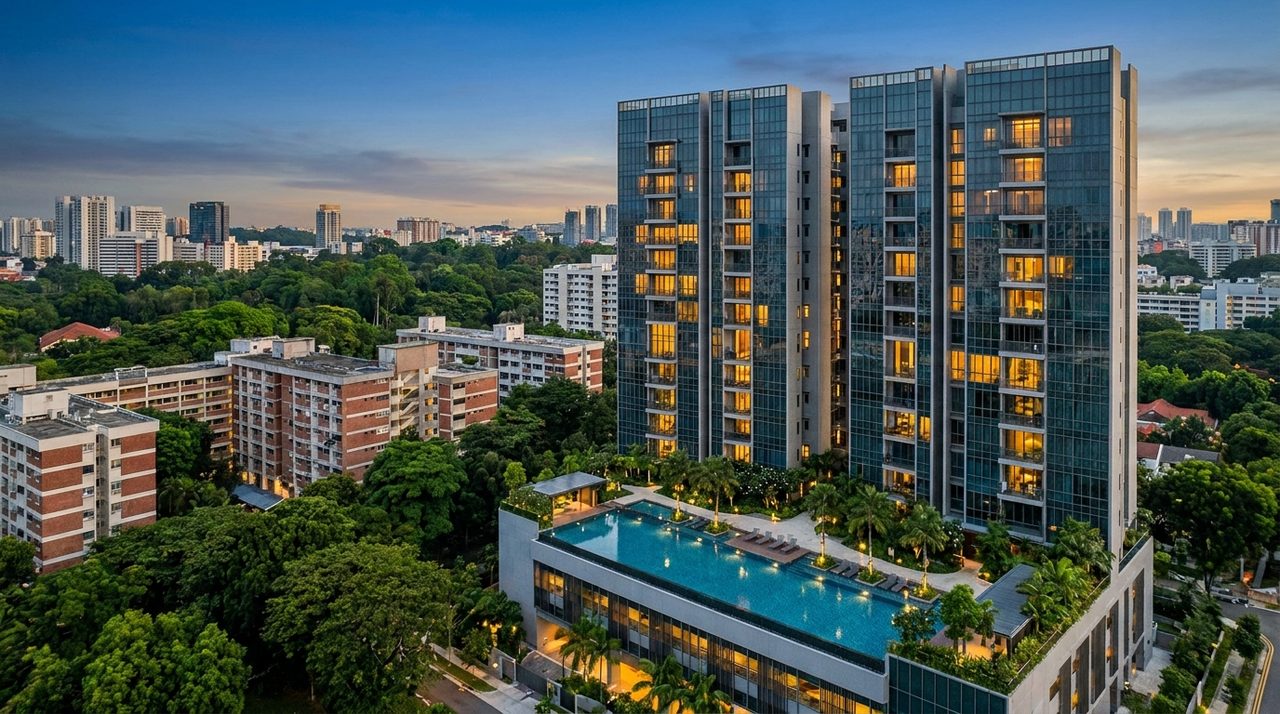
Toa Payoh Hillside is a Prime project planned beside Caldecott MRT station and an upcoming mixed-use development. The report identifies it as the first BTO project in Toa Payoh West. That gives applicants a concrete location to weigh up, rather than an abstract choice about living somewhere in Toa Payoh.
Its conventional flat options had both attracted more applications than supply at the snapshot. Alongside the heavily subscribed 4-room flats, the project’s 2-room Flexi flats received 1,247 applications for 592 flats, equivalent to approximately 2.1 applications per flat.
Community Care Apartments presented a markedly different picture: 139 applications for 256 apartments, or approximately 0.54 applications per apartment. Put another way, the application count was 117 below the number available at that point in the exercise. That is an early application gap, not a count of homes left unsold after selection.
The distinction is more than size. Community Care Apartments are senior-focused housing, and HDB’s November sales conditions require buyers invited to book one to sign a Basic Service Package Agreement with the operator. A household considering this option is therefore choosing a home with a service arrangement attached, not simply a smaller version of a conventional flat.
That makes the within-project comparison useful, but it also defines its limits. The lower Community Care Apartment count shows a different level of take-up for a different housing proposition at the same snapshot. It is not a like-for-like contest with the project’s 4-room homes. The shared address does not make the homes interchangeable.
For readers weighing the location, that is the practical insight: strong demand for one part of Toa Payoh Hillside did not extend evenly across everything on offer there. The specific home and household category mattered alongside the project name.
Plantation Dew: smaller flats had the higher overall ratio
At Plantation Dew, a Standard project in Tengah, 652 applicants sought 178 2-room flats. Its family-flat supply—covering 3-room, 4-room and 5-room/3Gen flats—received 1,390 applications for 532 flats.
The family flats attracted the larger absolute number of applications. Yet dividing each count by its corresponding supply reverses the emphasis: the 2-room flats had about 3.7 applications per flat, compared with about 2.6 across the combined family-flat supply. A bigger application count does not necessarily mean more applications competing for each available home.
One worked comparison makes this clear. The 2-room calculation is 652 divided by 178, giving 3.66; the combined family-flat calculation is 1,390 divided by 532, giving 2.61. Rounded to one decimal place, the difference is about 1.1 applications per flat. These calculations describe demand relative to supply, not an applicant’s probability of securing a home.
The first-timer-family figures reveal another layer. Within that category, Plantation Dew’s application rates were 1.3 for 3-room, 2.6 for 4-room, and 1.6 for 5-room/3Gen flats. The 4-room rate was twice the 3-room rate and higher than the rate for the larger options.
That is a more precise reading than saying family flats in Tengah were uniformly popular. Among Plantation Dew’s first-timer-family options, the strongest reported rate was for the middle-sized format, not the largest. The combined family-flat total alone would hide that distinction.
The layout choice behind Plantation Dew’s numbers
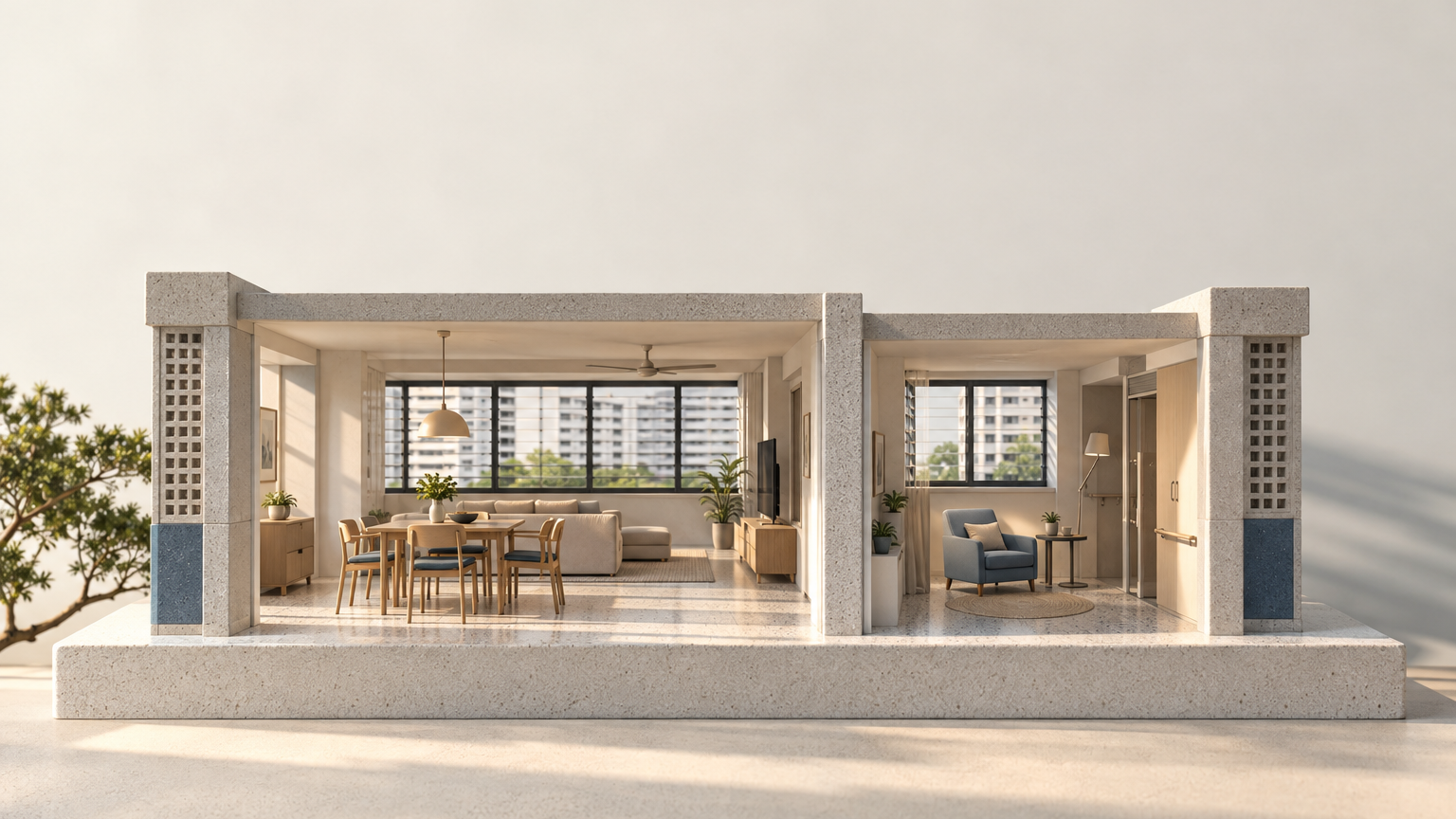
Plantation Dew also offers a physical choice that application figures cannot fully explain. Buyers of its 3-, 4- and 5-room flats can opt for White flats, described in the report as open-concept homes without internal partition walls, allowing greater flexibility in configuring the living space.
For a household comparing homes, that is worth separating from the demand ranking. Room count describes the flat category; the White-flat option concerns how the interior can be arranged. A buyer weighing Plantation Dew is therefore considering both the amount of space and an option for shaping its layout.
The reported figures do not separate applicants by whether they intend to choose a White flat. So the demand data can identify which flat categories attracted more applications, but cannot tell us how much the open-layout option influenced those applications.
The useful conclusion is narrower and more concrete: Plantation Dew combined demand across its flat types with a layout option for several family-flat categories. Applicants still need to judge that option on its own merits rather than treating a high application rate as an endorsement of every feature.
Read the category before comparing the rate
For first-timer families comparing 4-room options, the reported rates were 2.6 at Plantation Dew and 2.4 at Toa Payoh Hillside. Those are closer than the broader town-level demand story might suggest. They are also a more relevant comparison for that particular applicant group than setting Plantation Dew’s combined family-flat ratio against Toa Payoh Hillside’s second-timer rate.
Likewise, the exercise-wide median first-timer-family application rate of 1.1 is a different measure from the calculated launch-wide ratio of approximately 1.7 applications per flat. One summarises reported category rates across projects; the other divides all applications by all flats. Neither should be presented as the other.
HDB’s November sales conditions state that queue positions are determined by computer balloting. The application snapshot is consequently best used to understand where demand was concentrated, not converted into personal ballot-success odds.
The next meaningful comparison is how these same flat types and applicant categories look when the application window closes. For now, the clearest finding is already visible: November’s early demand was not simply a vote for Toa Payoh or Tengah. It was a set of distinct choices—between flat sizes, household categories and, at Toa Payoh Hillside, conventional housing and a senior-focused home with a service agreement.