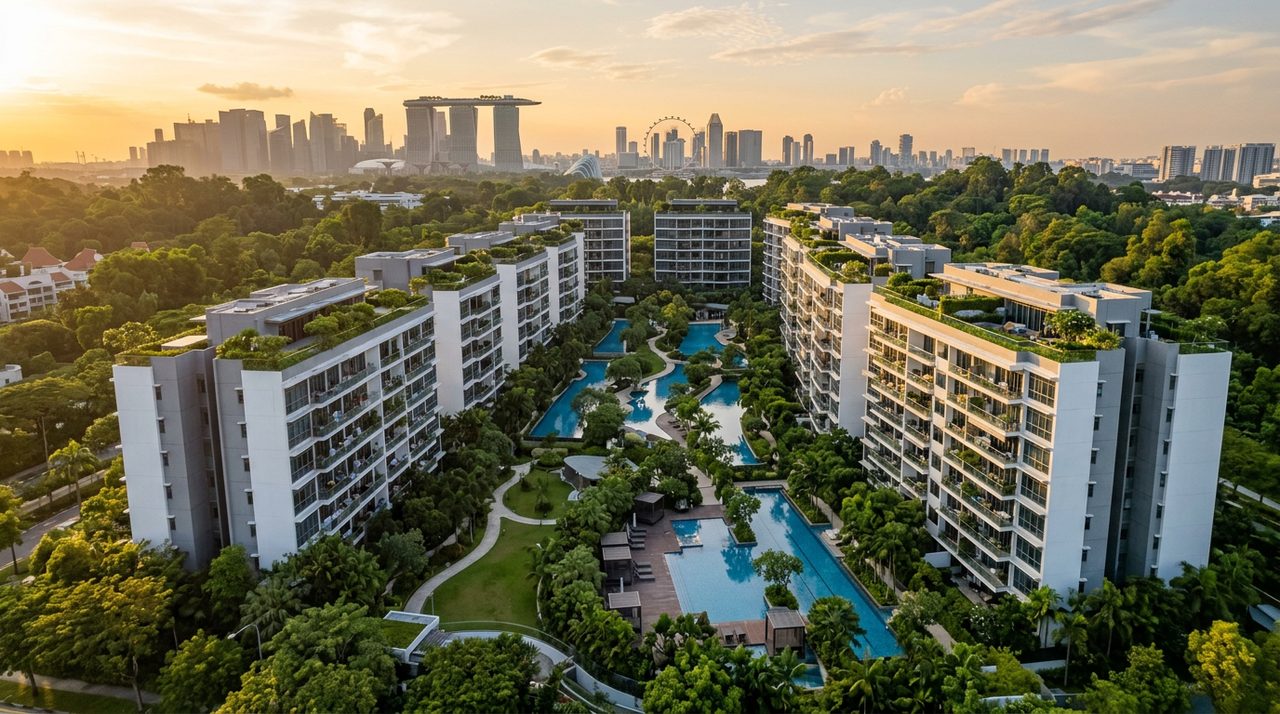
 plan
Singapore’s condo sales rebound was led by older projects
Developers issued 296 private-home options in September 2026, with nearly one in five going to Terra Hill and The Sen.
Singapore developers issued options for 296 new private homes, excluding executive condominiums (ECs), in September 2026. That was 93.5% more than August’s 153, but the eye-catching percentage came off a small base—and the projects leading the recovery were not brand-new launches.
Terra Hill and The Sen, two condominiums already on the market, recorded 32 and 25 sales respectively. Together, their 57 sales made up 19.3%—nearly one in five—of September’s total, based on mastREplan’s calculation.
What nearly doubling actually looked like
The jump from 153 to 296 homes means developers sold 143 more units month on month. Put that way, September looks more like a recovery from a quiet August than a rush involving thousands of buyers.
Developers also introduced relatively little fresh stock. They launched 158 units in September, up 36.2% from 116 in August. Sales rose much faster than the number of units launched, suggesting that buyers were looking beyond the month’s newest supply.
The timing matters when reading the comparison. The Lunar Seventh Month ended on 10 September 2026, while August had few major launches. Market observers commonly watch this period because some buyers and developers avoid major commitments during the festival, but the calendar alone cannot explain why any individual household bought.
September’s figures are therefore best understood as a combination of a weak comparison month, limited new supply and purchases spread across projects that were already selling.
Older projects, not the sole new launch, led sales
September had only one new condominium launch: Amberwood at Holland. It sold 24 units during the month, with 70 of its 212 homes released in the initial launch.
That was fewer than the 32 sales at Terra Hill and the 25 at The Sen. Terra Hill had sold four units in August, while The Sen sold 12, so both recorded a clear month-on-month pickup without being September debuts.
Here is the useful comparison:
| Project | September sales | August sales | September status |
|---|---|---|---|
| Terra Hill | 32 | 4 | Previously launched |
| The Sen | 25 | 12 | Previously launched |
| Amberwood at Holland | 24 | Not applicable | September’s sole condo launch |
This distinction matters because “new private-home sales” refers to homes sold by developers, not necessarily homes in projects launched that month. A buyer taking up a remaining unit in an older development still appears in the developer-sales total.
The regional distribution tells a similar story of activity outside the most central districts. The Rest of Central Region (RCR), often described as the city-fringe market, accounted for 131 sales. The Outside Central Region (OCR), covering suburban locations, contributed another 125. Together, those two regions supplied 256 sales, or 86.5% of September’s total.
Price may have helped—but it is not the whole answer
One possible reason Terra Hill and The Sen attracted attention is how their recorded prices compared with other new non-landed homes in the RCR.
Their median September prices were $2,209 per sq ft (psf) at Terra Hill and $2,386 psf at The Sen. Both were below the RCR median of $2,522 psf for new non-landed homes that month.
That gap is meaningful when buyers compare similar-sized homes. At 1,000 sq ft, the difference between $2,209 psf and $2,522 psf works out to about $313,000 before accounting for differences in floor, orientation, layout, tenure, completion timing and project location. This is a mastREplan illustration based on the reported median rates, not the price of a specific unit.
Still, a lower psf figure does not automatically make one home better value. The final purchase price depends on size, while the usefulness of the space and the buyer’s preferred location can matter more than a project-wide median. Nor does the available data establish that price was the reason all 57 buyers chose these two projects.
What the figures do show is simpler: older projects can regain momentum when their remaining homes compare favourably with the choices buyers see at that moment.
These are options issued, not completed conveyances
URA’s monthly developer-sales series is based on Options to Purchase issued by licensed developers. An Option to Purchase gives a buyer the right to proceed with the purchase under stated terms; it is not the same thing as a completed legal transfer of the property.
That is why developer-sales figures may differ from transaction counts drawn from lodged caveats. The monthly series is useful for tracking current buying activity, but readers should not treat all 296 options as 296 completed conveyances.
Executive condominiums are also excluded from the headline total here. ECs are a separate hybrid housing category with public-housing eligibility rules at launch, so including them would change the denominator and blur the comparison.
The next comparison will be more revealing
September’s 93.5% rebound is real within the developer-sales dataset, but the percentage alone overstates the breadth of the change. It represents 296 options after an unusually quiet month, with nearly one-fifth of sales concentrated at Terra Hill and The Sen.
For buyers, the interesting part is not that every new condominium suddenly became hot. It is that households continued to consider remaining units in established projects even when a fresh launch was available.
The next useful question is whether that pattern persists when buyers have a broader launch selection. If older projects keep moving alongside more new supply, their pricing and available unit mix may be doing lasting work. If activity shifts decisively to new launches, September will look more like a low-base rebound led by a few well-placed alternatives.