 plan
planInside MacPherson Weave: English classes, painting robots and an award
Hi-Tek paired construction automation with evening language lessons while navigating rail tunnels and flight restrictions.
After the day’s construction work, some Hi-Tek Construction workers returned to a meeting room for English lessons from 7pm to 9pm. Corporate safety manager Raymond Lee said the classes began after the company noticed that language barriers made some workers hesitant to speak with supervisors and managers.
The same contractor deployed tablet-controlled painting robots at MacPherson Weave, which was reported as a 2026 HDB Construction Award recipient. The contrast makes the project worth a closer look: building these homes involved new machinery, but also the decidedly human work of helping people communicate.
Seven blocks on a constrained site
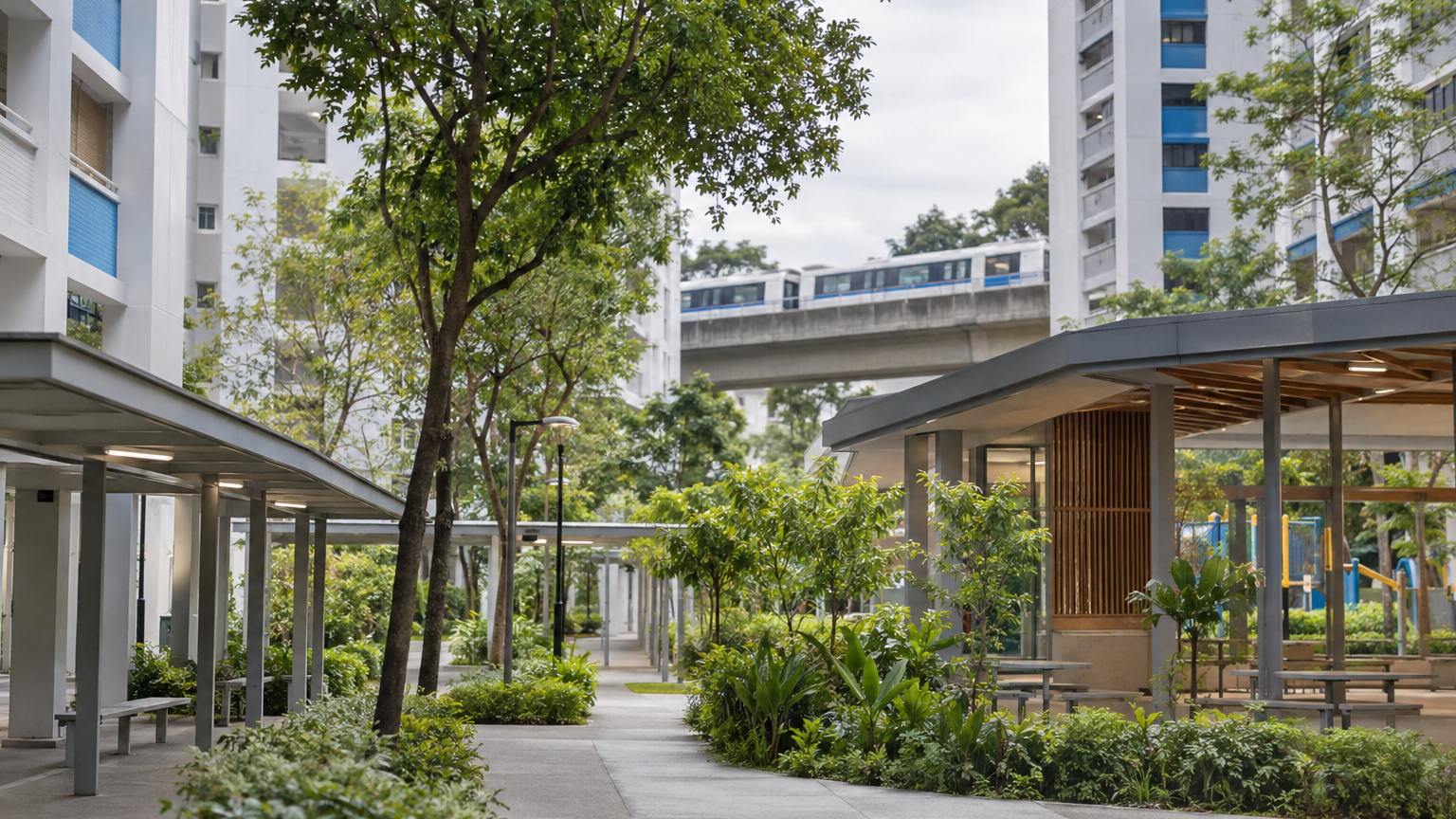
MacPherson Weave was launched in the May 2021 Build-To-Order exercise. Its site is beside MacPherson MRT station and bounded by Circuit Road, Circuit Link and Paya Lebar Road.
The development comprises seven residential blocks and 1,382 flats, spanning 2-room Flexi, 3-room and 4-room homes.
That convenient location complicated the building work. The contractor had to operate near MRT tunnels and within the Paya Lebar Air Base flight zone, monitor vibration, obtain clearances for crane operations and schedule some work after train services ended.
In everyday terms, the team could not organise every lift or construction activity around its preferred timetable. Work near the railway had to fit within tight operating windows, while cranes could not simply move whenever materials were ready.
What the painting robots actually did
Inside the flats, the painting robots first used lasers to map a room. They then followed preset routes to spray the walls, with one worker reportedly able to operate two robots in separate rooms using a tablet.
This was automation of a repetitive finishing task, not a worker-free site. People still had to prepare the rooms, position and oversee the machines, deal with awkward areas and inspect the completed surfaces.
Singapore’s Building and Construction Authority has separately showcased Hi-Tek’s integration of robotics and automation into its construction operations. The machines at MacPherson Weave were therefore part of a broader change in how repeated, physically demanding tasks are handled—not a one-off party trick for an awards entry.
That change is spreading across public-housing construction. Plans announced in 2024 called for robotic painting and skimming—applying a thin finishing coat to a wall—to be used at about half of BTO construction sites from 2025. HDB’s latest annual report also places robotics within its wider effort to raise construction productivity.
The practical advantage is repetition. A robot can follow the same planned movement across many similar rooms, while workers focus on preparation, corners, changing site conditions and quality checks.
Why the English lessons mattered
The evening classroom tackled a different kind of construction problem. Detailed schedules and advanced machines are of limited use if someone is uncomfortable asking for clarification or flagging a concern.
That mattered especially at MacPherson Weave. Work around rail infrastructure, restricted crane movements and multiple building trades required people to understand not only what to do, but also when it was safe and possible to do it.
The classes and robots therefore addressed opposite sides of the same challenge. One made a standard physical task more repeatable; the other helped workers participate more confidently in the conversations surrounding that work.
The award came at the end of a long sequence
HDB announced its 2026 awards on 23 September 2026, recognising projects and industry partners for work in design, engineering and construction. The accessible official announcement confirms the awards programme and date, although its searchable page does not identify MacPherson Weave; the project’s Construction Award and Hi-Tek’s role are established by the reported project account.
For residents, much of this work would have been invisible by the time they received their homes. The robots operated inside unfinished rooms, tunnel monitoring happened below or beside the site, and English lessons took place after the formal workday.
That is the more revealing story behind MacPherson Weave. The memorable machine handled paint, but delivering the homes depended on people coordinating around tunnels, cranes, deadlines and one another.