 plan
Green Mark buildings in CBD commanded rents up to 12% higher, BCA says
The comparison also found higher occupancy. For commercial owners and buyers, that leasing advantage is separate from sustainability-investment payback and savings shared through green leases.
Green Mark buildings in Singapore’s Central Business District commanded rents up to 12% higher than non-Green Mark properties, according to market analysis cited by the Building and Construction Authority (BCA). Its Green Mark page, updated on 9 October 2026, also reports consistently higher occupancy for those certified buildings—a useful pairing for commercial owners and buyers assessing leasing prospects.
The question is how much of that advantage a purchase or refurbishment can capture. A separate six-city office study, reported on 29 October 2026, found Singapore landlords investing in green refurbishments were least likely to secure an additional rent premium. Savills’ explanation was that these features are already widespread here and increasingly expected as standard. The distinction is between a building’s existing leasing position and the payback on fresh sustainability spending.
What the CBD rent comparison actually says
BCA’s comparison concerns Green Mark buildings in the CBD, rather than an explicitly office-only sample. “Up to 12%” is the upper figure reported, not an average increase to apply to every certified property. It describes an observed comparison, not a measured increase caused by certification.
Green Mark is Singapore’s building rating scheme for environmental impact and performance, covering new and existing buildings. Its assessment involves documentary evidence and, where applicable, verification that committed features have been implemented and are operational.
For a buyer, the practical distinction is between paying for an existing advantage and funding a future improvement. An application of BCA’s findings is to establish the property’s current rents and occupancy first, then identify what further spending is expected to change. That keeps an existing certification benefit separate from an uplift proposed after purchase.
BCA’s page does not give the rental comparison’s study period, sample size or breakdown by building type and certification tier. The figure is therefore a starting point for examining a particular property, rather than an asset-level rental forecast.
Why refurbishment may earn less extra rent here
The reported Savills analysis covered more than 2,000 office buildings in Amsterdam, Chicago, Hong Kong, London, New York and Singapore. It compared rental values against the environmental standard most commonly targeted in each city, controlling for factors including building age and size. Buildings meeting at least one relevant standard consistently attracted higher rents.
Its Singapore finding concerns the opportunity to earn an extra premium from green refurbishment where such standards are already common. BCA’s CBD statement compares certified and non-certified buildings. The two findings can coexist: a feature can help a property compete while offering less scope to charge separately for another improvement. That is an interpretation of the comparisons, not a measured refurbishment outcome.
The useful investment question is whether proposed works improve tenant appeal, address a competitive weakness or support an additional rent increase. Those are different commercial aims; the reported findings do not supply a single uplift that answers all three.
Five to six years refers to sustainability-investment payback
BCA supplies a separate benchmark for new commercial buildings with the highest Green Mark Super Low Energy certification. It says these buildings can recover their sustainability investments in about five to six years, while achieving average energy savings of 59%, based on its Green Mark Submissions Database.
The scope matters: new buildings, the highest Super Low Energy level, and recovery of sustainability expenditure. This is not recovery of the entire acquisition or development cost, nor a five-to-six-year benchmark for every existing office refurbishment.
It also measures something different from leasing performance. Rent and occupancy describe the income-generating side of the property; sustainability-investment payback describes recovery of expenditure on those measures. BCA presents the payback alongside energy savings without identifying a rent increase as the source of recovery.
For an older asset, the proposed upgrade’s own scope and cost are the appropriate starting point. Applying a new-building benchmark without that distinction would confuse two different investment cases.
A cooling saving is not a whole-building saving
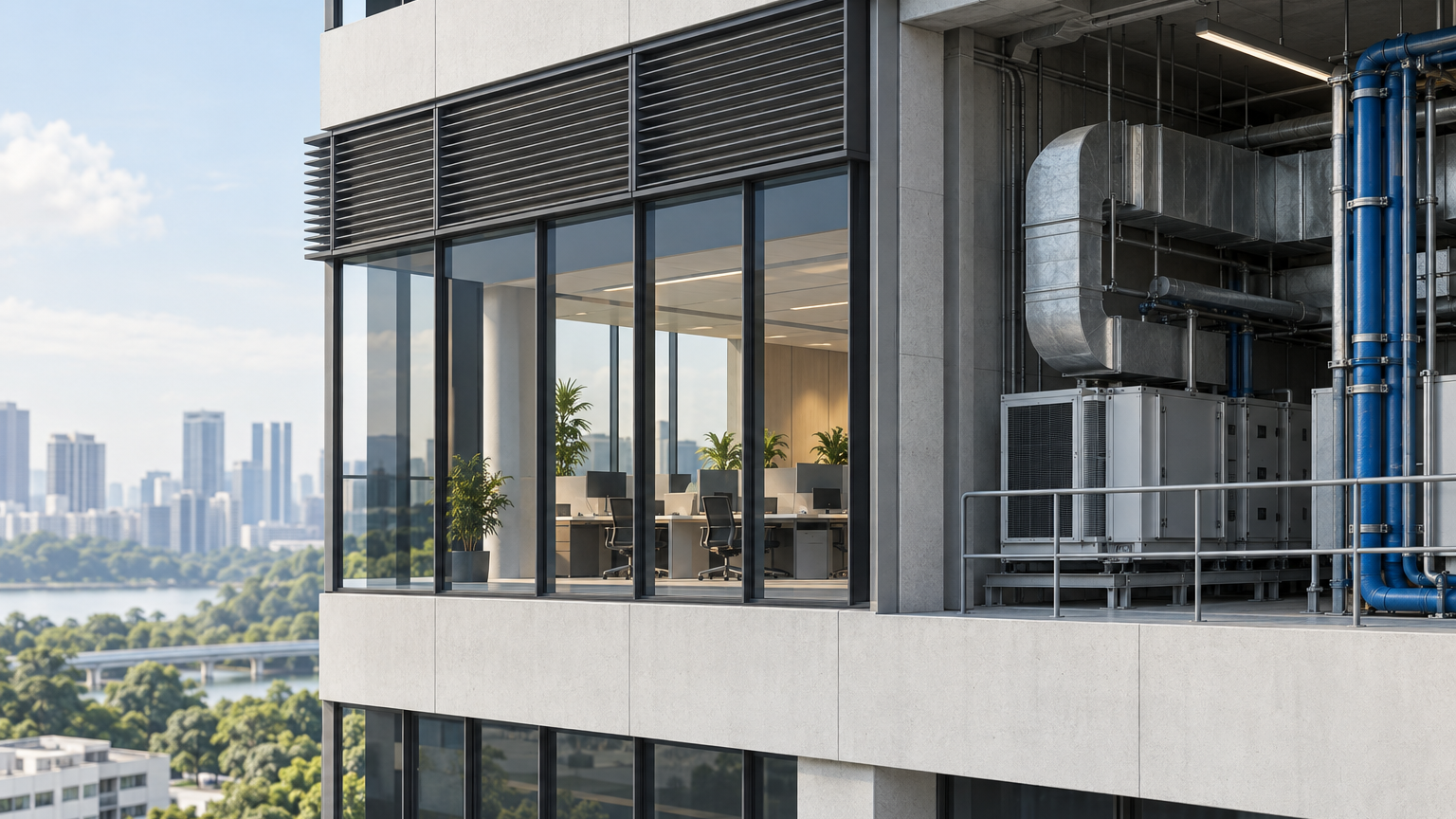
BCA’s Design Prototyping for Decarbonisation study identifies alternative cooling technologies, including Passive Displacement Cooling and hybrid cooling systems, as capable of cutting cooling energy consumption by 30% to 50% while maintaining thermal comfort. Cooling itself accounts for 40% to 60% of building energy consumption, BCA says.
Those percentages have different denominators. One measures the reduction within cooling; the other measures cooling’s share of the building’s total energy use. A proposal needs both to explain its whole-building effect.
Illustrative calculation: assume cooling uses 50% of a building’s energy and an intervention cuts that cooling consumption by 40%. Both assumptions fall within BCA’s ranges. If all other consumption stays unchanged, the whole-building reduction is 50% × 40% = 20%. This is explanatory arithmetic, not a measured project result.
That gives owners a clearer way to compare proposals: identify the system being changed, its share of total consumption and the expected reduction within that system. Keep the result separate from the 59% average energy-saving benchmark for new highest-SLE commercial buildings, which concerns a different population and measure.
How savings reach the owner matters too
BCA also highlights plug-load management—tracking and reducing electricity consumed by plugged-in equipment—as a practical energy-saving lever. Its study says green leases can enable landlords and tenants to share cost savings.
That makes the allocation of savings part of the investment case. The analysis should connect the party paying for the work, the energy costs affected and the lease arrangements governing how benefits are shared. Lower consumption alone does not establish an equal financial benefit for every landlord or tenant.
The CBD rent comparison, new-building payback benchmark and cooling study each answer a different question. Together, they support examining leasing performance, sustainability expenditure, energy consumption and allocation of savings separately. The unresolved commercial question is how much of each benefit reaches the owner of the particular building being bought or upgraded.