 plan
planGarden Waterfront II points to a more scalable BTO building model
The Tengah testbed reports stronger site productivity, but no proven premium in flat value, quality or completion time.
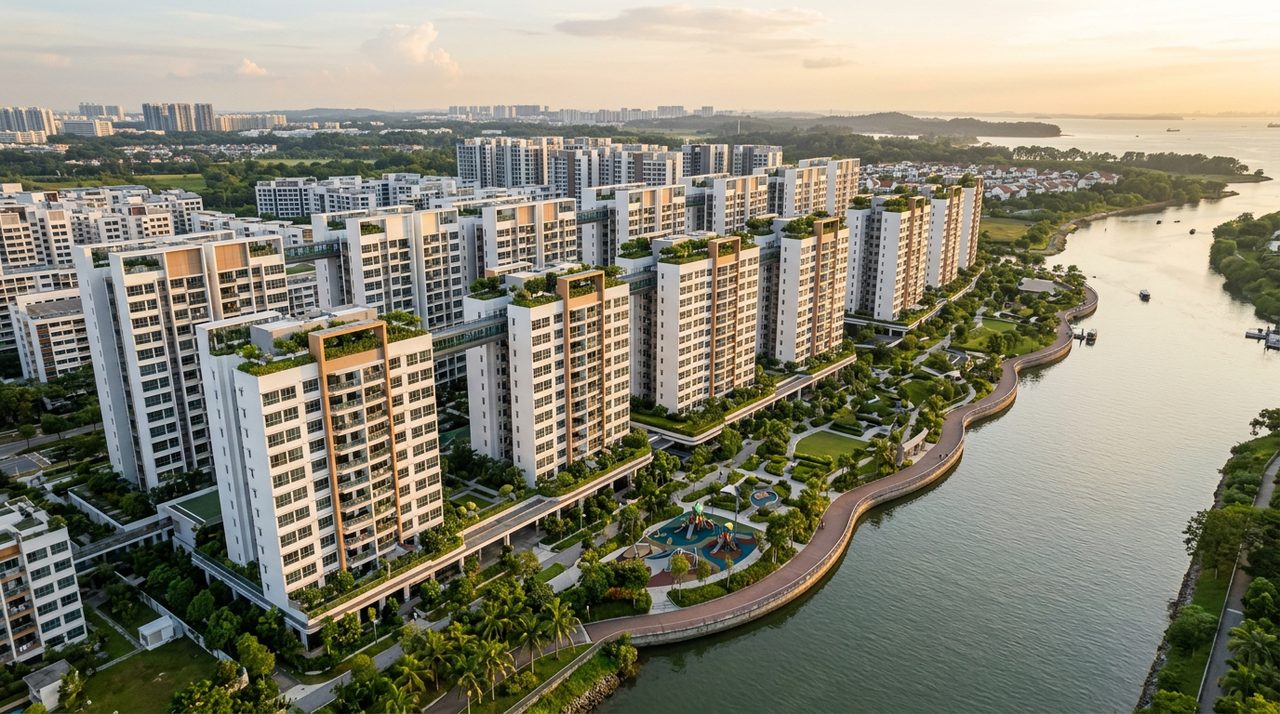
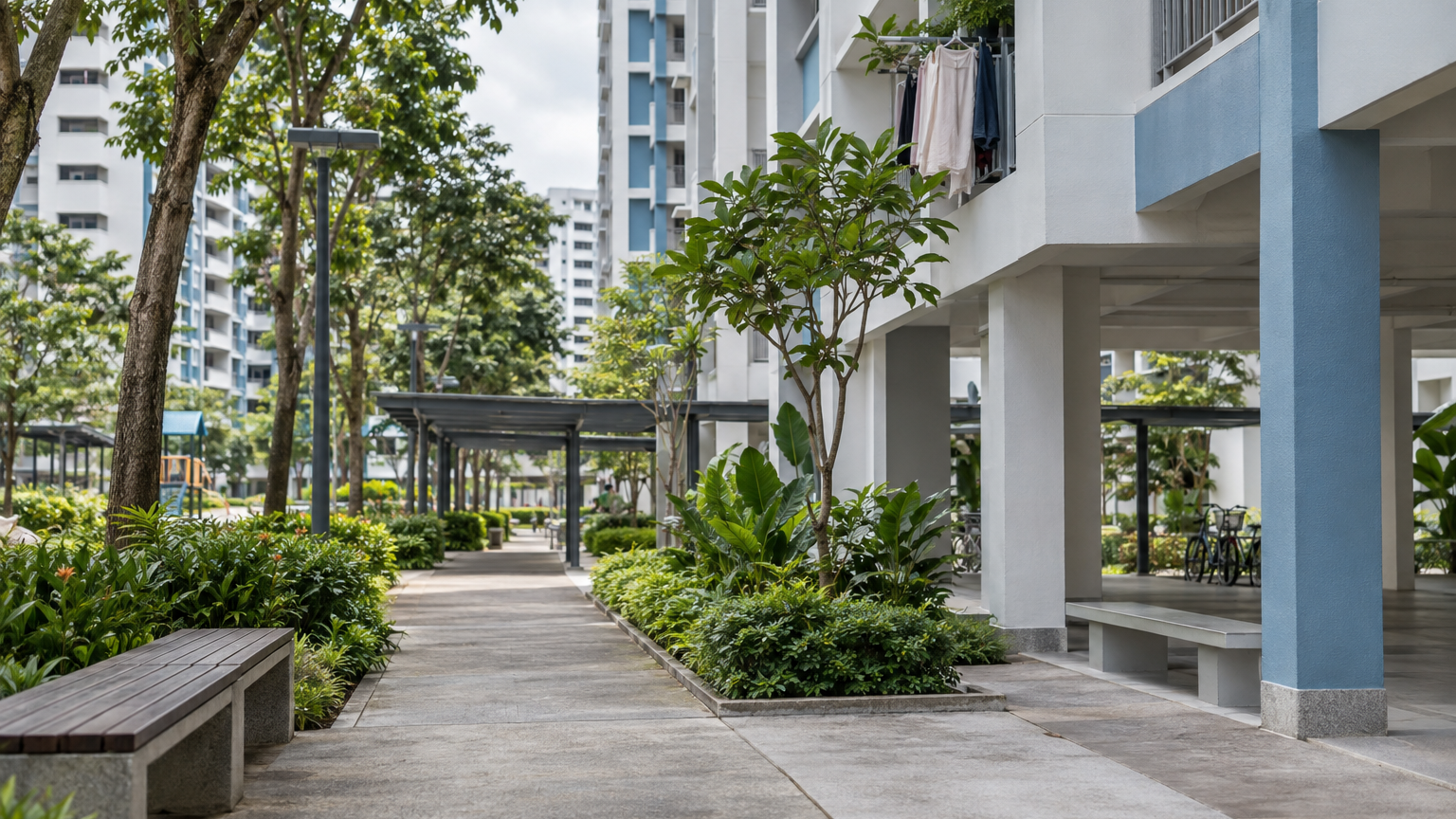
Garden Waterfront II @ Tengah was completed in June 2026, making it the first completed project under HDB’s Construction Transformation Project. Together with neighbouring Garden Waterfront I, the project is on track to deliver a reported 25% improvement in site productivity against the programme’s baseline.
For buyers asking whether this makes the flats more valuable, the available evidence says no. The milestone matters because HDB has taken a live construction testbed through to completion and plans to adapt successful methods progressively across other BTO projects—not because it has established a price, quality or completion-time premium.
What the 25% productivity gain means
HDB launched the Construction Transformation Project with Obayashi Singapore in 2022 at Garden Waterfront I and II. It used the projects to test greater prefabrication, digital coordination, precision lifting and other methods intended to make building work less labour-intensive.
HDB defines site productivity as constructed floor area per manday. Applying the reported 25% improvement to the baseline of 0.6 sq m per manday produces about 0.75 sq m per manday—a calculated increase of 0.15 sq m for the same unit of site labour.
That calculation also defines the claim’s limits. It is not evidence of a 25% reduction in construction duration, cost or manpower, and it does not measure flat quality or resale value.
Earlier HDB material identified an autonomous tower crane with the SkyJuster load-control system, crane machine guidance, digital project coordination, radio-frequency identification tracking and more standardised precast components among the technologies under trial.
These tools tackle different inefficiencies. Digital coordination can identify clashes before work reaches the site, while tracking can improve the flow of components. Precision lifting and standardised prefabrication can reduce manual handling and move more work into controlled production settings.
“The achievement is operational before it is financial.”
Why repeatability matters more than novelty
An unusual machine or successful demonstration has limited housing-market significance on its own. The more important question is whether HDB and its contractors can reproduce the gain across projects with different layouts, constraints and construction teams.
Singapore’s public-housing pipeline depends on contractor capacity, materials and labour as well as available land. HDB said it planned to launch 19,600 BTO flats in 2026, illustrating the scale at which construction methods must operate.
If each manday consistently produces more completed floor area, HDB may be better placed to sustain a large building programme without site manpower rising at the same rate. That is an interpretation of the productivity mechanism, not a confirmed forecast of lower costs or faster delivery.
A pilot average also does not reveal how much each technology contributed. A crane system suited to a large, standardised development may transfer less readily to a constrained site, while digital coordination could be easier to apply across different projects.
Public discussion and video material included in the evidence record illustrate the attention attracted by construction technology, but they do not establish buyer outcomes beyond HDB’s reported project results. The substantive test is therefore HDB’s stated move to adapt successful innovations progressively for other BTO projects.
What buyers gain—and what remains unproven
For prospective BTO applicants, the possible benefit is systemic. Repeatable methods could give HDB greater capacity to maintain its building programme with less reliance on expanding site labour.
That does not mean applicants will receive keys earlier. HDB has not attributed a shorter waiting time, reduced selling price or changed completion date to Garden Waterfront’s productivity result.
Productivity is not a substitute for workmanship evidence either. Defect rates, rectification performance and the condition of completed flats would require separate project-level measures. The reviewed evidence does not establish that these technologies prevented defects or reduced owners’ renovation costs.
Existing Tengah owners should apply the same restraint. Completion adds another finished project to the developing town, but there is no demonstrated resale premium for flats built with robotics, digital coordination or advanced lifting systems.
A resale buyer encounters the finished home rather than its production process. Layout, floor level, orientation, condition, remaining lease, transport and surrounding amenities remain more visible points of comparison.
The strongest counterargument is therefore persuasive: construction productivity is principally an industry metric, while buyers care about liveability, workmanship and value. The milestone becomes a direct buyer benefit only if better production capability subsequently supports measurable improvements in delivery, quality or supply.
Construction tools are not smart-home features
Garden Waterfront I and II are also the first Tengah BTO projects that HDB says will include Smart Adapters for real-time monitoring of household electricity consumption. These are resident-facing devices, unlike the systems contractors used to build the blocks.
The distinction matters because several technologies can be grouped loosely under a “smart town” label even though they have different purposes and operators. A Smart Adapter concerns household energy information. Crane guidance and digital coordination concern construction.
Tengah’s centralised cooling system is separate again. HDB announced in April 2026 that Keppel had received a new contract covering nine Tengah BTO projects, bringing its contracted coverage to 12 projects.
That announcement does not establish that Garden Waterfront II is one of those projects. Nor would cooling performance prove anything about construction productivity. Buyers should not treat these separate systems as a single technology package.
Tengah’s wider build-out will matter more to value
Garden Waterfront II’s completion advances Tengah’s physical development, but the town’s longer-term appeal will depend more directly on how transport, public spaces and everyday amenities work in practice.
HDB’s plans describe a future town centre pedestrianised at ground level and served by the Jurong Region Line. Garden Farmway is intended to connect the Garden District with the future Central Park and Tengah Pond.
These plans provide relevant context, but residents will experience them according to actual opening sequences, walking routes and service availability. A completed housing project can still sit within a town where construction and amenity development continue around it.
Garden Waterfront I is expected to be completed by the end of 2026. That would complete the paired testbed, but the more consequential evidence must come from later projects.
The development to watch is whether HDB identifies which methods enter mainstream BTO construction and publishes comparable effects on productivity, safety, timelines or quality. That will determine whether Garden Waterfront II was simply a successful pilot or the start of a durable change in how Singapore builds public housing.