 plan
planCan a Four-Room BTO Properly Accommodate Live-In Help?
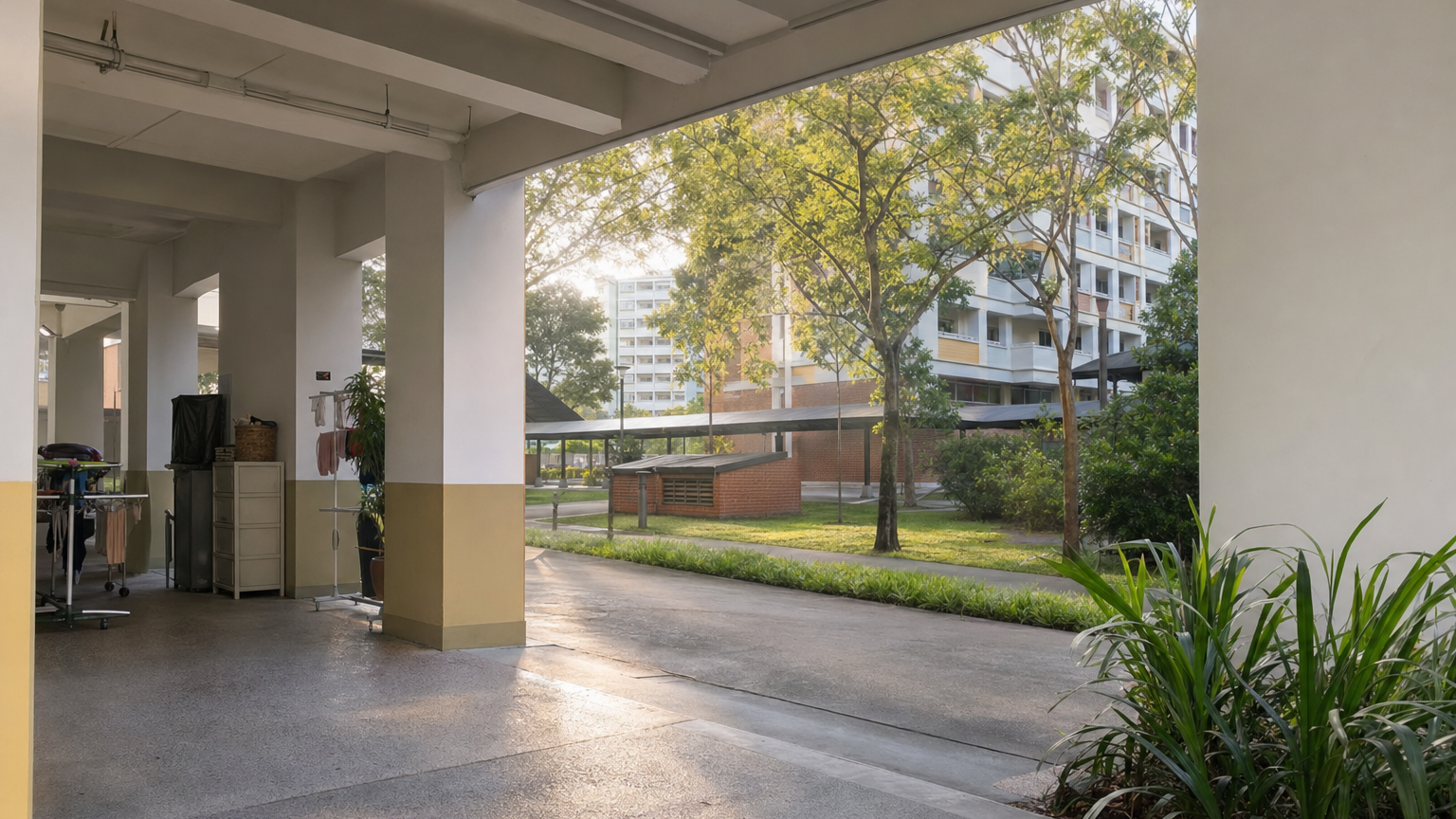
Three bedrooms can already be fully claimed by family life. Suitable worker accommodation must be planned as a core use of space.
A reported four-room BTO layout used part of a home office as a migrant domestic worker’s sleeping area, with a partition separating the bed from the daytime workspace. The episode did not establish a breach, identify the BTO project or announce a housing-policy change. It was also unrelated to the Home Improvement Programme, an upgrading scheme for older flats.
For owners and buyers, the important question is whether a four-room flat can properly accommodate live-in help. It can—but only if the worker’s safe, ventilated and private resting space is treated as a core housing need rather than fitted into the area left after every other room has been claimed.
A four-room flat may have no spare bedroom
In Singapore, “four-room” does not mean four bedrooms. Selected four-room flats in the June 2026 BTO exercise have three bedrooms and about 89 to 90 sq m of total floor area, including roughly 86 sq m of internal floor area.
That may be ample for a couple or small family. But a couple with two children can already have a claim on all three bedrooms. Add an ageing parent, home office or live-in worker and the same plan must support another essential function.
Dividing 86 sq m by three bedrooms produces nearly 29 sq m per bedroom, but that calculation is misleading. Living areas, the kitchen, bathrooms, circulation and storage consume much of the internal space. The relevant measure is the usable resting area remaining after the entire household is accommodated—not the flat’s average area per bedroom.
Renovation can reduce that flexibility further. Opening one bedroom into the living area may suit a couple today but remove an enclosed sleeping option if children arrive, an elderly parent moves in or the household later hires live-in help.
“A partition can divide floor area; it cannot automatically create a private room.”
Suitable accommodation means more than fitting a bed
The Ministry of Manpower’s published requirements cover adequate shelter, safety, ventilation, basic amenities, hygiene, modesty, and sufficient space and privacy. A migrant domestic worker must not sleep in the same room as a male adult or teenager, while cameras are prohibited in sleeping areas and bathrooms.
A separate room is encouraged where possible, but those requirements do not prescribe a universal minimum floor area for a worker sleeping in an employer’s home. Suitability therefore cannot be established simply by showing that a single bed fits behind a divider.
A study used as a bedroom at night might work if it is quiet, safe, adequately ventilated and genuinely private during resting hours. The arrangement becomes harder to justify if the worker must wait for someone to finish working, remove bedding each morning, sleep beside hazardous equipment or surrender privacy whenever another resident enters.
That is an editorial application of the official criteria, not a finding about any particular household. The actual room, ventilation and domestic routine would have to be considered together.
Singapore applies a 4.2 sq m per resident living-space standard to new purpose-built migrant-worker dormitories. That belongs to a separate accommodation regime and is not a legal minimum for domestic workers living in employers’ homes. It is relevant only as evidence that density, ventilation and liveability are recognised concerns in other worker-housing settings.
Hiring live-in help changes the household’s space budget
MOM asks prospective employers to consider both the full cost of employing a migrant domestic worker and whether their home has room for proper accommodation. Hiring is consequently an employment decision, a lifestyle decision and a property-use decision.
The spatial cost may be the loss of a study, nursery or hobby room. A foldaway bed or movable divider can manage two competing uses, but it cannot remove the conflict between them. Where a space belongs to the household by day and becomes the worker’s only at night, privacy and rest depend heavily on disciplined access and working hours.
A dedicated bedroom is not conclusive proof of decent accommodation either. Work can still intrude into rest time, and privacy can still be ignored. Conversely, an unconventional arrangement is not necessarily unsuitable if it protects safety, rest and dignity in practice.
Households must also plan for change. A sleeping arrangement may cease to work when a boy becomes a teenager because MOM’s requirements prohibit a worker from sharing a bedroom with a male adult or teenager. A lightly used study may also become unsuitable if an adult begins working there late every night.
Buyers should test the floor plan against future care needs
Buyers expecting to rely on live-in help should assess the actual plan rather than filter homes solely by bedroom count. The central question is whether everyone can be accommodated without assigning the worker the least functional leftover area.
| Layout choice | Immediate benefit | Longer-term constraint |
|---|---|---|
| Retain all three bedrooms | Maximum separation and flexibility | Smaller common area |
| Open one bedroom into living room | Larger shared space | One fewer enclosed sleeping option |
| Use a partitioned study nook | Supports work and sleeping uses | Day and night routines may conflict |
| Use a service or storage area | Preserves the main bedrooms | Ventilation, safety or privacy may be inadequate |
None of these configurations decides suitability by itself. Windows, airflow, access, household composition and actual routines matter. Buyers should model likely changes, including children needing separate rooms, an elderly parent requiring overnight care or remote work becoming permanent.
Private-property buyers should also distinguish occupancy treatment from accommodation quality. MOM’s housing guidance treats domestic helpers as part of the same family unit for the stated private-residential occupancy cap. That treatment does not remove the employer’s separate accommodation obligations.
Caregiving need is real, but it cannot create floor area
The strongest counterargument is that some families need live-in assistance precisely when their homes are fullest. Young children, frail parents, disability, shift work and overnight contingencies can make a resident caregiver materially different from a cleaner visiting for several hours.
MOM identifies part-time household services as an alternative for some needs. It also says applications from families in two-room HDB flats are considered in light of possible space constraints and household need, while pointing to alternatives including domestic cleaning, childcare, eldercare and extended-family support.
Such options may help with cleaning, errands or limited care, but they do not necessarily replace continuous supervision or overnight support. Two simplistic conclusions should therefore be resisted: that every family without a spare bedroom is indifferent to a worker’s dignity, or that a genuine caregiving need makes every sleeping arrangement acceptable.
The property implication is narrower. A four-room flat can be entirely adequate as a three-bedroom family home yet poorly matched to a household requiring three bedrooms, a workplace and live-in care. The room label cannot make all those functions coexist.
The development to watch is whether official guidance becomes more measurable about privacy and ventilation in homes, alongside any expansion of credible live-out caregiving options. Until then, allocating proper resting space for a worker remains a consequential housing decision—not a detail to resolve after every room has been assigned.