 plan
153 Kampong Ampat industrial sale beats guide by S$16.8 million
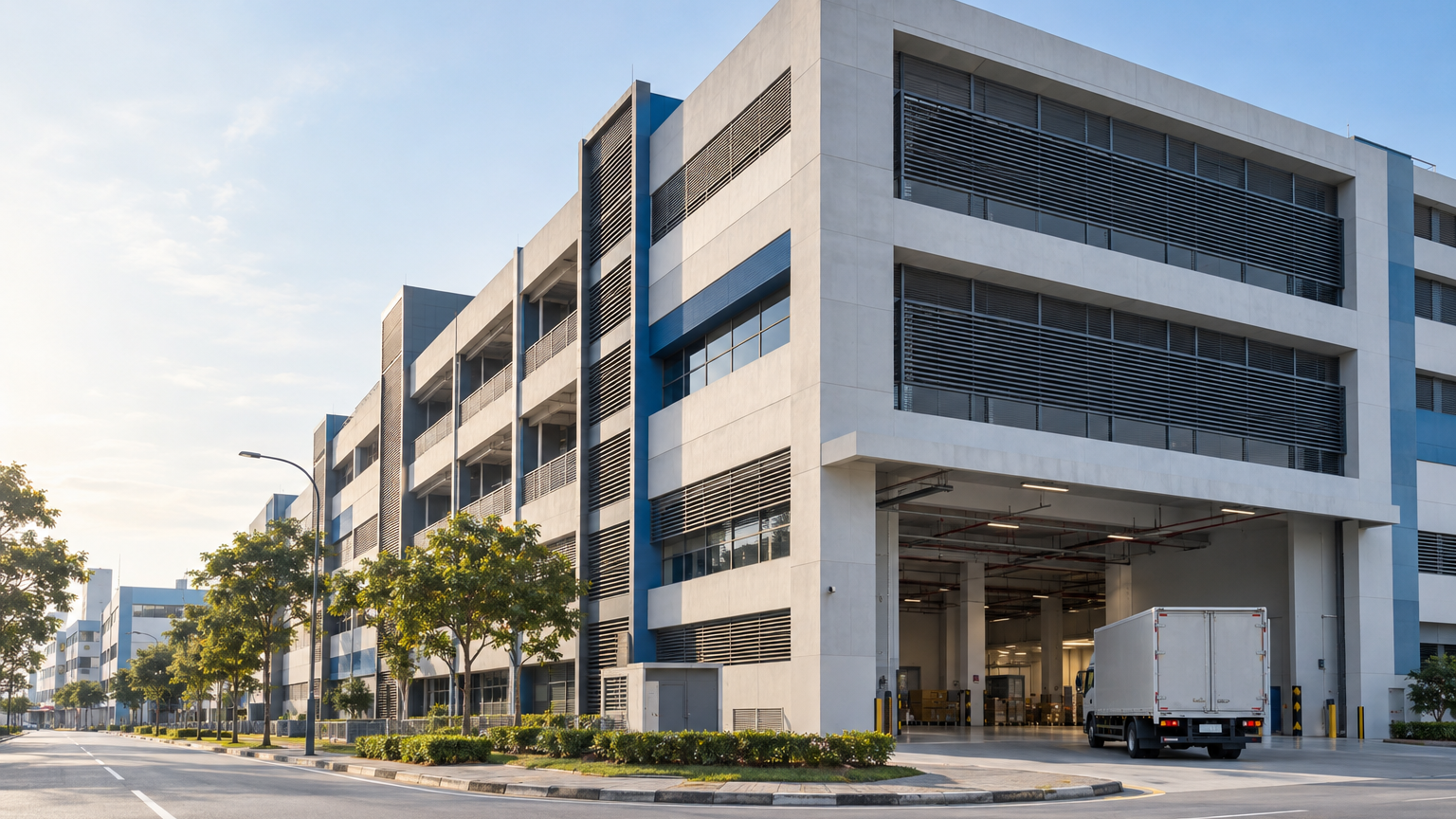
More than 12 bids competed for the freehold industrial building. The reported S$121.8 million outcome exceeded its S$105 million launch benchmark.
More than 12 bids were received for 153 Kampong Ampat, where a freehold industrial building has been reported sold collectively for S$121.8 million. Knight Frank Singapore, its exclusive marketing agent, announced the sale on 5 November 2026, following a public tender that closed on 23 October.
The result put the seven-storey, multi-user building in the Tai Seng–MacPherson industrial precinct S$16.8 million above its S$105 million guide price. That is the striking part of this sale: bidders were prepared to go substantially beyond the benchmark used when the property entered the market in late September. For its selling owners, the reported outcome is a larger collective-sale sum; for readers comparing property deals, the useful question is exactly what that 16% premium measures.
A tender with several different kinds of buyers
According to Knight Frank’s reported account, the tender attracted industrial developers, businesses looking for premises for their own operations, and investors considering another possible use. More than a dozen bids therefore represented interest from buyers with different potential purposes for the same property.
Industrial developers were exploring redevelopment into separately owned industrial units. Owner-occupiers, meanwhile, were looking for a sizeable freehold property to accommodate their operations. Those are distinct choices: one centres on creating a future development, while the other centres on securing a place to work.
The property itself combines a freehold land parcel of approximately 43,354 sq ft with an existing building containing 114,969 sq ft of gross floor area. It also occupies a corner site with extensive road frontage, according to the reported sale particulars. These details describe the specific asset that drew the bids, rather than the industrial precinct as a whole.
Melvin Chay, Knight Frank Singapore’s interim head of capital markets, interpreted the response as evidence of continuing industrial-investment interest. He highlighted demand for well-located freehold sites offering scale and redevelopment flexibility. That is the marketing agent’s assessment of the response, alongside the concrete result of more than 12 bids.
What the 16% premium actually measures
The arithmetic is straightforward: S$121.8 million minus S$105 million equals S$16.8 million. Dividing that difference by the S$105 million guide gives 16%. The denominator matters because it tells us what the percentage is comparing.
Here, the comparison is between a marketing guide and the reported sale outcome for the same property. It captures how far the outcome exceeded the amount used to guide prospective bidders at launch. It is not a comparison between the property’s purchase price years ago and its sale price today.
That makes “16% above guide” different from “a 16% investment gain”. Calculating an owner’s investment return would require that owner’s acquisition cost and other relevant costs, not the collective-sale guide. Nor is this a measurement of a 16% increase in industrial-property values across Singapore: the two numbers concern one sale exercise.
The useful reading is narrower and more concrete. This building attracted a double-digit number of bids and a reported outcome above its launch benchmark. The bid count adds important context to the price gap, although it does not reveal how closely the competing offers were grouped.
Why S$1,059 psf refers to floor space, not land
The reported sale rate is about S$1,059 per square foot, calculated using the existing 114,969 sq ft gross floor area, or GFA. In everyday terms, that denominator measures floor space across the building rather than the size of the plot beneath it.
The calculation is S$121.8 million divided by 114,969 sq ft, which rounds to approximately S$1,059 psf. The separate 43,354 sq ft land-area figure describes the freehold parcel. A multi-storey building can contain considerably more floor space than the land it stands on.
This distinction matters when comparing the deal with another property. A price expressed per square foot of existing GFA answers a different question from a price expressed per square foot of land. Putting those rates side by side without checking their denominators would make unlike measures appear comparable. Here, the reported S$1,059 psf belongs firmly to the existing-floor-area measure.
The next use remains an open question
Some investors were also evaluating potential secondary workers’ dormitory use, according to the reported account of bidder interest. Any such use would remain subject to detailed planning submissions and the relevant authority approvals. It should therefore be understood as a possibility considered during bidding, not an approved dormitory project.
Knight Frank did not disclose the purchaser’s intended use in its reported response. That leaves a meaningful distinction between the sale result and the property’s next chapter: the former has been announced, while the latter has not been established.
For now, the clearest consequence is the reported S$121.8 million collective-sale outcome, achieved after competitive bidding and S$16.8 million above guide. What happens to the building next will depend on the purchaser’s eventual plans and any approvals those plans require.