Duxton, Tras and Neil Road: The S$500 Million Shophouse Deal Is Capital Substitution, Not Spillover
Fifty conservation shophouses in Tanjong Pagar are in play at about S$500 million — and the money behind it is a verdict on the 60% ABSD wall, not a leading indicator for luxury homes.
The gist
- About 50 conservation shophouses in Tanjong Pagar are in talks at roughly S$500 million, averaging S$10 million each.
- Foreign buyers pay 60% ABSD on homes but zero on purely commercial conservation shophouses, diverting capital there.
- Stock is mostly 99-year leasehold with about 61-62 years left; Tras Street assets run near 67 years.
- Prime CBD shophouse pricing rose from S$1,800-S$2,200 psf GFA in 2015 to S$4,000-S$5,500 psf, yields near 2.0-2.5%.
About 50 conservation shophouses in the Tanjong Pagar Conservation Area are in play at roughly S$500 million. The reflex reading — big heritage cheque, therefore private wealth is back, therefore luxury homes next — is the part worth arguing with.
Fifty doors, one process
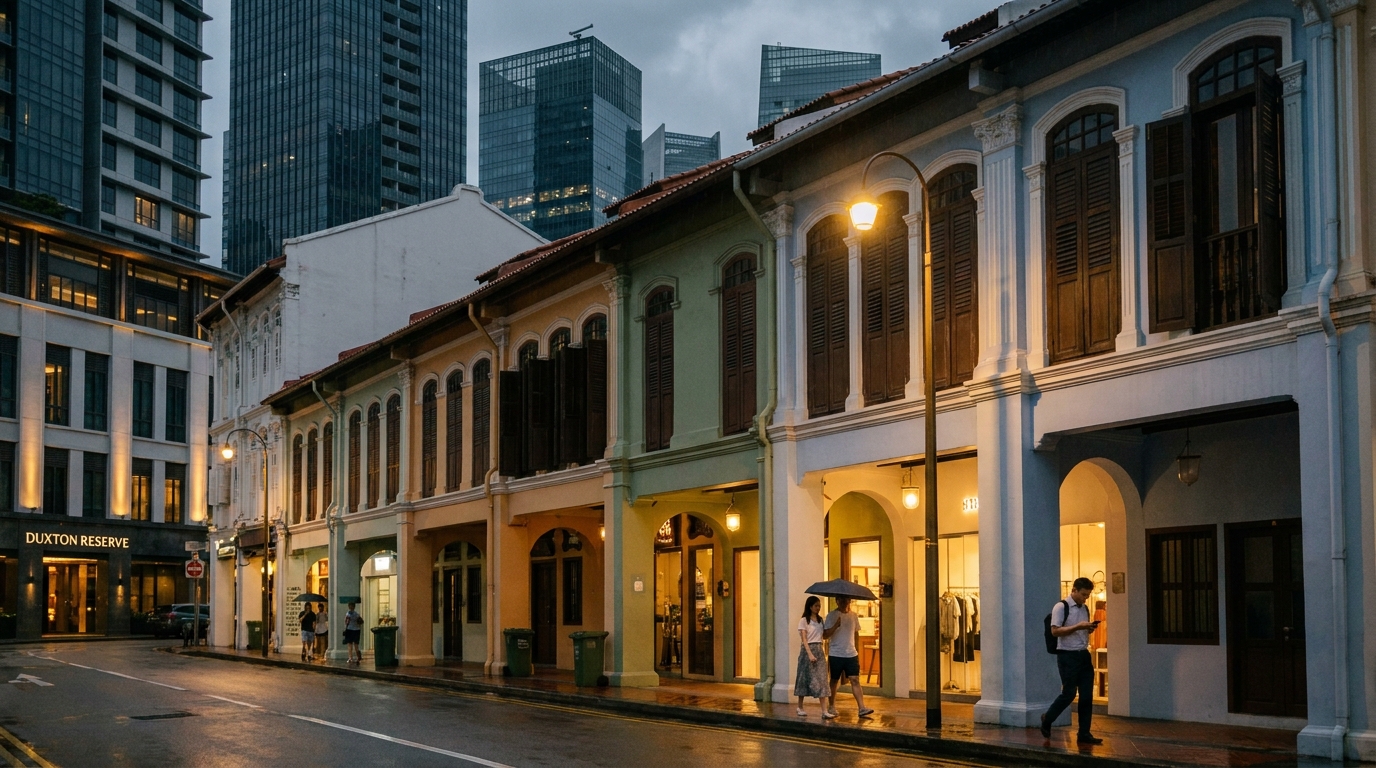
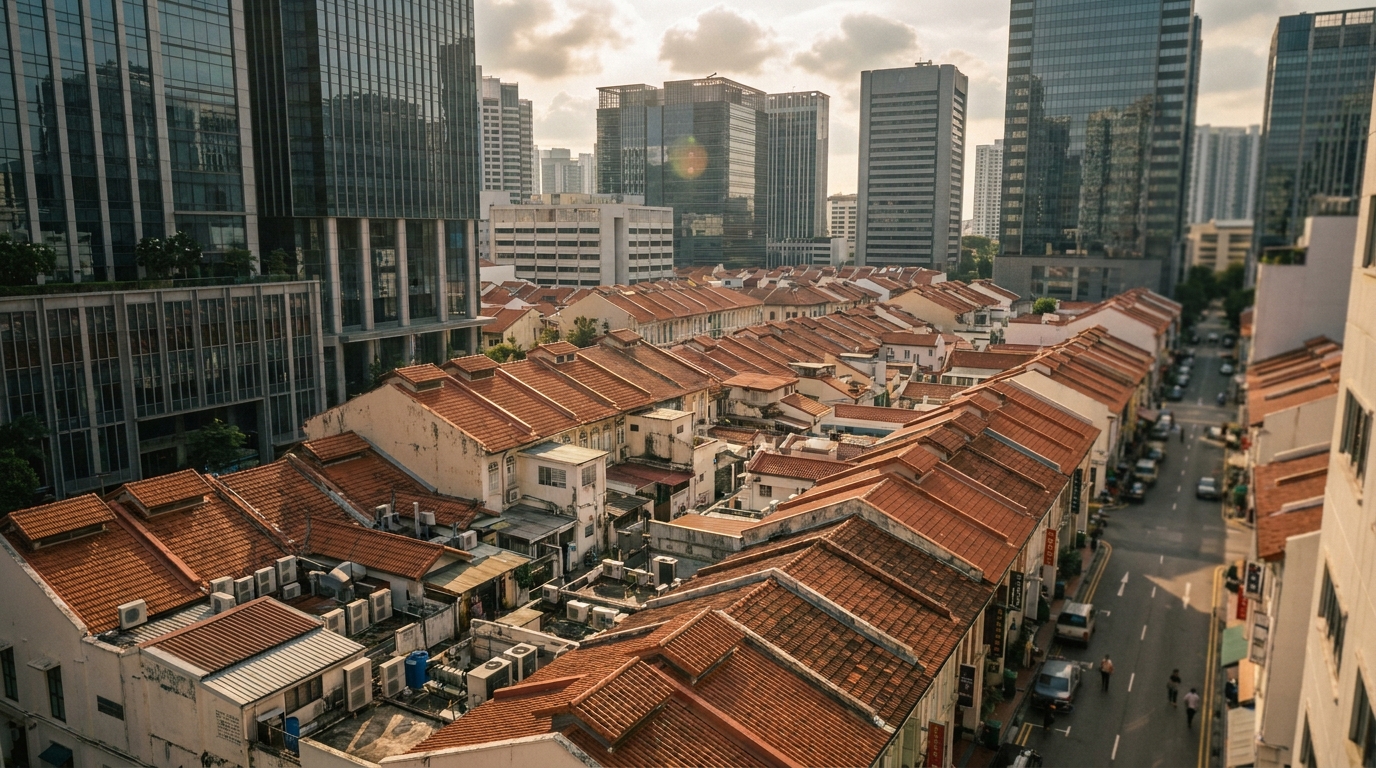
Talks are under way for a portfolio of about 50 conservation shophouses at an expected price of around S$500 million, according to The Business Times. The properties sit along Duxton Road, Duxton Hill, Tras Street, Craig Road and Neil Road — all inside the Tanjong Pagar Conservation Area, all in District 2.
The portfolio is understood to include a contiguous row of seven shophouses on Duxton Road next to the Duxton Reserve hotel. 8M Real Estate, a Singapore-based investor and manager with a heritage and commercial portfolio valued at over S$1.5 billion, is said to be in talks to buy. The seller side is largely Hillington International, a British Virgin Islands entity linked to Arcc Holdings and investor Tony Chen, alongside separate investor consortiums. EY-Parthenon is running the sale process.
Two details deserve more weight than the headline number. The stock is predominantly 99-year leasehold, with most sites carrying balance terms of about 61 to 62 years; the Tras Street assets run to roughly 67 years. And 8M is backed by institutional money — Hong Kong's Crane Capital and the US-based Washington State Investment Board.
The 60-point gap that built this market
Nothing explains the last three years of shophouse demand better than one arithmetic gap. A foreign buyer of a Singapore residential property pays 60% Additional Buyer's Stamp Duty. A buyer of a purely commercial-zoned conservation shophouse pays zero.
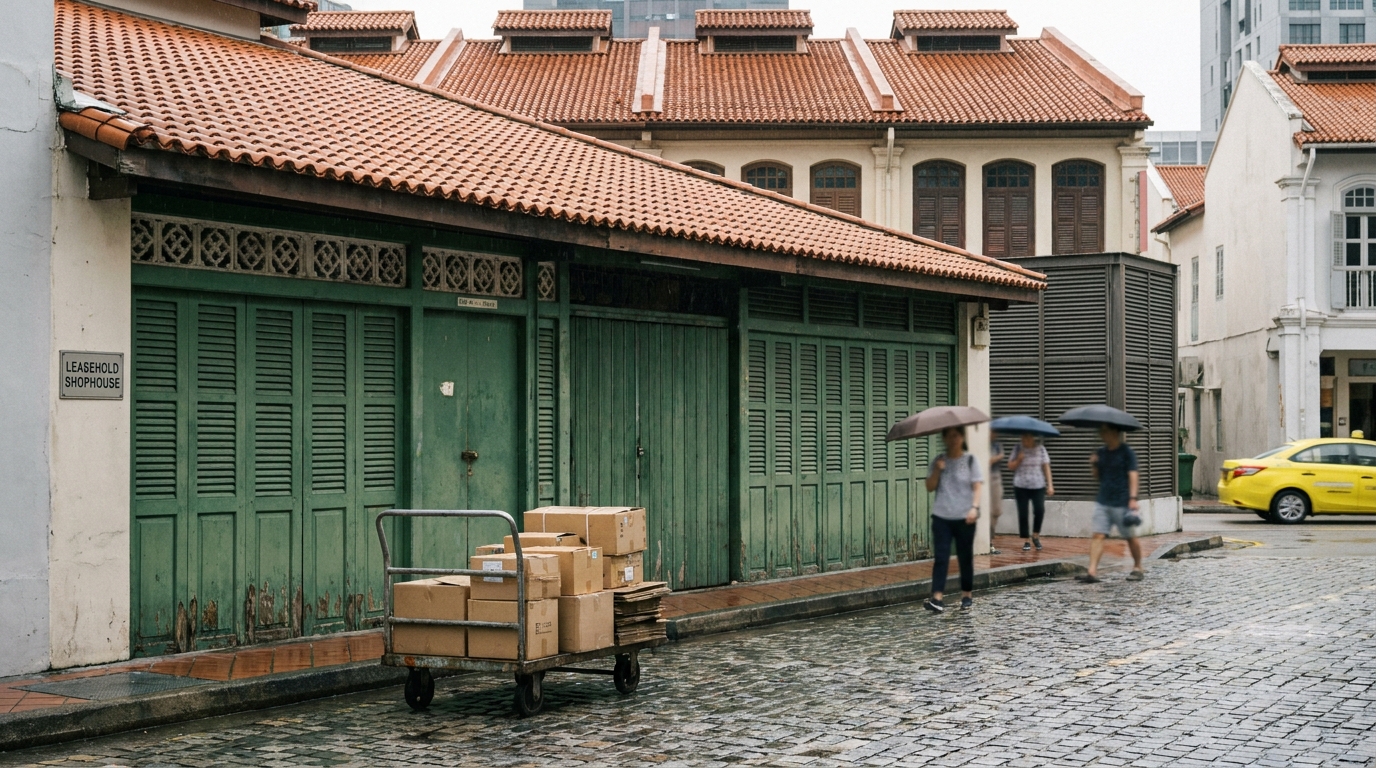
Commercial shophouses also sidestep the Residential Property Act approval process, so a foreign or corporate entity can transact without going through the Land Dealings (Approval) Unit. Add a fixed universe — the Urban Redevelopment Authority counts only about 6,500 gazetted conservation shophouses islandwide — and you have a scarce, taxed-lightly, foreign-accessible asset in a jurisdiction global capital already trusts.
That combination is why the asset class re-rated so hard. Prime CBD conservation shophouses have moved from roughly S$1,800–S$2,200 psf on gross floor area in 2015 to S$4,000–S$5,500 psf, and S$5,500–S$8,000 psf for restored prime stock. Net yields in the prime belt have compressed to about 2.0% to 2.5%.
Substitution, not spillover
Here is the argument the market keeps skipping. Big shophouse deals are routinely read as a barometer of private wealth that will wash into Good Class Bungalows and Core Central Region apartments. The more defensible reading is the opposite: the 60% ABSD actively diverted foreign capital away from luxury homes, and this portfolio is where some of it landed.
A S$500 million commercial cheque written by buyers who would pay 60% to write a residential one is not a leading indicator. It is a workaround.
The buyer profile reinforces the point. A 50-asset portfolio advised by a global strategy consultancy and pursued by an institutionally backed platform is a fund transaction. Its underwriting runs on commercial cap rates, F&B and boutique hospitality tenant income, and commercial debt terms. None of those inputs move a family's decision to buy a bungalow.
Meanwhile, the luxury residential strength recorded in 2026 — transactions at S$5 million and above hitting multi-year highs — has been driven by new citizens, Permanent Residents and Free Trade Agreement nationals who are not paying the 60% rate in the first place. Different buyers, different rulebook, different liquidity cycle.
If your thesis for buying a CCR apartment is "shophouse deals are hot, wealth is flowing in," you are borrowing a signal from a market that exists precisely because residential is taxed out of reach for those buyers.
There is a genuine overlap — local family principals who cash out of heritage assets do redeploy into GCBs and prime penthouses. But that is a seller-side effect, and this portfolio's sellers are offshore holding structures, not local families cashing out of a shop on Craig Road.
What S$500 million actually buys on Duxton Road
At the mooted quantum, the portfolio averages roughly S$10 million per shophouse. That sits comfortably inside recent District 2 evidence rather than above it.
- 70, 71 and 72 Duxton Road — three adjoining conservation shophouses transacted at an estimated S$45 million to S$50 million, to Zhang Ying, wife of Alibaba co-founder Jack Ma.
- 38 Tras Street — 3,434 sq ft GFA with about 68 years left, marketed at S$15.6 million (S$4,543 psf GFA), after changing hands at S$11.1 million (S$3,232 psf) in 2021.
- Keong Saik Road — a shophouse at S$22 million, or S$17,089 psf on land area, a benchmark for the Chinatown/Outram belt.
- Upper Cross Street — The Platinum, three adjoining four-storey shophouses totalling 14,330 sq ft GFA, guided at S$45 million (~S$3,140 psf GFA).
Now the comparison that should unsettle tenure purists. A row of seven freehold conservation shophouses on Joo Chiat Road was launched at S$100 million, about S$3,948 psf on maximum allowable GFA — below what restored 60-something-year leasehold stock commands in Tanjong Pagar. In this market, precinct beats tenure. Duxton, Tras and Neil Road have the footfall, the hotel-and-dining cluster and the institutional buyer pool; Joo Chiat has a longer title.
That is a rational pricing outcome, not a mispricing — but it is a fragile one. It holds only as long as the precinct premium holds.
The lease is the risk nobody prices until they refinance
Sixty-one years is a long time to a tenant and a short time to a lender. Balance leases of 61 to 62 years across most of this portfolio sit at the point where loan tenor, amortisation and terminal value assumptions start to bite — and each year of decay tightens the screw for the next buyer, not this one.
Stack that against yield. Gross rentals in the segment run roughly 2.5% to 3.5%, with net yields in the prime CBD belt at 2.0% to 2.5%. Even after the 2024–2026 easing cycle narrowed the gap between borrowing costs and income, the carry is thin. The return has to come from asset enhancement, tenant curation and capital appreciation — which is exactly why a portfolio of this scale suits an operator platform and punishes a passive landlord.
Then there is what URA controls. Facade and structural conservation requirements, change-of-use permissions and F&B approvals all cap the speed at which a buyer can reposition a row. Capex is not optional and redevelopment upside is largely off the table. Any lease top-up sits with the Singapore Land Authority and carries a differential premium — a cost, not a given.
What actually matters from here
For anyone tracking the shophouse market rather than admiring the headline, four things determine whether this deal marks a floor or a peak.
- Zoning line-by-line. Only full commercial zoning carries 0% ABSD. Mixed commercial-and-residential stock attracts pro-rated ABSD on the residential component — the single most expensive detail to get wrong.
- Caveat evidence in Districts 1 and 2. Watch psf on GFA against actual achieved rents. A widening gap between land-rate benchmarks and income is where the next repricing starts.
- Compliance drag. After Singapore's major money-laundering investigations, source-of-wealth and onboarding scrutiny on high-quantum deals has lengthened. Big portfolios now move at the speed of due diligence.
- Policy, not sentiment. If residential ABSD settings ever shift, the arbitrage that funnels foreign capital into commercial heritage narrows — and some of this demand walks back across the street.
Transaction volumes have already moderated from the 2021 peak of 253 shophouse deals, even as total values have been held up by fewer, larger, prime-district trades. That is textbook bifurcation: a market getting more institutional and less liquid at the same time.
So take the Tanjong Pagar portfolio for what it is. It is strong evidence that Singapore remains the safe-haven of choice for cross-border capital, and that 6,500 gazetted shophouses is a supply ceiling buyers are willing to pay for. It is weak evidence that anything is about to happen to the price of a Core Central Region apartment.
Two markets, one country, and a 60-point tax wall between them. Read each on its own numbers.